De Maupassant The Necklace: Technical Analysis of Paste vs Diamond
A gemological deep dive into de Maupassant The Necklace, analyzing 19th-century rivière designs, strass paste composition, and authentication.

Guy de Maupassant’s 1884 literary masterpiece, "The Necklace" ("La Parure"), hinges on a devastating twist of material science and social perception. Mathilde Loisel’s tragic descent into poverty is triggered by the loss of a borrowed diamond rivière necklace, only to discover a decade later that the original was a mere paste replica. For modern gemologists and jewelry historians, de Maupassant the necklace represents far more than a cautionary tale about vanity; it is a perfect case study in 19th-century French bijouterie de fantaisie, the chemistry of strass (lead glass), and the structural nuances of antique rivière settings. In this expert deep dive, we dissect the exact metallurgical and gemological realities of the piece that ruined the Loisels, exploring how 1880s jewelers engineered paste to deceive the naked eye, and how modern professionals authenticate these historical simulants today.
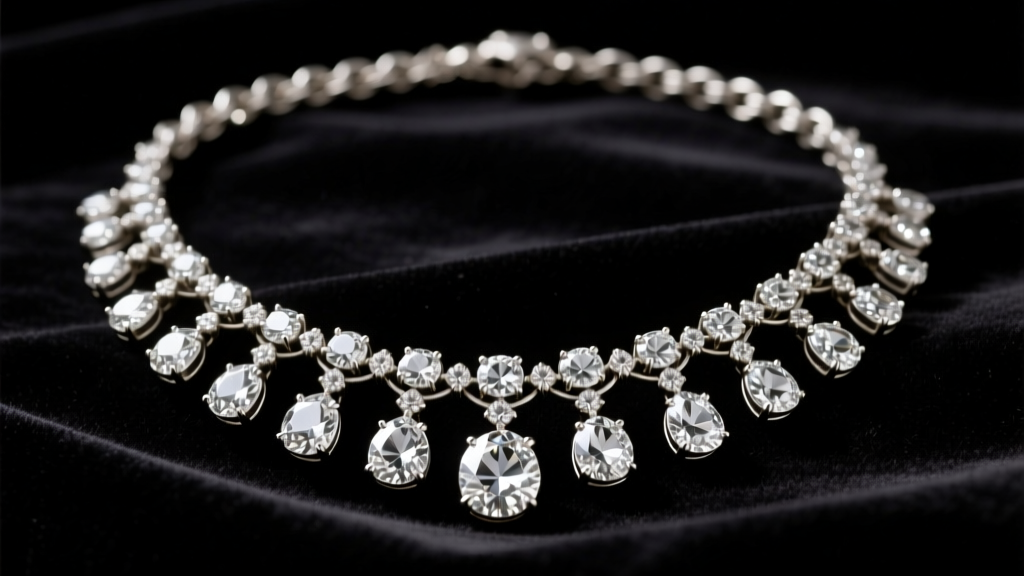
The Anatomy of a 19th-Century Rivière Necklace
To understand the deception at the heart of de Maupassant the necklace, one must first understand the architecture of a rivière. Translating literally to "river," a rivière necklace consists of a continuous, unbroken line of identically or gradually sized gemstones, typically mounted in individual collets without a distinct central pendant. The design is intended to mimic a flowing river of light around the neckline.
In the 1880s Parisian high society depicted by Encyclopædia Britannica, diamond rivières were the ultimate status symbol, usually featuring "old mine cut" or "rose cut" diamonds. These antique cuts possessed higher crowns, smaller tables, and steeper pavilion angles than the modern round brilliant cut developed by Marcel Tolkowsky in 1919. While old mine cuts possessed incredible fire, their irregular facet patterns and lower overall light return made them surprisingly susceptible to being mimicked by high-quality paste in the dim, flickering gaslight of 19th-century Parisian ballrooms.
Strass Paste vs. Natural Diamond: The Chemical Reality
The "diamonds" borrowed by Mathilde Loisel were almost certainly crafted from strass, a highly specialized lead glass invented by Georges Frédéric Strass in the 1730s. By the late 19th century, Parisian manufacturers had perfected the formula, creating a simulant that was dangerously convincing to the untrained eye. According to the Victoria and Albert Museum, true strass is not merely glass; it is a complex metallic oxide composite.
Refractive Index and Dispersion Metrics
The primary optical property that gives a diamond its brilliance is its Refractive Index (RI). Natural diamond boasts an exceptionally high RI of 2.417, meaning it bends light dramatically. Standard crown glass has an RI of roughly 1.52, which makes it look flat and lifeless compared to a diamond. However, 19th-century French strass incorporated up to 50% lead oxide (PbO) and trace amounts of bismuth and thallium. This heavy metal doping elevated the RI of the paste to approximately 1.70 to 1.85.
While still short of diamond's 2.417, this elevated RI, combined with the high dispersion (fire) caused by the lead content, allowed strass to mimic the colorful light flashes of old mine cut diamonds. Furthermore, because strass was a homogeneous, lab-created material, it lacked the natural inclusions of earth-mined diamonds, appearing "too perfect" to the naked eye—a flaw that ironically made it more convincing to laypeople who associated clarity with high value.
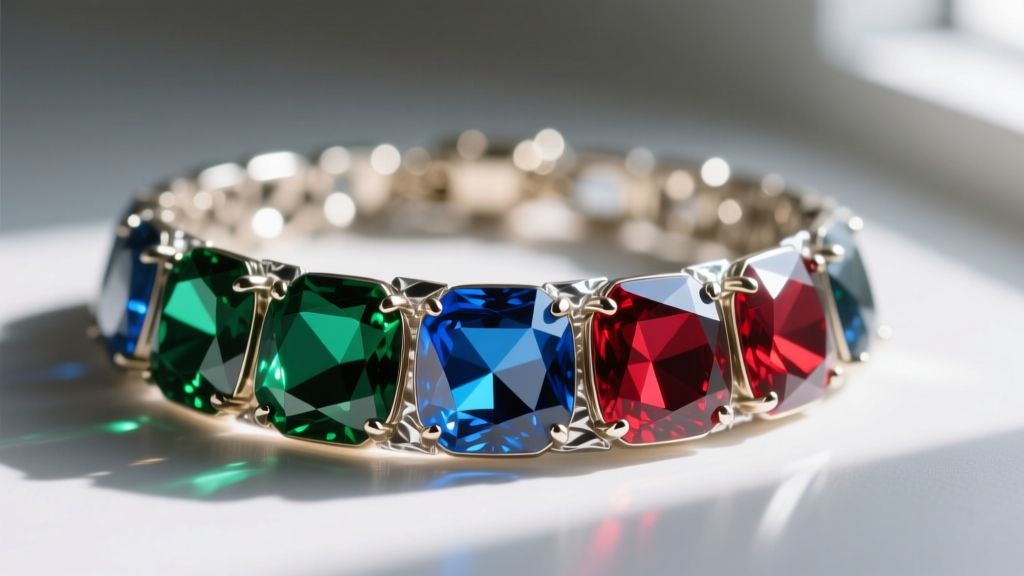
Metallurgical Forensics: Foil Backing and Collet Settings
The true genius—and the ultimate tell—of 19th-century paste jewelry lay not just in the glass, but in the metallurgy of the setting. Because strass could not perfectly replicate the deep light return of a diamond, jewelers employed a technique known as foil backing.
- Closed-Back Collets: Unlike diamonds, which were increasingly being set in open-back (à jour) settings to allow light to enter and exit the pavilion, paste stones were set in completely enclosed metal cups (collets).
- Metallic Foil: A thin sheet of silver, copper, or tinted metallic foil was placed behind the paste stone inside the closed collet. This foil acted as a mirror, bouncing ambient light back through the crown of the stone, artificially amplifying its brilliance.
- Galvanic Corrosion: Over decades, the moisture and salts from the wearer's skin would often penetrate the collet, causing the metallic foil to oxidize, tarnish, or turn black, effectively "killing" the stone's brilliance—a common failure mode in antique paste jewelry today.
Material Comparison: Diamond vs. 1880s Paste Rivière
| Property | Natural Diamond (Old Mine Cut) | 19th-Century Strass Paste |
|---|---|---|
| Chemical Composition | Pure Carbon (C) | Lead Glass (SiO2 + up to 50% PbO) |
| Refractive Index (RI) | 2.417 | 1.70 - 1.85 |
| Mohs Hardness | 10 | 5.5 - 6.0 |
| Specific Gravity (SG) | 3.52 | 3.80 - 4.50 |
| Setting Style | Open-back (à jour), silver-topped gold | Closed-back collet with metallic foil |
| Wear Patterns | Sharp facet junctions, pristine edges | Abraded, rounded facet edges, surface scratches |
Modern Gemological Authentication: Spotting the Fake
If Mathilde Loisel had brought the borrowed necklace to a modern gemological laboratory, the deception would have been unmasked in under three minutes. Today's Gemological Institute of America (GIA) protocols rely on advanced physical and optical testing that bypasses the visual trickery of foil and lead glass.
Thermal and Electrical Conductivity
The most immediate test is thermal conductivity. Diamond is the ultimate thermal conductor, dispersing heat rapidly. Paste, regardless of its lead content, is a thermal insulator. A standard electronic diamond tester applies a heated thermistor to the stone's table; if the heat does not dissipate instantly, the stone is flagged as a simulant. Furthermore, modern testers measure electrical conductivity to differentiate diamond from moissanite (a later 20th-century simulant), though moissanite was not an issue in 1884.

Magnification and Inclusion Analysis
Under a 10x triplet loupe or a gemological microscope, the internal landscape of the stones tells the definitive story. Natural diamonds contain crystalline inclusions (such as garnet, diopside, or olivine), feather fractures, and growth lines. Strass paste, being a melted and cooled liquid, often traps spherical gas bubbles and exhibits curved striae (swirl marks) from the manufacturing process. Additionally, because paste is much softer (Mohs 5.5-6.0), the facet junctions on an antique strass necklace will appear abraded, chipped, or rounded from decades of friction against the metal collets, whereas diamond facet edges remain razor-sharp.
The Economics of the 36,000-Franc Replacement
The tragedy of de Maupassant the necklace is ultimately one of economics. To replace the lost paste rivière, the Loisels purchased a genuine diamond rivière for 36,000 French francs. In 1884, this was an astronomical sum, equivalent to the annual salary of a high-ranking government minister.
"He possessed eighteen thousand francs, which he had inherited from his father. He borrowed the rest... ruining himself financially for a piece of carbon he could not afford."
Adjusted for inflation and the relative purchasing power of the late 19th-century French economy, 36,000 francs equates to roughly $150,000 to $220,000 in today's currency. In the 2026 auction market, a genuine 15-carat total weight antique diamond rivière in silver-topped gold—matching the description of the replacement piece—would command between $120,000 and $250,000 at houses like Sotheby's or Christie's, depending on the clarity (typically VS1-SI1 for antique stones) and color (usually J-K, as warmer stones were common and often masked by the yellow-gold backs of silver-topped settings).
Conclusion: The Enduring Legacy of the Rivière
De Maupassant’s narrative remains a masterclass in the psychology of adornment. From a technical standpoint, the story perfectly captures the zenith of 19th-century paste manufacturing, a period where the line between genuine carbon and engineered lead glass was blurred by foil, gaslight, and societal desperation. For modern collectors and jewelers, analyzing de Maupassant the necklace serves as a vital reminder: true value in jewelry is not merely perceived through the eye, but proven through the rigorous, unforgiving metrics of material science.


