Technical Guide to Buying a Diamond Riviere Necklace
Discover the technical details of a diamond riviere necklace. Learn about carat distribution, setting types, clasp mechanics, and pricing.


The Anatomy of a Rivière: Beyond the 'River of Diamonds'
The term rivière translates from French as 'river,' a poetic nod to the continuous, unbroken flow of gemstones encircling the neck. Originating in the mid-18th century, the diamond riviere necklace was initially designed with uniform stones of the exact same carat weight. However, modern lapidary and jewelry engineering have evolved. Today, the vast majority of high-end rivière necklaces are graduated, featuring a larger center stone that tapers symmetrically toward the nape of the neck. This structural shift was not merely aesthetic; it was a necessary adaptation to human anatomy, allowing the necklace to drape flush against the clavicle without buckling or standing away from the skin.
For collectors and buyers in 2026, understanding the technical construction of a diamond riviere necklace is paramount. Unlike a pendant necklace where the focal point bears the brunt of the design, a rivière requires absolute consistency in diamond color, clarity, and cut precision across dozens of individual stones. A single mismatched stone in the frontal arc can disrupt the continuous light return, creating a visible 'dead spot' in the necklace's scintillation.
Carat Weight Distribution & Graduation Metrics
When evaluating a graduated diamond riviere necklace, the carat weight distribution dictates both the visual impact and the structural drape. A poorly graduated necklace will feel heavy at the back and visually underwhelming at the front. Master jewelers utilize specific millimeter-to-carat ratios to ensure a seamless transition. According to historical archives and modern grading standards documented by Lang Antiques, the tapering must follow a strict logarithmic curve to maintain the illusion of uniformity from a conversational distance.
| Position on Necklace | Stone Diameter (mm) | Approx. Carat Weight | Stone Count |
|---|---|---|---|
| Center Stone | 6.5mm | 1.00 ct | 1 |
| Adjacent (Left/Right) | 5.8mm | 0.75 ct | 2 |
| Mid-Front Arc | 5.0mm | 0.50 ct | 4 |
| Side Profile | 4.0mm | 0.25 ct | 8 |
| Nape (Back) | 3.0mm | 0.10 ct | 14 |
Note: The above table represents a standard blueprint for a 10.00 Total Carat Weight (CTW) graduated rivière comprising 29 stones. Custom commissions often alter the nape stone count to accommodate specific neck circumferences, typically ranging from 15 to 17 inches.
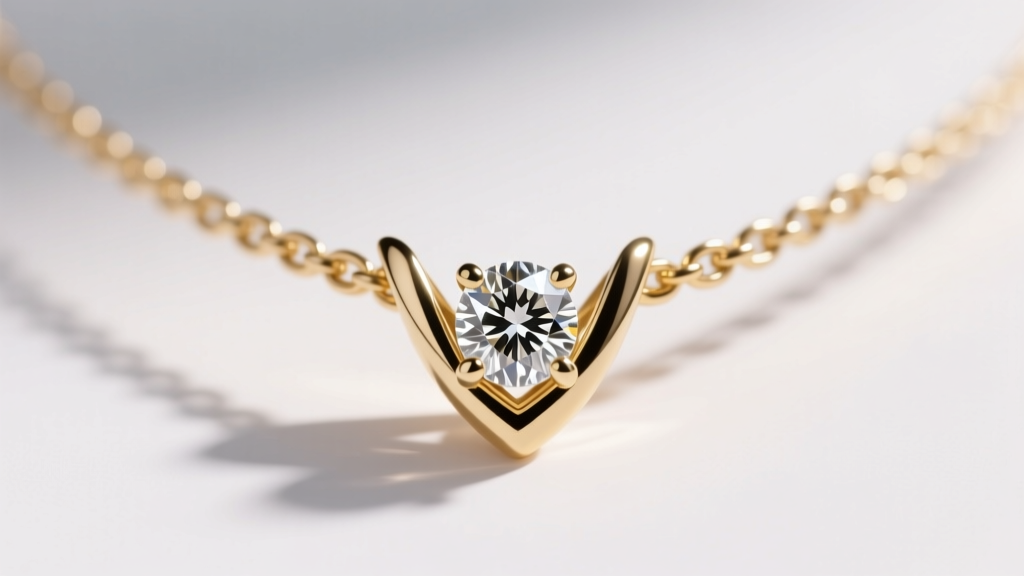
Setting Mechanics: Prong vs. Bezel vs. U-Prong
The setting style in a diamond riviere necklace directly influences the metal-to-diamond ratio, which in turn dictates the overall brilliance and security of the piece. Because the stones are linked in a continuous chain, the setting must allow for articulation (flexibility) while protecting the girdle of each diamond.
U-Prong and Standard 4-Prong Settings
The U-prong setting is the industry standard for modern rivière necklaces. By carving out a U-shaped channel beneath the diamond's pavilion, jewelers minimize the metal visible from the profile and allow maximum light entry from the sides. According to the Gemological Institute of America (GIA), minimizing metal obstruction is critical for round brilliant cuts to achieve optimal scintillation. Standard 4-prong settings offer slightly more security for the girdle but can create a 'chunkier' metal appearance, which may interrupt the 'river' effect if the stones are under 0.25ct each.
Bezel and Half-Bezel Settings
Bezel settings encircle the diamond's girdle in a continuous metal rim. While this offers superior protection against chipping—ideal for active wearers—it comes with a technical trade-off. A full bezel reduces the visible spread (diameter) of a diamond by approximately 0.15mm to 0.20mm per stone. In a 30-stone necklace, this equates to a significant loss in perceived carat weight. Half-bezel settings offer a compromise, using two opposing metal walls to secure the stone while leaving the north and south pavilions open for light return.
"The articulation of a riviere necklace is just as critical as the diamonds themselves. If the links between the settings are too rigid, the necklace will torque and flip, constantly showing the back of the settings rather than the diamond faces." — Master Bench Jeweler
Clasp Engineering and Security Protocols
A diamond riviere necklace represents a substantial financial investment, making clasp engineering a non-negotiable aspect of the purchase. The standard lobster clasp is entirely insufficient for a piece weighing over 15 grams. High-grade rivière necklaces utilize a precision-machined box clasp with integrated safety mechanisms.
- The Tongue and Groove Mechanism: The 'tongue' of the clasp is a folded piece of springy metal (usually platinum or 18k gold) that compresses upon insertion and snaps into a groove inside the 'box.' The tongue must possess a precise tension bend; if it is too loose, it will rattle and eventually slip out.
- Figure-Eight Safety Catches: A premium rivière will feature dual figure-eight safety wires hinged on one side of the clasp that snap over a button on the opposite side. This provides a secondary mechanical lock in the event the primary tongue is depressed accidentally.
- Hidden Hinges: To maintain the seamless flow of diamonds, the clasp is often designed to mimic the exact width and setting style of the adjacent links, utilizing a hidden pin hinge to allow the clasp to bend around the neck without kinking.

Metal Alloys: Platinum vs. 18k Gold for Structural Integrity
The choice of metal in a diamond riviere necklace affects durability, maintenance, and weight. Platinum 950 (95% platinum, 5% ruthenium or iridium) is the premier choice for heirloom-grade pieces. Platinum's tensile strength means that prongs will not easily wear away or snap under tension. When platinum scratches, the metal is merely displaced, not lost, allowing it to be polished repeatedly without compromising the structural integrity of the settings.
Conversely, 18k white gold (75% gold alloyed with palladium, nickel, or silver) is a popular, more affordable alternative. However, white gold requires rhodium plating to achieve a bright white finish. Over time, the friction of the necklace against the skin and clothing will wear away the rhodium, revealing the slightly yellowish undertone of the white gold alloy. For a necklace that requires professional cleaning and inspection every 12 to 18 months, this maintenance cycle is manageable, but it is a technical reality buyers must factor into their total cost of ownership.
Pricing Framework and Market Valuations
As of 2026, the market for diamond riviere necklaces is distinctly bifurcated between natural earth-mined diamonds and high-pressure high-temperature (HPHT) or chemical vapor deposition (CVD) lab-grown diamonds. The pricing framework is heavily dictated by the Total Carat Weight (CTW), the color/clarity consistency, and the precision of the cut.
Natural Diamond Pricing Tiers (G-H Color / VS1-VS2 Clarity)
- 5.00 CTW (Subtle/Everyday): $18,000 – $28,000
- 10.00 CTW (Statement/Classic): $45,000 – $75,000
- 20.00+ CTW (Red Carpet/Investment): $120,000 – $250,000+
Lab-Grown Diamond Pricing Tiers (E-F Color / VVS1-VS1 Clarity)
- 5.00 CTW: $3,500 – $5,500
- 10.00 CTW: $7,000 – $12,000
- 20.00+ CTW: $15,000 – $28,000
When purchasing, always demand a master grading report or a matching set of GIA/IGI dossiers for the primary center stones. In a true rivière, the smaller nape stones are rarely individually certified due to cost and time, but the frontal arc stones (typically 0.30ct and above) should be laser-inscribed and mapped to ensure you are receiving the exact color and clarity grades promised.
Conclusion: Investing in Heirloom-Grade Construction
A diamond riviere necklace is the pinnacle of classic jewelry design, but its longevity relies entirely on the technical execution of its construction. By scrutinizing the graduation metrics, demanding U-prong or precision bezel settings, and insisting on a box clasp with dual safety catches, you ensure that the piece will not only dazzle under the light but will endure as a structurally sound heirloom for generations. Do not compromise on the metallurgy or the clasp engineering; the diamonds may draw the eye, but it is the metalwork that holds the legacy together.


