Disney Stitch Necklace Guide: Metals, Enamels & Fit (2026)
Explore the technical craftsmanship of Disney Stitch necklaces. We analyze metal grades, enamel types, chain gauges, and authentic hallmarks.

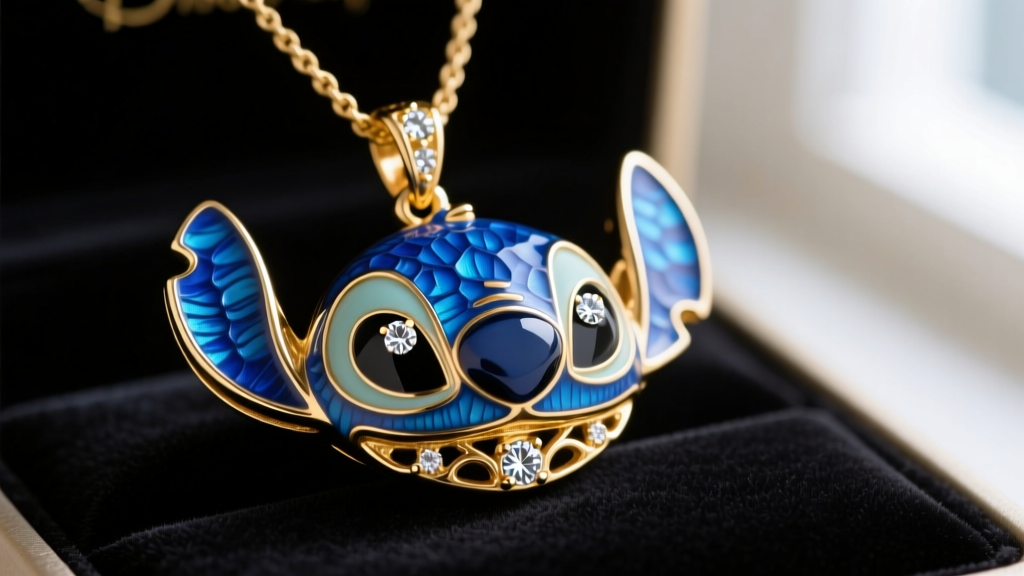
When collectors and jewelry enthusiasts seek out a Disney Stitch necklace, the market is flooded with options ranging from $15 theme park souvenirs to $2,500 fine jewelry masterpieces. However, evaluating character jewelry requires looking past the nostalgic silhouette and examining the metallurgical integrity, enamel application techniques, and structural mechanics of the piece. In this 2026 expert guide, we deconstruct the technical specifications that separate premium Disney Stitch pendants from mass-produced costume jewelry, providing you with a definitive framework for authentication and quality assessment.
The Metallurgy of Official Disney Stitch Jewelry
The base metal of a Stitch pendant dictates its longevity, weight, and skin biocompatibility. While budget options utilize zinc alloys or brass with thin electroplating, premium licensed Disney jewelry relies on precious metals. Understanding the exact alloy composition is critical for predicting how the necklace will react to environmental stressors over time.
Sterling Silver vs. Gold Vermeil
Authentic sterling silver (925) consists of 92.5% pure silver and 7.5% copper. This copper addition raises the Vickers hardness from 25 (pure silver) to roughly 65-70, providing enough structural rigidity to support heavy Stitch pendants without bending. However, the copper content makes it susceptible to silver sulfide tarnishing.
Gold vermeil is frequently used for high-end Disney Stitch necklaces. According to the Federal Trade Commission Jewelry Guides, true vermeil must consist of a sterling silver base coated with at least 10k gold that is a minimum of 2.5 microns thick. Many counterfeit or low-tier manufacturers use 'gold plated' brass, which features a mere 0.5-micron gold layer over a nickel-heavy base, leading to rapid wear-through and contact dermatitis.
| Metal Grade | Vickers Hardness | Tarnish Resistance | Avg. Price Range (2026) |
|---|---|---|---|
| 925 Sterling Silver | 65 - 75 HV | Low (Requires Polishing) | $120 - $350 |
| 14k Solid Gold | 120 - 140 HV | High | $800 - $2,200 |
| Gold Vermeil (2.5μm) | 65 - 75 HV (Base) | Moderate | $250 - $600 |
| Zinc Alloy (Costume) | 90 - 110 HV | Very Low (Corrodes) | $15 - $45 |
Enamel Techniques: Rendering Stitch’s Signature Blue
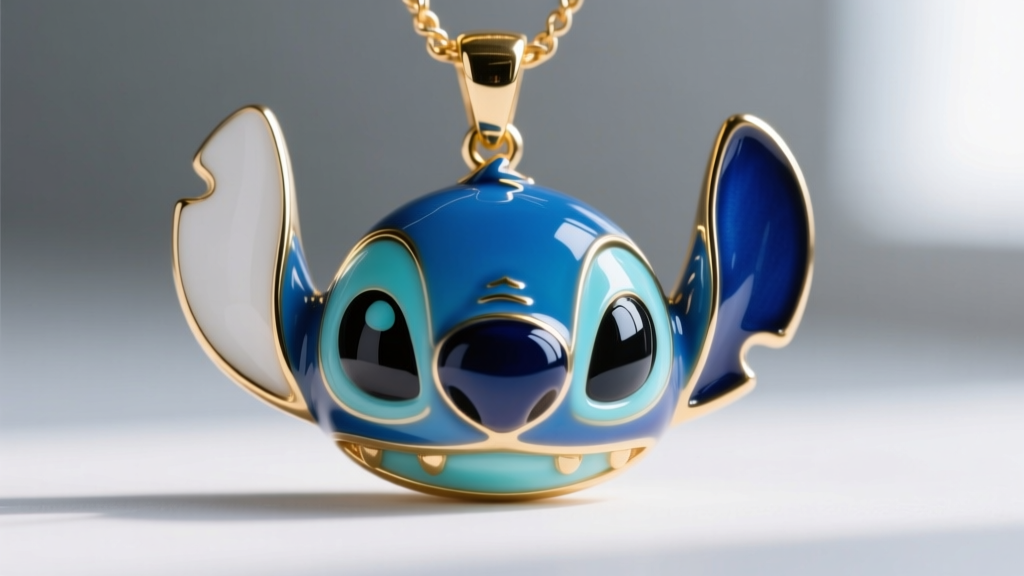
The most technically demanding aspect of a Disney Stitch necklace is replicating his vibrant blue fur and detailed features. Jewelers utilize two primary methods for applying color: vitreous enamel and cold enamel (epoxy resin). The choice of medium drastically impacts the pendant's refractive index, durability, and value.
Vitreous Enamel (Champlevé and Cloisonné)
High-end Disney fine jewelry collections utilize vitreous enamel, which is essentially finely ground glass fused to metal. According to Rio Grande Enameling Resources, this process requires firing the piece in a kiln at temperatures between 1,400°F and 1,500°F (760°C - 815°C). The champlevé technique involves carving troughs into the solid silver or gold Stitch silhouette and packing them with enamel powder before firing. The resulting surface boasts a Mohs hardness of 5 to 6, making it highly scratch-resistant with a permanent, glass-like luster that will never yellow or fade under UV exposure.
Cold Enamel (Epoxy Resin)
Mid-tier and theme-park exclusive Stitch necklaces typically use cold enamel. This is a two-part epoxy resin poured into recessed metal cavities and cured at room temperature or in low-heat ovens (around 150°F). While it allows for a broader spectrum of Pantone color matching and gradient effects, cold enamel has a Mohs hardness of only 2 to 3. It is highly susceptible to micro-scratching, chemical degradation from perfumes, and UV-induced yellowing over a 3-to-5-year lifespan.
Chain Mechanics and Clasp Engineering
A 12-gram solid silver Stitch pendant requires a chain with adequate tensile strength and a secure closure mechanism. The failure point of 80% of lost pendants is the chain or the clasp, not the bail.
Gauge Thickness and Link Architecture
For pendants weighing between 8 and 15 grams, a 1.2mm to 1.5mm cable or rolo chain is optimal. Rolo chains, characterized by uniform interlocking round or oval links, offer superior multi-directional flexibility and resist kinking better than box chains. The links should be drawn and soldered, rather than simply stamped and bent, to prevent them from pulling apart under sudden tension.
Clasp Mechanics: Lobster vs. Spring Ring
Premium Disney Stitch necklaces are fitted with cast lobster clasps. Unlike stamped sheet-metal spring rings, a forged lobster clasp features a robust internal spring and a thicker lever arm that resists accidental depression. Crucially, the jump ring connecting the clasp to the chain must be soldered shut. An unsoldered jump ring will inevitably gap open over time due to the rotational friction of the pendant sliding along the chain.
Identifying Authentic Hallmarks and Licensing
Authentication goes beyond the packaging. Genuine licensed Disney jewelry features specific micro-stamping that counterfeiters often overlook or execute poorly.
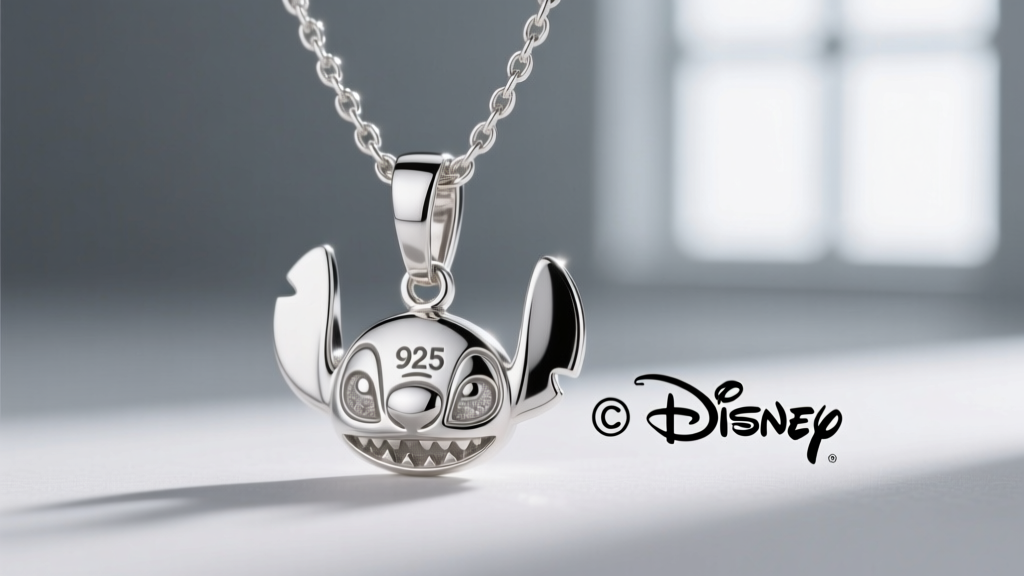
- Metal Purity Mark: Look for '925', '14k', or '18k' stamped in a recessed area on the bail or the back of the pendant. The stamp should be crisp, with uniform depth, indicating a steel punch was used on the raw metal before polishing.
- Disney Copyright Stamp: Authentic pieces will feature the '© Disney' stamp. On smaller Stitch pendants, this may be laser-engraved rather than stamped to preserve the structural integrity of thin silver areas.
- Maker’s Mark: High-end collaborations (such as those with Alex and Ani or Pandora) will include the manufacturer's specific hallmark alongside the Disney copyright.
Troubleshooting and Maintenance Protocols
Proper maintenance of a Disney Stitch necklace requires understanding the specific failure modes associated with character jewelry.
Enamel Creep and Tarnish
In cold enamel pieces, silver sulfide tarnish often creeps underneath the porous resin edges, creating a black halo around Stitch’s silhouette. Do not use ultrasonic cleaners on cold enamel, as the high-frequency cavitation will shatter the resin bond. Instead, use a specialized silver polishing cloth, carefully working the edge of the cloth around the enamel boundary with a wooden toothpick to avoid scratching the resin.
Bail Friction Wear
The bail (the loop connecting the pendant to the chain) acts as a fulcrum. Over years of wear, a 1.5mm gold chain can act like a saw, cutting through a soft sterling silver bail. To prevent this catastrophic failure, inspect the interior of the bail annually. If the metal has thinned by more than 20%, take the necklace to a bench jeweler to have a hardened platinum or 14k gold bail sleeve soldered into place, ensuring your Disney Stitch necklace survives for generations.


