Engineering the Perfect Perler Bead Necklace: A Technical Guide
Master the material science and structural engineering of a durable perler bead necklace. Learn fusing thermodynamics, stringing tension, and resin finishes.


While often dismissed as a nostalgic children's craft, the modern perler bead necklace has evolved into a legitimate medium for pixel-art haute couture and intricate geometric jewelry design. However, transitioning fuse beads from a hobbyist craft to a durable, wearable garment requires a rigorous understanding of polymer science, thermodynamics, and structural engineering. Standard crafting techniques inevitably lead to fractured pendants, snapped stringing materials, and degraded plastics. This expert deep dive explores the technical specifications required to engineer a high-end, structurally sound perler bead necklace that withstands the rigors of daily wear.
The Polymer Science of Polyethylene Fuse Beads
To manipulate fuse beads effectively, one must first understand their chemical composition. Authentic Perler beads are manufactured from Low-Density Polyethylene (LDPE). According to Encyclopedia Britannica's polymer database, LDPE is characterized by its high ductility, low tensile strength, and a relatively low melting point ranging between 105°C and 115°C (221°F - 239°F).
Understanding this thermal threshold is critical. Unlike glass or metal, LDPE does not have a sharp melting point; it transitions through a viscous state. When designing a perler bead necklace, you must also account for UV degradation. Untreated LDPE is highly susceptible to photo-oxidation, which causes the polymer chains to break down, resulting in brittleness and yellowing over time. This necessitates the use of UV-inhibiting finishes, which we will cover in the advanced finishing section.
Brand Variations and Material Blends
Not all fuse beads are created equal. While standard Perler beads use pure LDPE, competitors like Artkal (specifically their 'Hard' line) often utilize Ethylene-Vinyl Acetate (EVA) blends or higher-density polyethylene. EVA blends offer a higher melting point and a significantly harder final cure, making them superior for large, load-bearing pendant structures where standard LDPE might warp under its own weight.
Thermodynamics of Fusing: Achieving Structural Integrity
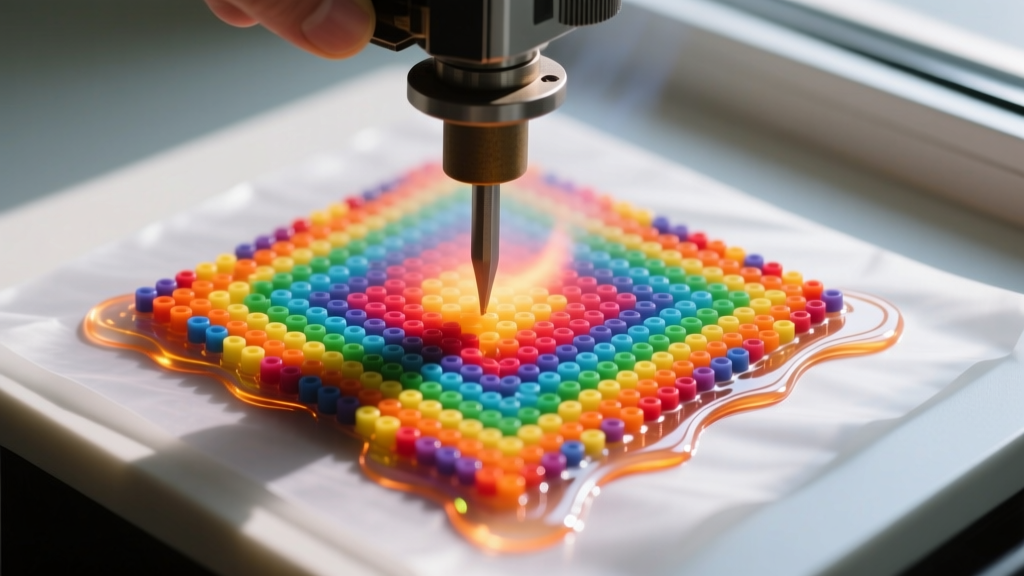
The most common point of failure in a perler bead necklace is improper fusing. Fusing is not a binary state; it exists on a thermodynamic spectrum. Mastering the 'Flat Fuse' is mandatory for jewelry applications.
The Three Stages of Thermal Fusion
- Tack Fuse (Surface Adhesion): Achieved at minimal heat exposure. The top edges of the cylinders melt just enough to stick together. The internal structure remains hollow. Verdict: Unacceptable for jewelry. High risk of delamination.
- Flat Fuse (Complete Matrix Integration): The heat penetrates the entire Z-axis of the bead. The plastic flows laterally, completely closing the top and bottom apertures and creating a solid, continuous polymer matrix. Verdict: Mandatory for structural jewelry.
- Over-Melt (Loss of Geometry): The plastic becomes overly viscous, pooling outward and destroying the precise pixel grid. Verdict: Ruins design tolerances.
The Teflon Advantage
Amateur crafters use parchment paper, which absorbs ambient moisture and creates a matte, textured finish. For a professional perler bead necklace, you must use a PTFE (Teflon) fiberglass sheet. PTFE provides perfectly even thermal conductivity and leaves a glass-smooth, glossy finish on the fused surface, eliminating the need for excessive post-processing sanding.
Stringing Mechanics: Tensile Strength and Hardware
The internal extrusion process of manufacturing LDPE beads leaves microscopic, razor-sharp plastic burrs inside the bead holes. When a necklace flexes during wear, these burrs act like tiny saws. Traditional stringing materials like silk thread, cotton, or even standard nylon will be severed in a matter of days.
To engineer a lasting perler bead necklace, you must utilize advanced metallurgical stringing materials. The industry standard for high-stress bead stringing is 49-strand micro stainless steel wire with a nylon coating. As detailed by the jewelry supply authority Rio Grande, a 49-strand construction provides maximum flexibility and drape, mimicking the behavior of thread while offering the sheer tensile strength of steel.
Stringing Material Comparison Matrix
| Material | Diameter | Tensile Strength | Abrasion Resistance | Best Application |
|---|---|---|---|---|
| Silk Thread | 0.6mm | Low (12 lbs) | Poor | Pearls (Never use for fuse beads) |
| UHMWPE (Dyneema) | 0.4mm | High (65 lbs) | Excellent | Lightweight, flexible perler chokers |
| 49-Strand SS Wire | 0.018' (0.46mm) | Very High (30+ lbs) | Superior | Heavy pendants, structural collars |
Hardware Integration and Edge Protection
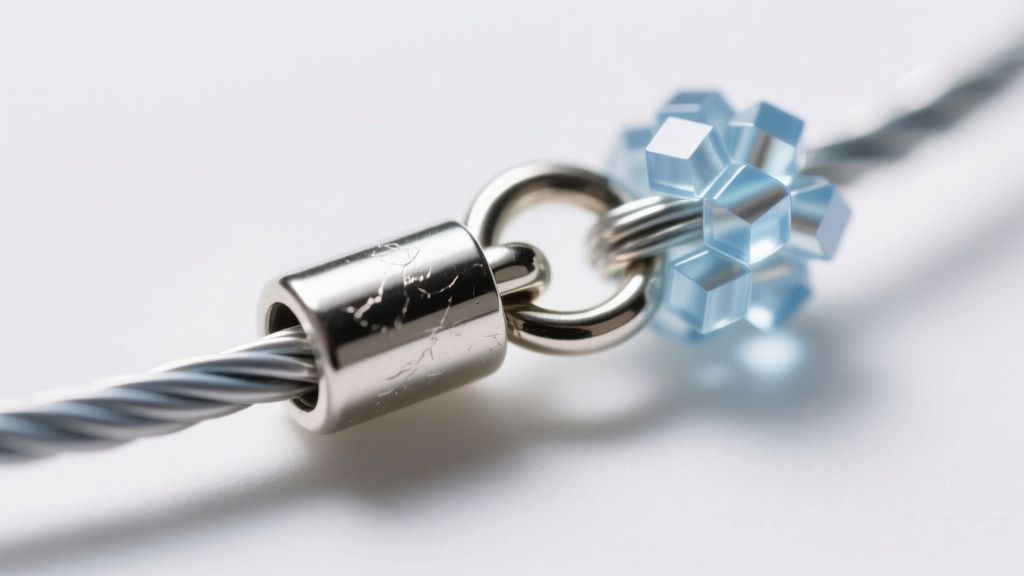
When terminating your 49-strand stainless steel wire, standard crimp beads are insufficient. The rigid steel wire will easily crush soft aluminum crimps over time, leading to catastrophic failure. You must use 2x2mm Sterling Silver or Copper crimp tubes. Silver and copper possess the exact malleability required to fold securely over the steel wire without cutting it when compressed with micro-crimping pliers.
Implementing French Wire (Gimp)
The transition point where the wire loops through the clasp is a critical vulnerability. The friction of the metal clasp rubbing against the nylon coating of the stringing wire will eventually wear through to the steel core, causing it to snap. To prevent this, thread a 2-inch section of French wire (bullion/gimp) onto the wire before forming the clasp loop. This fine, coiled metal tubing acts as a sacrificial abrasion shield, ensuring the longevity of your perler bead necklace hardware.
Advanced Finishing: Resin Encapsulation
To combat the aforementioned UV degradation and to elevate the visual depth of the piece, professional jewelers encapsulate the finished pendant in resin.
The UV Resin Doming Technique
Using a high-viscosity, non-yellowing UV jewelry resin, apply a thin layer over the front face of the fused perler matrix. The surface tension of the resin will naturally pull it to the edges of the pendant, creating a 'domed' effect. Cure the resin under a 36W UV lamp for exactly 120 seconds. This creates a hardened, glass-like acrylic shield that not only protects the LDPE from photo-oxidation but also refracts light, giving the pixel art a vibrant, three-dimensional depth that raw plastic cannot achieve.
Design Geometry and Load Distribution
When designing large-scale perler bead necklace pendants (exceeding 3x3 inches), structural sagging becomes a primary concern. A flat sheet of fused LDPE lacks a high moment of inertia, meaning it will bend easily under its own weight.
To counteract this, expert designers incorporate structural ribbing into the pixel pattern. By intentionally leaving specific vertical columns of beads unfused (or using a thicker, multi-layered fusing technique), you create hidden I-beam-like supports within the pendant's geometry. Additionally, utilizing a multi-point suspension system—where the pendant is hung from three distinct points on the collar rather than a single top loop—distributes the gravitational load evenly, ensuring the necklace lays perfectly flat against the sternum without warping.
Conclusion
Creating a master-level perler bead necklace requires abandoning the casual approach of childhood crafts and embracing the严谨 (rigor) of material science. By selecting the correct polymer blends, mastering the thermodynamics of the flat fuse, utilizing 49-strand metallurgical stringing, and applying UV-inhibiting resin encapsulation, you transform simple plastic cylinders into a durable, high-fashion garment built to last a lifetime.


