Anatomy of a Thick Gold Necklace Chain: Karats, Links, and Clasps
Discover the metallurgy, link structures, and clasp mechanics behind a thick gold necklace chain. Expert guide to karats, weight, and durability.

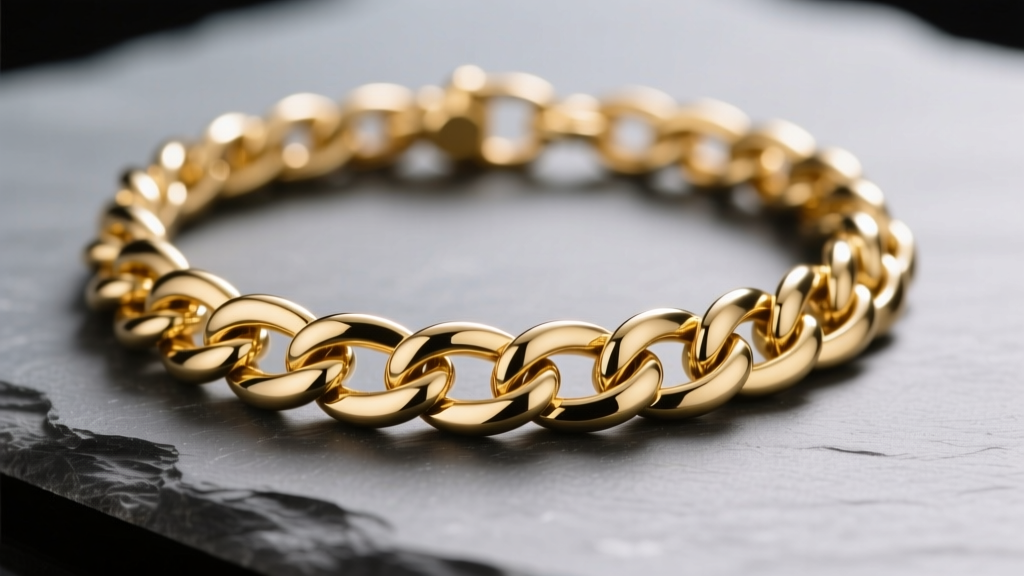
When evaluating fine jewelry, few pieces demand as much structural engineering as a heavy, solid gold chain. A thick gold necklace chain is not merely a bold aesthetic choice; it is a complex assembly of micro-mechanics, metallurgical balancing, and tensile physics. Whether you are investing in a 10mm Cuban link or an 8mm braided rope, understanding the technical specifications that dictate its longevity, drape, and failure points is essential for any serious collector or jeweler.
The Metallurgy of Mass: Karats and Vickers Hardness
The fundamental challenge of manufacturing a thick gold necklace chain lies in the inherent softness of pure gold. Pure 24K gold possesses a Vickers Hardness (HV) of roughly 25, making it entirely unsuitable for heavy link chains. Under the sheer gravitational load of a 100-gram chain, 24K links would suffer from 'creep deformation'—a slow, permanent stretching caused by continuous stress.
To achieve the necessary tensile strength, gold is alloyed with metals like copper, silver, and zinc. According to the Gemological Institute of America (GIA), the specific ratio of these alloying metals dramatically alters the chain's structural integrity:
- 10K Gold (41.7% Pure): With an HV of roughly 120-130, 10K gold offers the highest tensile strength. It is highly resistant to link distortion but sacrifices the deep, warm hue associated with high-karat gold.
- 14K Gold (58.3% Pure): The industry standard for heavy chains. With an HV of 110-120, it provides an optimal balance of structural rigidity and rich color. The copper content provides excellent work-hardening properties during the wire-drawing phase.
- 18K Gold (75.0% Pure): Softer (HV 90-100) and significantly denser. An 18K thick gold necklace chain will weigh approximately 25% more than its 14K counterpart of the exact same dimensions, increasing the dynamic load on the clasps and lower links.
- 22K Gold (91.6% Pure): Rarely used for thick, heavy chains. If manufactured, the links must be excessively bulky to prevent pulling apart at the solder joints.
Link Architecture: Soldered vs. Unsoldered Geometries
The geometry of the link dictates how the chain distributes weight and interacts with the wearer's clavicle. Flat-profile chains, such as the Cuban or Curb, offer a high surface-area contact with the skin, resulting in a fluid, fabric-like drape. Cylindrical chains, like the Rope or Wheat, distribute tension radially, making them exceptionally resistant to lateral snapping.

The Critical Role of Laser Soldering
In a thick gold necklace chain exceeding 8mm in width, the structural weak point is the seam where the link closes. Unsoldered chains (often seen in lightweight Figaro or cable styles) rely on the mechanical tension of the bent wire. However, in heavy chains, this tension is insufficient. Modern manufacturing utilizes laser welding to fuse the micro-seams. Laser soldering introduces a localized heat source that melts the gold alloy without annealing (softening) the surrounding work-hardened wire. According to the Jewelers of America, laser-soldered links exhibit up to a 40% increase in tensile failure resistance compared to traditional torch-soldered links, while completely eliminating the risk of hair-snagging.
Weight-to-Width Ratios and Tensile Limits
Understanding the weight-to-width ratio helps in predicting how a chain will behave under stress. Below is a technical breakdown of common thick chain profiles measured at a standard 20-inch length:
| Chain Profile | Width (mm) | Avg Weight (Solid) | Soldered? | Max Static Pendant Load |
|---|---|---|---|---|
| Cuban Link | 10.0mm | 85 - 95g | Yes (Laser) | 45g |
| Rope Chain | 8.0mm | 65 - 75g | Yes (Laser) | 30g |
| Figaro Link | 12.0mm | 70 - 80g | Rarely | 15g |
| Mariner (Anchor) | 10.0mm | 55 - 65g | Yes | 50g |
Clasp Mechanics for Heavy Loads
The clasp is the most frequent point of catastrophic failure on any heavy necklace. A thick gold necklace chain weighing over 60 grams generates significant dynamic shear force when the wearer moves, turns their head, or experiences accidental snags. A standard 12mm spring-ring clasp is entirely inadequate; the internal spring mechanism will fatigue, and the thin wire catch will shear off under a sudden 3-Newton load.

For chains exceeding 50 grams, a tongue-and-groove box clasp is mandatory. This mechanism operates on a compression-fit principle. A folded, V-shaped wire (the tongue) is compressed to slide into a hollow rectangular housing (the groove). Once inside, the V-shape expands, locking against the internal lip. The structural integrity of this clasp relies on the shear strength of the tongue's metal memory. Furthermore, premium heavy chains will feature dual 'figure-8' safety catches on the sides. These secondary hinges are not designed to hold the primary static load, but rather to prevent the chain from dropping to the floor if the primary tongue mechanism is accidentally depressed against the wearer's neck.
Real-World Troubleshooting: Stretch and Micro-Fractures
Even with optimal metallurgy and laser soldering, thick gold chains are subject to physical wear. The most common issue reported by bench jewelers is 'chain stretch' or plastic deformation. This occurs when a heavy pendant is hung on a chain that lacks the appropriate wire gauge thickness. Over time, the bottom links (which bear the highest pendulum stress) elongate, changing from perfect circles or ovals into teardrop shapes.
Maintenance and Ultrasonic Risks
Cleaning a heavy chain requires specific protocols. The World Gold Council notes that while ultrasonic cleaners are excellent for removing sebum and lotion buildup from intricate link interiors, they can be disastrous for hollow or semi-solid thick chains. The high-frequency cavitation can cause microscopic water intrusion into hollow cores, leading to internal corrosion of the base-metal alloys if the chain is not perfectly baked out afterward. For solid thick gold chains, a standard ultrasonic bath followed by a high-pressure steam clean is the safest, most effective method to restore the diamond-cut facets to their original brilliance without risking structural compromise.
Ultimately, investing in a thick gold necklace chain requires looking past the gram weight and karat stamp. By evaluating the link soldering techniques, the clasp engineering, and the specific alloy hardness, you ensure that the piece remains a durable, structural masterpiece for decades to come.


