Engraving Necklace Lyrics: Technical Guide to Custom Pendants
Master the art of custom necklace lyrics. Explore metal grades, micro-engraving techniques, font legibility, and pendant geometry.

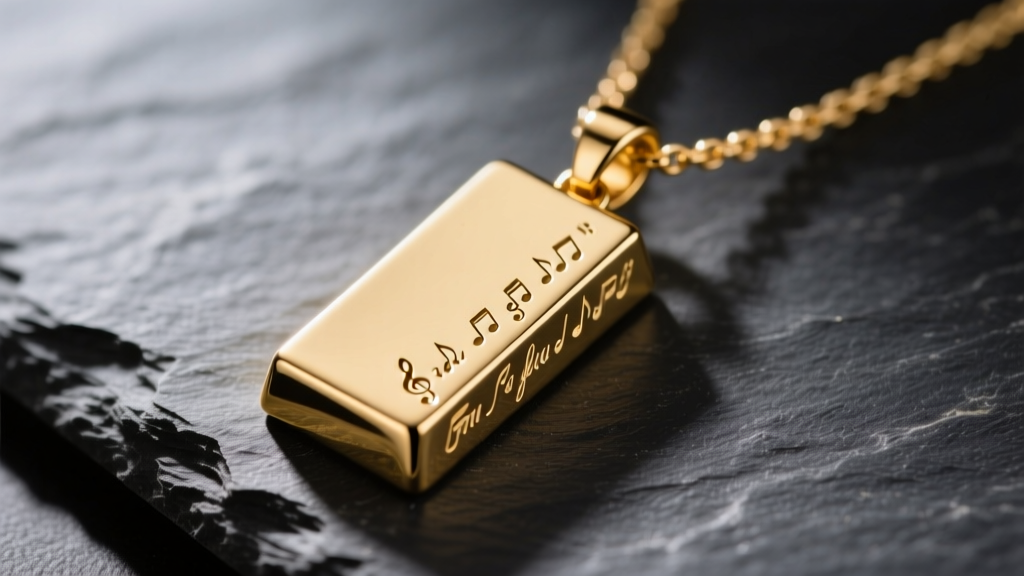
The intersection of horology, typography, and metallurgy culminates in one of the most intimate forms of jewelry: the custom lyric pendant. While the emotional resonance of wearing a favorite song stanza or poetic verse is universally understood, the physical execution of necklace lyrics requires rigorous technical precision. Translating a digital font into a microscopic, permanent physical impression on precious metals involves navigating strict spatial constraints, material hardness variables, and optical legibility thresholds.
This expert deep dive dissects the engineering and design principles required to produce high-fidelity lyric engravings on bar, disc, and dog-tag pendants, ensuring your custom piece survives decades of daily wear without losing typographic integrity.
The Metallurgy of Lyric Pendants: Hardness and Grain Structure
Before a single character is etched, the base metal dictates the boundaries of what is physically possible. The Vickers Hardness (HV) scale is the primary metric jewelers use to determine which engraving method will yield the cleanest edges without inducing structural stress fractures.
- Sterling Silver (925): Typically annealed to 70-90 HV for stamping, but work-hardened to 115 HV for finished pendants. Its soft, ductile grain structure makes it ideal for deep rotary cutting and traditional diamond drag, but it is prone to micro-burring if laser parameters are miscalibrated.
- 14k and 18k Gold: Ranging from 130 HV (18k yellow) to 160 HV (14k white). The alloy composition (copper, zinc, nickel) heavily influences laser absorption. White gold, often rhodium-plated, requires the laser to penetrate the plating layer without scorching the underlying alloy.
- 316L Surgical Steel: At 200-250 HV, stainless steel is too hard for standard diamond drag tools. It requires fiber laser annealing to oxidize the surface carbon, creating a permanent black mark without removing material.
- Grade 5 Titanium (Ti-6Al-4V): Measuring 350+ HV, titanium demands high-wattage MOPA (Master Oscillator Power Amplifier) fiber lasers. According to material standards outlined by the Gemological Institute of America (GIA), titanium's low thermal conductivity means heat dissipates slowly, requiring precise pulse-frequency tuning to prevent warping thin pendant blanks.
Engraving Techniques: Physics at the Micro-Scale
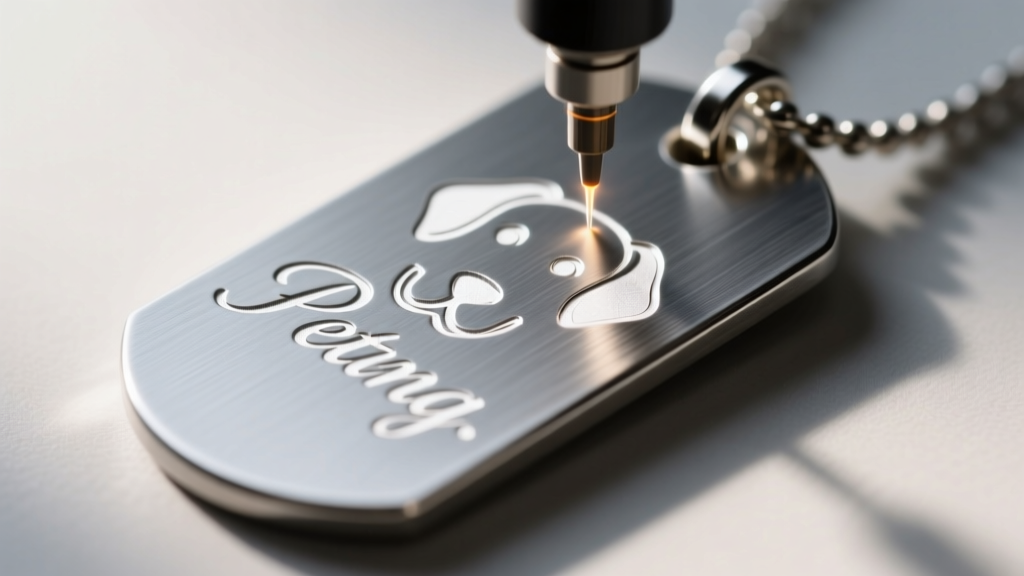
Choosing the right engraving mechanism is critical for preserving the delicate serifs and tight kerning inherent in lyric typography. The three primary methods operate on entirely different physical principles.
1. Fiber Laser Engraving (1064 nm Wavelength)
The industry standard for modern lyric necklaces. A fiber laser uses pulses of light to either ablate (vaporize) the top layer of metal or anneal (heat) it to create a dark oxide layer. For high-density lyrics on a small bar pendant, a MOPA fiber laser is preferred because it allows independent control of pulse width and frequency. This prevents the 'melt pool' effect that blurs micro-text on soft metals like 18k gold.
2. Diamond Drag Engraving
A spring-loaded, industrial-grade diamond tip is dragged across the metal surface, plowing a microscopic trench. This method is entirely dependent on the metal's hardness. It produces a brilliant, reflective cut on silver and gold but will instantly snap the diamond tip if used on hardened steel or titanium. It is limited to a minimum cap height of 1.0mm, restricting the total character count for lyric verses.
3. Rotary (CNC) Micro-Milling
Using carbide burrs spinning at 30,000 RPM, rotary engraving removes significant material. It is rarely used for full song lyrics due to the tool's physical radius (usually 0.15mm or larger), which cannot navigate the tight inner corners of letters like 'e' or 'a' at micro-scales. It is best reserved for bold, block-letter quotes on thick dog tags.
Comparative Analysis of Engraving Methods
| Method | Optimal Metals | Min. Font Cap Height | Depth / Profile | Enamel Fill Compatibility |
|---|---|---|---|---|
| Fiber Laser (Ablation) | All Metals, esp. Steel/Titanium | 0.3mm | 0.001 - 0.005 in. | Poor (too shallow) |
| Fiber Laser (Annealing) | Steel, Titanium | 0.4mm | 0.000 in. (Surface) | None required |
| Diamond Drag | Silver, Gold, Platinum | 1.0mm | 0.002 - 0.008 in. | Excellent |
| Rotary CNC | Thick Silver, Gold, Brass | 1.5mm | 0.010 - 0.030 in. | Excellent |
Spatial Geometry: Mapping Lyrics to Pendant Shapes
The physical footprint of the pendant dictates the typographic layout. A common failure in custom jewelry design is attempting to force a 40-character lyric line onto a geometry that induces severe optical distortion.
Design Rule of Thumb: Never exceed 75% of a pendant's total surface area with text. The remaining 25% must serve as negative space to allow the human eye to resolve the characters from a standard conversational distance of 3 feet.
The Bar Pendant (e.g., 5mm x 40mm)
The bar pendant is the most popular canvas for necklace lyrics. With a strict 5mm vertical limit, jewelers typically utilize a 1.2mm font size, allowing for a maximum of three lines of text. Total character capacity is roughly 45-60 characters. Horizontal kerning must be tightened by 5-10% to prevent text from wrapping off the polished edges.
The Disc Pendant (e.g., 15mm Diameter)
Engraving straight text across a circular disc creates a 'treadmill' effect, where the top and bottom lines appear to curve away from the viewer. Expert CAD designers use a subtle radial warp (barrel distortion) in the vector file to counteract this optical illusion, ensuring the lyric appears perfectly straight when worn on the curvature of the chest.
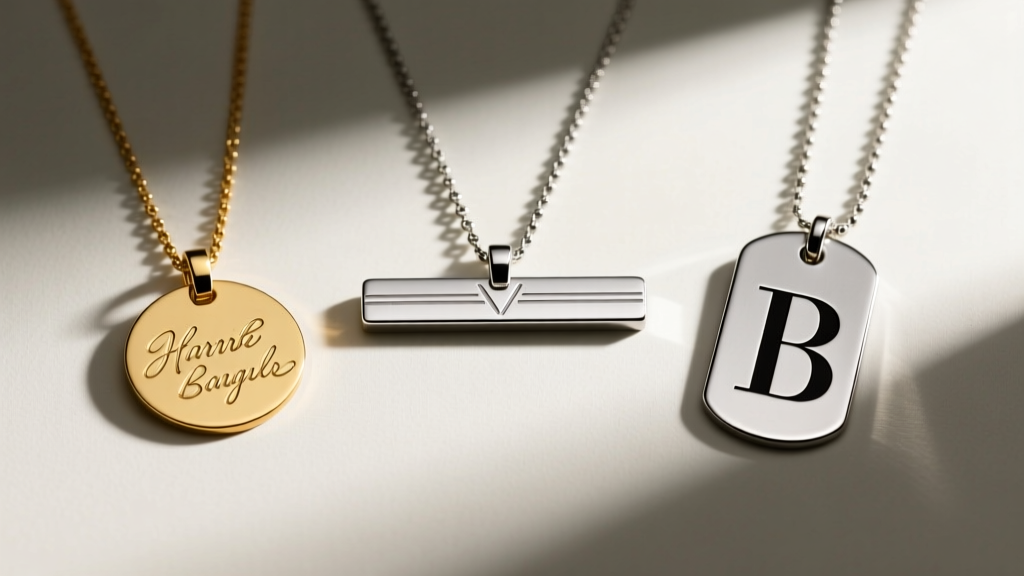
The Dog Tag (e.g., 20mm x 40mm)
Offering the largest continuous flat plane, dog tags can accommodate up to 120 characters. However, because dog tags are often stamped from sheet metal and subject to bending stresses, deep engraving on the edges can compromise structural integrity. Text blocks should be centered, leaving a 3mm safety margin from the perimeter.
Typography and Legibility at the Micro-Scale
Not all fonts survive the transition from screen to metal. When working with necklace lyrics, typographic selection is a matter of mechanical engineering as much as aesthetics.
- X-Height vs. Cap Height: Fonts with a large x-height (the height of lowercase letters like 'a' and 'e') relative to their cap height are vastly superior for micro-engraving. A font like Helvetica or Proxima Nova maintains legibility at 0.8mm, whereas high-contrast serif fonts like Bodoni will lose their thin hairlines entirely during the polishing phase.
- Script and Cursive: Continuous script fonts require flawless vector paths. If the laser or diamond drag hesitates at a node intersection, it creates a visible 'blob' of melted metal or a deep gouge. Custom scripts must be manually simplified in CAD software to reduce node count before engraving.
- Enamel Fills: For high-contrast readability, jewelers often fill deep diamond-drag engravings with two-part epoxy resin enamel. The trench must have a minimum width of 0.15mm to allow the enamel to flow via capillary action without spilling over the letter boundaries.
Longevity and Wear Resistance
A lyric necklace is subjected to friction from clothing, UV exposure, and the acidic pH of human sweat. Surface-level laser annealing on steel is highly durable, but ablated engravings on soft gold can accumulate skin oils and lotions, reducing contrast over time. To mitigate this, high-end manufacturers apply a nano-ceramic hydrophobic coating post-engraving. This invisible layer prevents debris from settling into the micro-trenches, ensuring your custom necklace lyrics remain as crisp and legible on day 1,000 as they were on day one.
For those sourcing materials or verifying metal purities for custom manufacturing, consulting technical data sheets from major suppliers like Rio Grande is essential to ensure the alloy's grain structure can withstand the thermal shock of precision laser etching.


