White Chunky Necklace Guide: Material Science & Weight Mechanics
Explore the technical anatomy of a white chunky necklace. We analyze resin grades, weight distribution, clasp mechanics, and UV resistance.

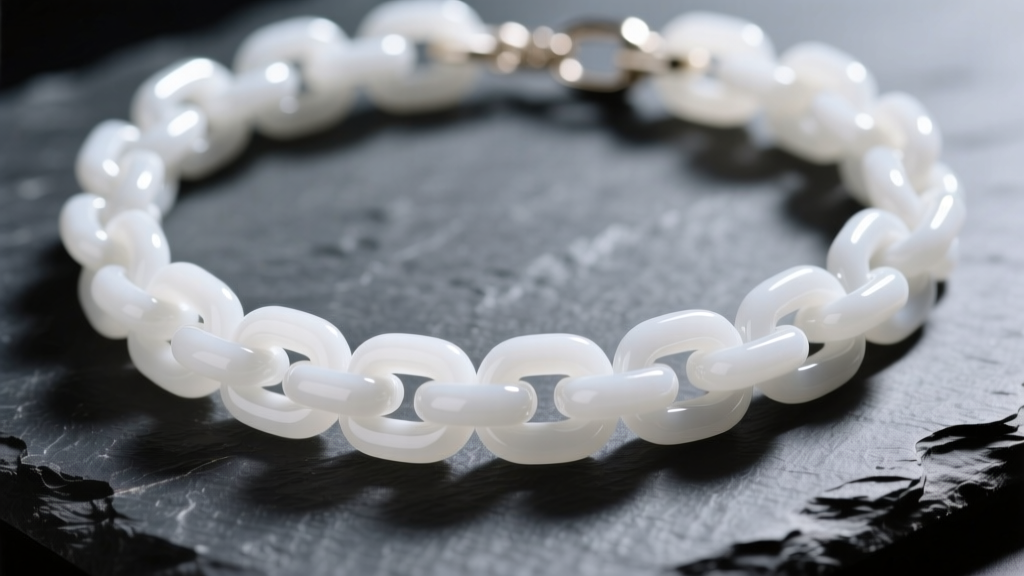
When evaluating a white chunky necklace, most consumers focus exclusively on aesthetics, silhouette, and trend alignment. However, from an expert jewelry design and materials science perspective, a chunky necklace is a complex structural assembly. The substantial volume required to achieve the 'chunky' silhouette introduces unique challenges regarding weight distribution, tensile stress, polymer degradation, and clasp mechanics. Whether crafted from high-fired ceramic, cast epoxy resin, or injection-molded acrylic, the longevity and wearability of these pieces depend entirely on their underlying engineering.
In this technical deep dive, we deconstruct the anatomy of the modern white chunky necklace, examining the material grades, structural geometries, and mechanical findings that separate premium, enduring jewelry from fast-fashion liabilities.
The Material Matrix: Polymers vs. Ceramics
The term 'white chunky necklace' encompasses a wide array of base materials, each with distinct physical properties that dictate how the piece drapes, wears, and ages. The three most common materials utilized in contemporary chunky designs are Cast Epoxy Resin, Polymethyl Methacrylate (PMMA/Acrylic), and High-Fired Ceramic.
Cast Epoxy Resin
Epoxy resin is favored for its ability to capture intricate mold details and its high impact resistance. A premium white resin necklace utilizes a two-part bisphenol-A (or bisphenol-F) epoxy system. The specific gravity (SG) of cured epoxy typically ranges from 1.1 to 1.2, making it relatively lightweight despite its massive visual volume. However, standard epoxies are susceptible to micro-scratching, registering a mere 2.0 to 2.5 on the Mohs hardness scale. To counteract this, expert manufacturers apply a UV-cured polyurethane topcoat, elevating the surface hardness and providing a glass-like optical clarity that enhances the white pigment.
Injection-Molded PMMA (Acrylic)
Acrylic offers superior optical clarity and a slightly higher hardness (Mohs 3.0) than epoxy, but it is inherently more brittle. The injection molding process allows for mass production of seamless, interlocking links. The critical failure mode for white acrylic is environmental stress cracking (ESC) when exposed to certain cosmetics or solvents, a factor we will address in the maintenance section.
High-Fired Ceramic
For luxury iterations of the white chunky necklace, high-fired kaolin-based ceramics are utilized. With a specific gravity of 2.3 to 2.5, ceramic pieces are substantially heavier, offering a premium, substantial hand-feel. The white glaze, typically formulated with zirconium silicate, provides exceptional UV stability and a Mohs hardness of 6.0 to 7.0, rendering it virtually impervious to everyday scratching.
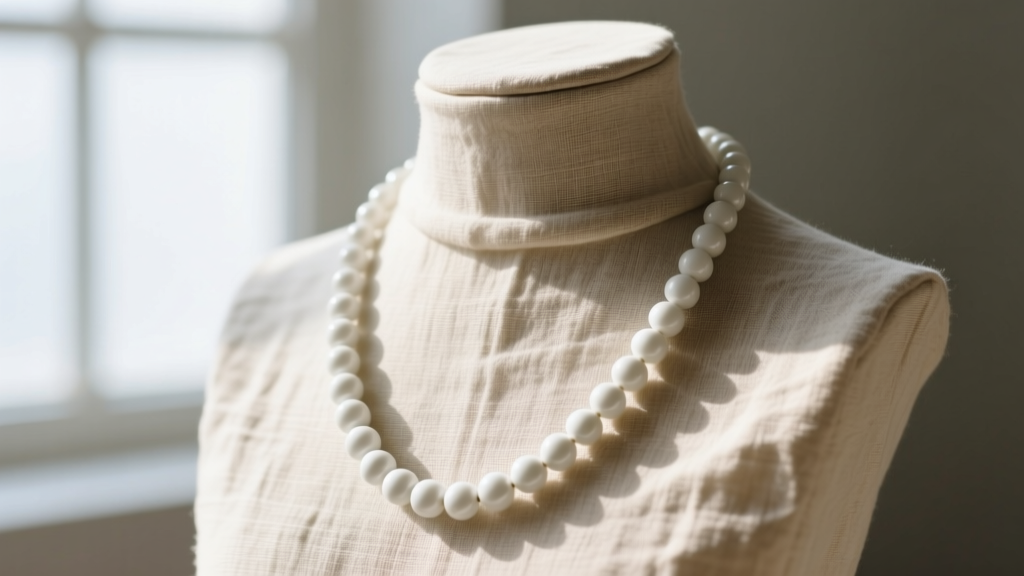
Link Articulation and Weight Distribution
The 'drape' of a chunky necklace is not merely a stylistic choice; it is a function of link articulation geometry and the center of gravity. In heavy white necklaces, poor articulation leads to the 'pendulum effect,' where the necklace shifts uncomfortably and pulls on the cervical spine.
Expert designers manipulate the friction coefficient between links. For example, interlocking oval links offer multi-axis rotation, allowing the necklace to conform to the clavicle. Conversely, puzzle-piece or flat-chain links restrict movement to a single axis, creating a rigid, collar-like structure. To mitigate neck strain in pieces exceeding 150 grams, the posterior links (those resting on the back of the neck) are often scaled down by 30% in volume, shifting the center of gravity forward and anchoring the piece securely against the sternum.
Material Stress Tolerance Comparison
| Material | Specific Gravity | Mohs Hardness | Impact Resistance | Articulation Wear |
|---|---|---|---|---|
| Cast Epoxy Resin | 1.1 - 1.2 | 2.0 - 2.5 | High | Moderate (requires steel pin reinforcement) |
| PMMA Acrylic | 1.18 | 3.0 | Low (Brittle) | High (prone to friction polishing) |
| High-Fired Ceramic | 2.3 - 2.5 | 6.0 - 7.0 | Very Low (Shatters) | Low (glaze resists friction) |
Clasp Mechanics for Heavy-Gauge Links
The most frequent point of catastrophic failure in a white chunky necklace is the clasp assembly. Standard 5x10mm lobster clasps, while adequate for delicate gold or silver chains, are entirely insufficient for the shear stress generated by a 100-gram resin or ceramic piece. When the wearer moves, the kinetic energy transfers to the clasp lever, eventually causing metal fatigue or bending the lever arm, leading to accidental decoupling.
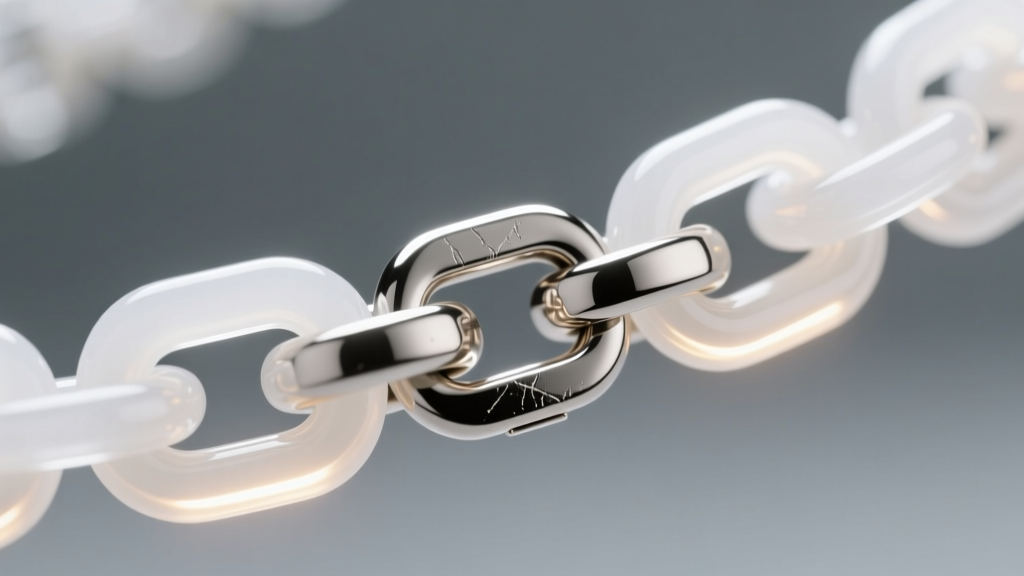
According to jewelry findings specialists at Rio Grande, heavy-gauge necklaces require specialized mechanical closures:
- N52 Neodymium Magnetic Clasps: Encased in 316L surgical stainless steel, these provide up to 12 lbs of tensile pull force. They are ideal for heavy resin pieces, allowing for seamless, single-handed operation without stressing the polymer links.
- Heavy-Duty Toggle Clasps: A 15mm+ diameter toggle ring with a weighted T-bar ensures that the kinetic swing of the necklace cannot accidentally pull the bar through the ring. The tensile load is distributed across the entire thickness of the metal rather than a tiny lever spring.
- Integrated Screw-Barrels: Often machined from anodized aluminum or stainless steel, these thread together, offering the highest security for ultra-heavy ceramic statement pieces.
The Yellowing Problem: UV Degradation and TiO2 Pigments
The most pervasive issue plaguing white polymer necklaces is photodegradation, commonly known as 'yellowing.' This is not merely a surface stain; it is a fundamental chemical breakdown of the polymer matrix triggered by ultraviolet radiation. When a white chunky necklace turns yellow, it indicates that the manufacturer utilized inferior optical brighteners or unstable pigment grades.
To achieve a permanent, brilliant white, expert manufacturers utilize Titanium Dioxide (TiO2). However, the crystalline structure of the TiO2 matters immensely. Anatase-grade TiO2 is cheaper but acts as a photocatalyst under UV exposure, actually accelerating the degradation of the surrounding resin. Premium white chunky necklaces exclusively use Rutile-grade TiO2. Rutile possesses a higher refractive index (providing superior opacity and brightness) and is inherently UV-stable. Furthermore, high-end formulations include Hindered Amine Light Stabilizers (HALS), which scavenge the free radicals generated by UV exposure, effectively halting the yellowing process before it begins. The British Plastics Federation extensively documents the necessity of HALS in maintaining the structural and optical integrity of exterior and high-exposure polymers.
Expert Maintenance and Restoration Protocols
Maintaining the pristine white finish and structural integrity of a chunky necklace requires strict adherence to material-specific cleaning protocols. The high surface area of chunky links makes them magnets for sebum, cosmetic foundations, and environmental particulates.
What to Avoid
Never use acetone, alcohol-based astringents, or ammonia-based glass cleaners on acrylic or resin necklaces. These solvents induce Environmental Stress Cracking (ESC), creating a network of microscopic fissures beneath the surface that scatter light, turning the once-glossy white plastic cloudy and brittle.
The Correct Cleaning Protocol
- Preparation: Create a 2% solution of a mild, non-ionic surfactant (such as baby shampoo or a dedicated jewelry cleaning soap) in distilled water. Avoid tap water, as dissolved minerals can leave micro-deposits on the glossy surface.
- Application: Submerge the necklace for no more than 5 minutes. Use a ultra-soft, lint-free microfiber cloth or a natural goat-hair brush to gently agitate the crevices between the interlocking links.
- Drying: Pat dry immediately. Do not air dry, as water spots can etch into certain low-grade resin topcoats over time.
- Polishing (Resin/Acrylic only): If micro-scratches have dulled the white finish, apply a specialized plastic polish (containing fine cerium oxide) using a low-speed rotary buffer. This removes a microscopic layer of the oxidized surface, restoring the original optical clarity and deep white hue.
By understanding the material science, structural engineering, and chemical vulnerabilities inherent in these bold accessories, collectors and stylists can confidently select, wear, and preserve a white chunky necklace that remains a striking, structurally sound statement piece for years to come.


