How to Evaluate the True Value of a Long Charm Necklace
Discover how to assess the true value of a long charm necklace. We break down material costs, brand markups, and craftsmanship for smart buyers.

The Anatomy of a Long Charm Necklace's Price Tag
When investing in fine jewelry, understanding the gap between intrinsic material value and retail markup is crucial. A long charm necklace—typically defined as an opera-length (28 to 32 inches) or rope-length (33+ inches) chain adorned with multiple pendants or a single oversized motif—presents a unique valuation challenge. Because these pieces require significantly more metal than standard 16-inch chokers or 18-inch princess chains, the raw material cost forms a much larger baseline of the final price.
However, a high price tag does not automatically equate to high value. To accurately assess whether a long charm necklace is a smart financial and sartorial investment, you must deconstruct the pricing into three core pillars: melt value (metal weight and purity), craftsmanship (labor and structural integrity), and brand equity (the "heritage tax"). By mastering these metrics, you can confidently navigate the market, whether you are browsing a high-end boutique or an independent artisan's studio.
Material Grade Breakdown: What You Should Actually Pay
The foundation of any necklace's value lies in its metallurgy. According to the Federal Trade Commission's Jewelry Guides, strict standards govern how metals are stamped and marketed. For a 32-inch chain with three medium-sized charms, the metal weight will typically range from 12 grams (for delicate 1.5mm chains) to over 35 grams (for robust 3mm rolo chains). Here is a realistic 2026 pricing framework based on current precious metal markets and standard labor rates.
| Material Grade | Purity / Composition | Expected Weight (32" + Charms) | Fair Retail Value Range | Long-Term Durability |
|---|---|---|---|---|
| Sterling Silver | 92.5% Silver, 7.5% Copper | 15g - 25g | $140 - $280 | Moderate (Prone to tarnish) |
| Gold Vermeil | 2.5µm 14k/18k Gold over 925 Silver | 15g - 25g | $220 - $400 | Low-Moderate (Wears off in 1-3 years) |
| Solid 10k Gold | 41.7% Pure Gold | 18g - 30g | $450 - $750 | High (Very hard, less malleable) |
| Solid 14k Gold | 58.3% Pure Gold | 18g - 30g | $950 - $1,600 | Excellent (Industry standard) |
| Solid 18k Gold | 75.0% Pure Gold | 20g - 35g | $1,800 - $3,200 | Good (Softer, prone to scratching) |
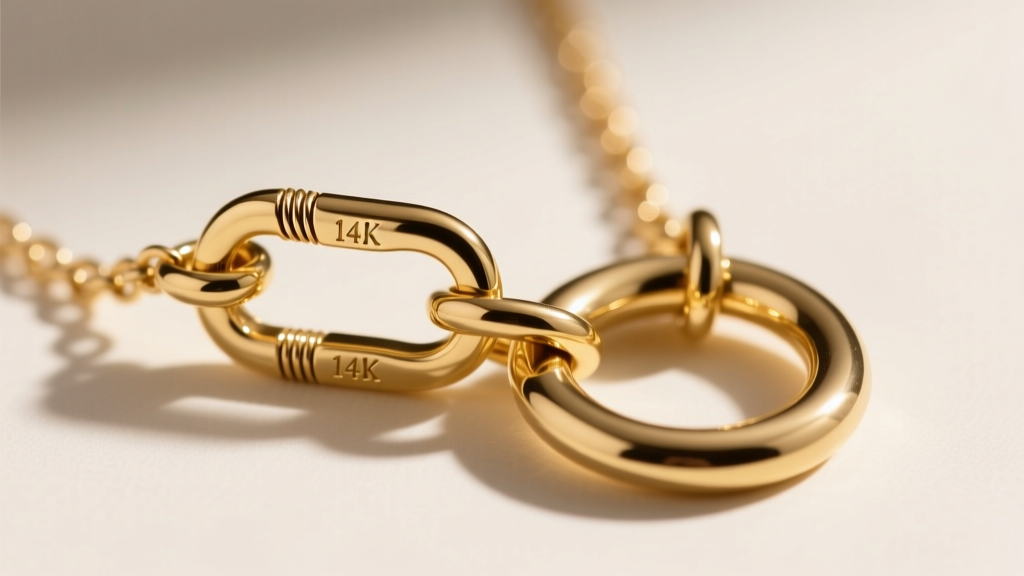
When evaluating a piece, always check the hallmark. As noted by the Gemological Institute of America (GIA), legitimate precious metals must bear a quality stamp (e.g., "14K", "925") and often a maker's mark. If a brand is charging 14k solid gold prices for a piece that only boasts "gold-plated brass," the intrinsic value is virtually zero, and you are paying entirely for the label.
Assessing Craftsmanship and Clasp Mechanics
A long charm necklace is subjected to immense kinetic stress. Unlike a short chain that sits securely in the hollow of the throat, a 32-inch chain swings freely, catching on clothing, door handles, and seatbelts. This pendulum effect places severe tensile stress on the chain links, the clasp, and the charm jump rings.
The Jump Ring Vulnerability
The most common failure point on any charm necklace is the jump ring connecting the pendant to the chain. For a long chain, these rings must be either soldered closed or constructed as heavy-duty split rings. If the jeweler uses standard open jump rings, the wire gauge must be at least 18-gauge (1.02mm thick) and work-hardened. Thin 20-gauge or 22-gauge open jump rings will inevitably pull apart under the swinging weight of a long chain, resulting in lost charms.
Clasp Tensile Strength
Do not accept a standard 9mm spring-ring clasp on a heavy, long charm necklace. Spring rings have weak internal springs that fail under dynamic loads. Insist on a 12mm to 15mm lobster claw clasp or, ideally, a box clasp with a figure-8 safety catch. The clasp should account for at least 5% of the total metal weight of the piece to ensure it can handle the tensile strain of the chain's drape.
Brand Markup vs. Independent Artisan Value
The "heritage tax" is the premium you pay for a recognizable logo. Luxury fashion houses often mark up their solid gold long charm necklaces by 400% to 800% over the intrinsic melt and labor value. For example, a 25-gram solid 18k gold rope chain with three simple diamond-cut charms might have an intrinsic manufacturing cost of $1,400. A heritage brand will retail this exact configuration for $6,500 or more.

Conversely, independent artisans and specialized chain-makers (often found on platforms like Etsy or at local guild shows) typically operate on a 30% to 50% markup over materials and labor. When you buy from an independent jeweler, you are often getting superior craftsmanship—such as hand-soldered links and custom-cast charms—for a fraction of the designer price. The trade-off is the lack of immediate brand recognition and a potentially lower resale value in the secondary luxury market. However, if your goal is personal wear and material value, the independent route offers a vastly superior return on investment.
The 4-Point Value Checklist Before You Buy
Before finalizing your purchase, run the necklace through this rigorous assessment framework to ensure you are paying a fair price for genuine quality.
- Verify the Hallmarks: Inspect the clasp and the back of the largest charm for clear, legible purity stamps (e.g., 14K, 750, 925). Use a jeweler's loupe if necessary.
- Test the Clasp and Links: Gently pull the chain near the clasp. A high-quality lobster clasp should have a strong, snappy spring-back. Run your fingernail along the chain links; they should feel smooth, with no sharp burrs or uneven soldering joints.
- Inspect the Charm Attachments: Look closely at how the charms hang. Are the jump rings soldered shut? If they are open, is the wire thick enough (18-gauge or lower number) to resist pulling?
- Calculate the Gram Price: Weigh the necklace (or ask the seller for the exact gram weight). Divide the retail price by the gram weight. Compare this "price per gram" against the current spot price of the metal plus a reasonable 40-60% labor markup. If the multiplier exceeds 5x the melt value, you are paying a heavy brand premium.
By applying these technical assessments, you transform from a passive consumer into an informed collector. A well-made long charm necklace is not just a fleeting trend; it is a versatile, layered staple that, when chosen for its intrinsic and structural value, will remain a cornerstone of your jewelry wardrobe for decades.


