The Fine Jewelry Peanut Necklace: Casting, Metals, and Chain Pairing
Discover the technical anatomy of the fine jewelry peanut necklace. Expert insights on 3D casting, gold alloys, bail reinforcement, and chain pairing.

Introduction: Beyond the Novelty Charm
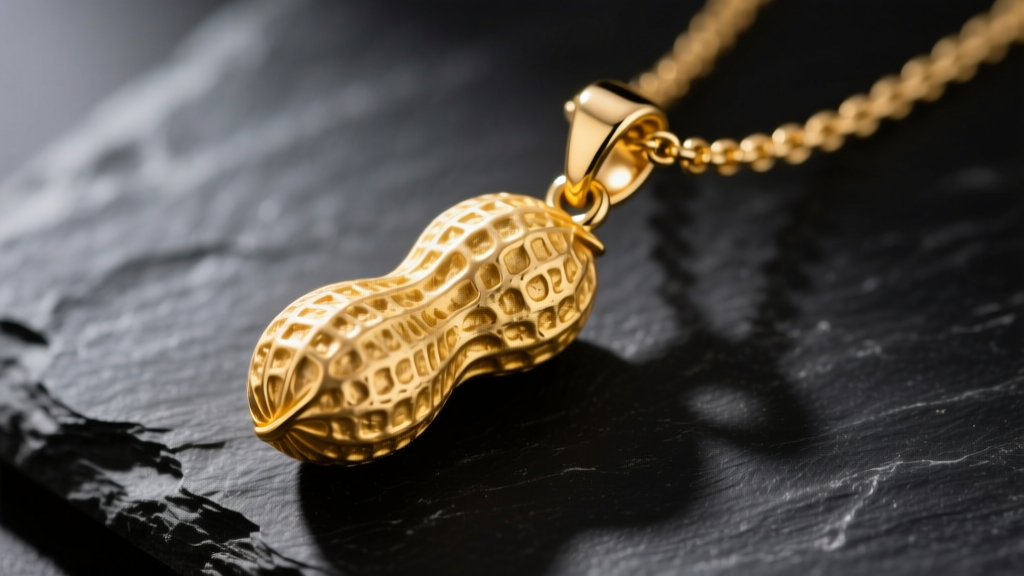
The peanut necklace has transcended its mid-century costume jewelry roots—often associated with vintage Trifari or novelty charm bracelets—to become a staple in modern minimalist and fine jewelry collections. However, translating this organic, bilobed shape into a durable piece of fine jewelry requires precise metallurgical planning and structural engineering. Unlike simple geometric pendants, the asymmetrical form and deep surface texturing of a peanut introduce unique stress points and casting challenges. This expert deep dive explores the technical anatomy of the fine jewelry peanut necklace, breaking down alloy selection, lost-wax casting mechanics, and the critical chain pairings required to support its specific weight distribution.
Metallurgical Breakdown: Alloys and the Peanut Form
When evaluating a fine jewelry peanut necklace, the alloy composition dictates both the aesthetic warmth and the structural longevity of the piece. Because the peanut shape features a narrow waist between its two lobes, the metal must possess adequate tensile strength to resist bending or snapping under lateral pressure.
14k vs. 18k Gold: Structural Trade-offs
According to the Gemological Institute of America (GIA), pure 24k gold is far too malleable for daily-wear pendants. Therefore, jewelers rely on alloyed gold. An 18k gold peanut necklace (75% pure gold) offers a richer, deeper yellow hue and higher hypoallergenic properties, but it is inherently softer. If the pendant is cast with a thin profile at the waist, an 18k piece is highly susceptible to permanent deformation if caught on clothing.
Conversely, 14k gold (58.5% pure gold, alloyed with copper, silver, and zinc) provides superior yield strength. For a heavily textured peanut shell design, 14k yellow or rose gold is the optimal technical choice. The copper content in rose gold, in particular, increases the alloy's hardness, making it highly resistant to the micro-abrasions that can wear down the intricate cross-hatching of the peanut shell over decades of wear. Sterling silver (925) is also widely used, though jewelers must account for oxidation; the deep crevices of the peanut texture will trap sulfur and moisture, accelerating tarnish unless a rhodium or e-coat finish is applied.
The Lost-Wax Casting Process for Asymmetrical Pendants
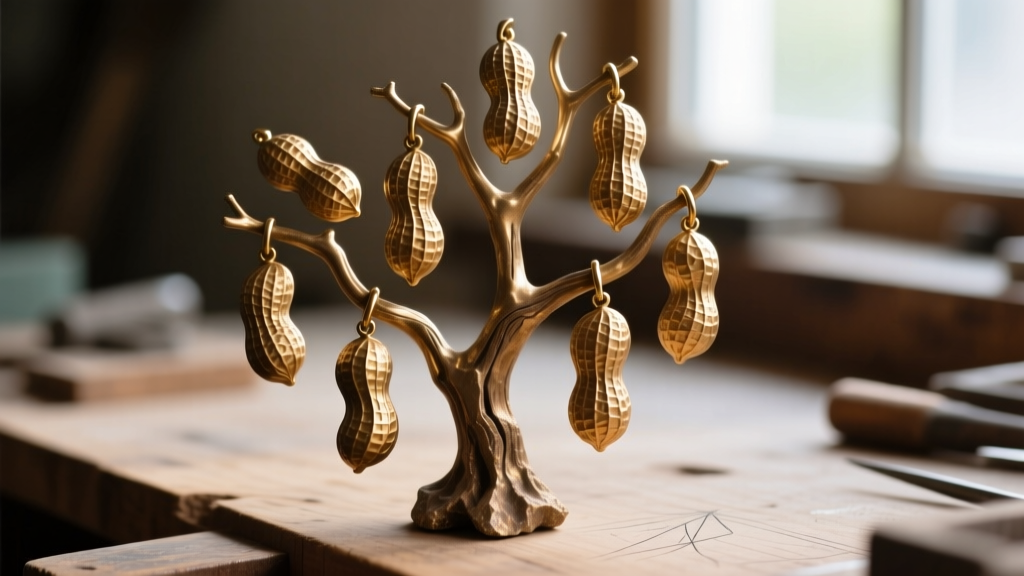
Manufacturing a high-quality solid gold peanut pendant relies on the lost-wax casting method. The organic geometry of the peanut presents specific fluid dynamics challenges when molten metal is injected into the investment flask.
- Wax Injection and Detail Fidelity: The master mold must capture the microscopic striations of a real peanut shell. High-pressure wax injection ensures these details are replicated without air bubbles, which would otherwise manifest as pitting on the gold surface.
- Sprue Placement Strategy: The sprue (the channel through which molten metal flows) must be attached to the thickest part of the wax model—typically the upper lobe. If a sprue is mistakenly placed at the narrow waist, cutting it off post-casting leaves a structural weak point and requires aggressive filing that ruins the pendant's symmetry.
- Shrinkage Compensation: Gold shrinks as it cools. Master modelers must scale the initial CAD or hand-carved wax model up by approximately 1.5% to 2% to ensure the final cast peanut necklace matches the intended millimeter dimensions.
Structural Vulnerabilities: The Pinch Point and Bail Mechanics
The most common failure mode in poorly engineered peanut necklaces occurs at the pinch point (the waist) and the bail attachment. In an effort to reduce gold weight and lower the retail price, some manufacturers utilize electroforming to create hollow gold peanuts. While visually identical to solid cast pieces, hollow electroformed pendants have walls less than 0.3mm thick. A single accidental compression at the waist will crush the pendant, and because the metal is work-hardened and hollow, it cannot be repaired by a bench jeweler.
Expert Bench Tip: When soldering a standard loop bail to the top lobe of a solid peanut pendant, the jeweler must use a heat sink (such as cross-locking tweezers or thermal paste) on the textured shell. Without a heat sink, the thermal conductivity of the gold will cause the intricate shell texture near the solder joint to melt and slump, destroying the detail.
For optimal structural integrity, look for a peanut necklace featuring a hidden tube bail or a seamlessly cast integrated bail. Integrated bails, where the loop is formed directly within the lost-wax mold rather than soldered on afterward, eliminate the risk of solder joint failure entirely.
Chain Gauge and Clasp Engineering
A solid 14k gold peanut pendant typically weighs between 3.5 grams and 7.2 grams, depending on its millimeter footprint (usually ranging from 15mm to 25mm in length). Pairing this weight with an inadequate chain is a frequent cause of jewelry loss. Standard 1.0mm or 1.2mm cable chains lack the shear strength to support a 7-gram asymmetrical pendant, leading to jump ring pull-through or link elongation.
| Chain Style | Recommended Gauge/Width | Max Pendant Weight Capacity | Durability Rating for Peanut Pendants |
|---|---|---|---|
| Standard Cable | 1.5mm - 1.8mm | Up to 4.5g | Moderate (Prone to kinking) |
| Rolo Chain | 1.8mm - 2.2mm | Up to 8.0g | High (Excellent link interlock) |
| Wheat (Spiga) | 1.5mm - 2.0mm | Up to 10.0g | Very High (Multi-directional weave) |
| Box Chain | 1.2mm - 1.5mm | Up to 5.0g | Low (Hinges snap under torque) |
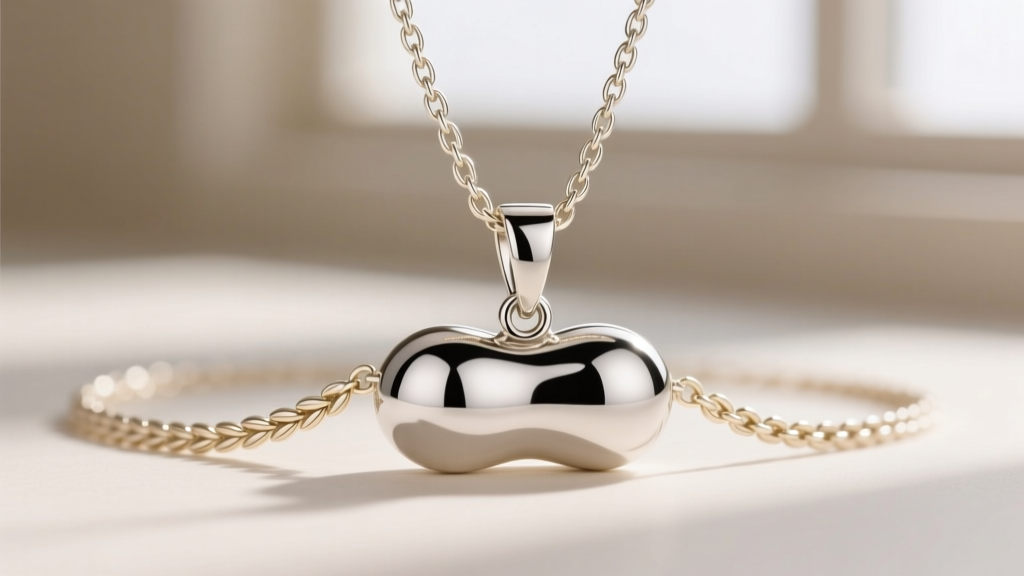
As noted by manufacturing specialists at Rio Grande Jewelry Supply, the clasp mechanism is equally critical. A lightweight lobster clasp paired with a heavy peanut pendant will cause the necklace to constantly flip, resting the clasp at the front of the neck. To counterbalance the pendant, utilize a heavier trigger clasp or add a small counterweight tag near the clasp on the chain's terminus.
Market Pricing and Authenticity Markers
When shopping for a fine jewelry peanut necklace in the current market, understanding the pricing tiers helps distinguish between solid craftsmanship and mass-produced novelties. A solid 14k gold peanut pendant (weighing approx. 4g) on a matching 18-inch rolo chain will typically retail between $350 and $550, reflecting the raw gold market value plus bench labor. Sterling silver equivalents generally range from $85 to $140.
To verify authenticity and manufacturing quality, inspect the hallmark stamps. A legitimate fine jewelry piece will bear a 585 (14k) or 750 (18k) stamp. On a peanut pendant, this stamp should be located on the flat back of the upper lobe or laser-engraved inside the bail ring. Avoid pieces where the stamp is clumsily struck across the textured front shell, as this indicates poor quality control during the finishing process.
Furthermore, examine the jump rings connecting the chain to the clasp and the pendant. High-end manufacturers use soldered jump rings—meaning the seam of the ring is fused shut with hard solder. If the jump ring is merely twisted shut, the heavy, asymmetrical peanut pendant will eventually work the seam open through kinetic friction and lateral movement, resulting in the loss of the gold piece.
Conclusion
Ultimately, the transition of the peanut motif from a mass-market trinket to a respected fine jewelry silhouette relies entirely on these hidden structural decisions. Whether you are a bench jeweler designing a new collection or a collector investing in modern gold staples, demanding transparency in casting methods and alloy grades ensures the piece will endure. By prioritizing solid casting, proper alloy selection, and engineered chain pairings, you ensure your peanut necklace remains a structurally sound and aesthetically striking heirloom for decades to come.


