Troubleshooting Your Amethyst and Pearl Necklace Damage
Discover expert troubleshooting for your amethyst and pearl necklace. Learn how to prevent scratching, clean safely, and fix stringing failures.

The Mohs Hardness Conflict: Why Your Necklace is Failing
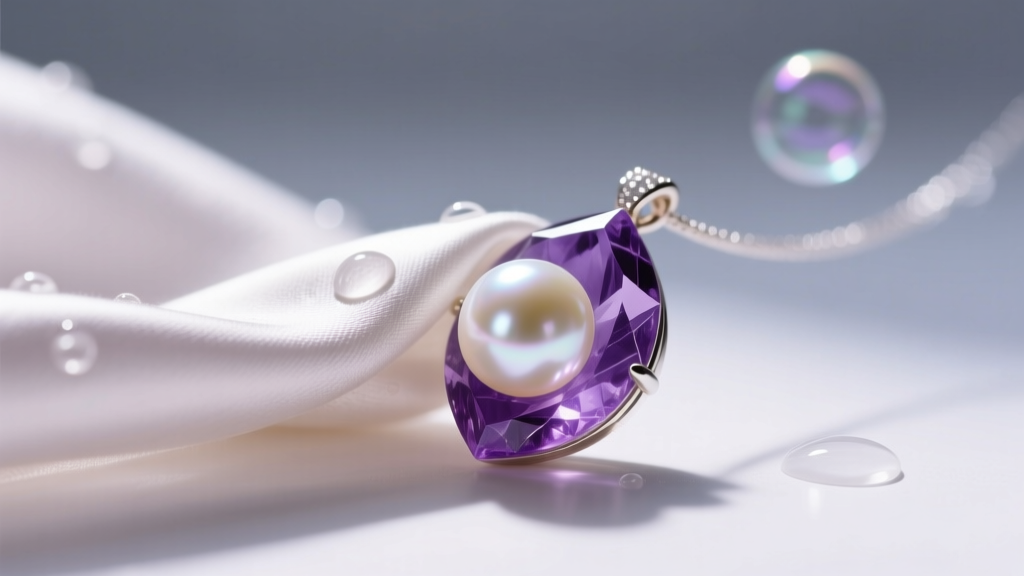
When you combine the regal purple of quartz with the organic luster of nacre, the resulting amethyst and pearl necklace is a masterpiece of contrast. However, from a gemological and structural perspective, this pairing is a high-risk liability. The core issue lies in the Mohs scale of mineral hardness.
Amethyst, a crystalline variety of quartz, sits at a solid 7 on the Mohs scale. It is hard enough to scratch glass and steel. Pearls, conversely, are organic gems composed of calcium carbonate (aragonite) platelets bound by a protein called conchiolin. They rank between 2.5 and 4.5 on the Mohs scale. When these two materials are strung adjacently on a flexible necklace strand, the natural movement of the wearer forces the harder amethyst facets to act like microscopic sandpaper against the softer pearl nacre.
According to the Gemological Institute of America (GIA), pearls require specialized care precisely because of their low hardness and chemical sensitivity. If your pearls are placed directly next to amethyst briolettes or faceted rondelles without adequate spacing, you will inevitably experience catastrophic nacre loss, leading to a dull, chalky appearance and eventual structural failure of the pearl itself.
Troubleshooting Surface Abrasion and Nacre Loss
Symptom: Chalky Spots and Loss of Orient
The first sign of abrasion damage is not necessarily a deep, visible gouge. Instead, look for a loss of 'orient'—the iridescent play of color on the pearl's surface. The area facing the amethyst will appear matte, chalky, or whitish. If the nacre is thin (under 0.4mm, common in lower-grade Akoya or freshwater pearls), the abrasion can quickly reach the shell bead nucleus, effectively ruining the gem.
The Fix: Spacer Beads and Silk Knotting Upgrades
To salvage or properly construct an amethyst and pearl necklace, you must eliminate direct gem-to-gem contact. This requires a strategic stringing architecture.
- French Wire Protection: Use 14k or 18k gold-filled French wire (bullion) to wrap the silk near the clasp, preventing the amethyst clasp components from fraying the thread.
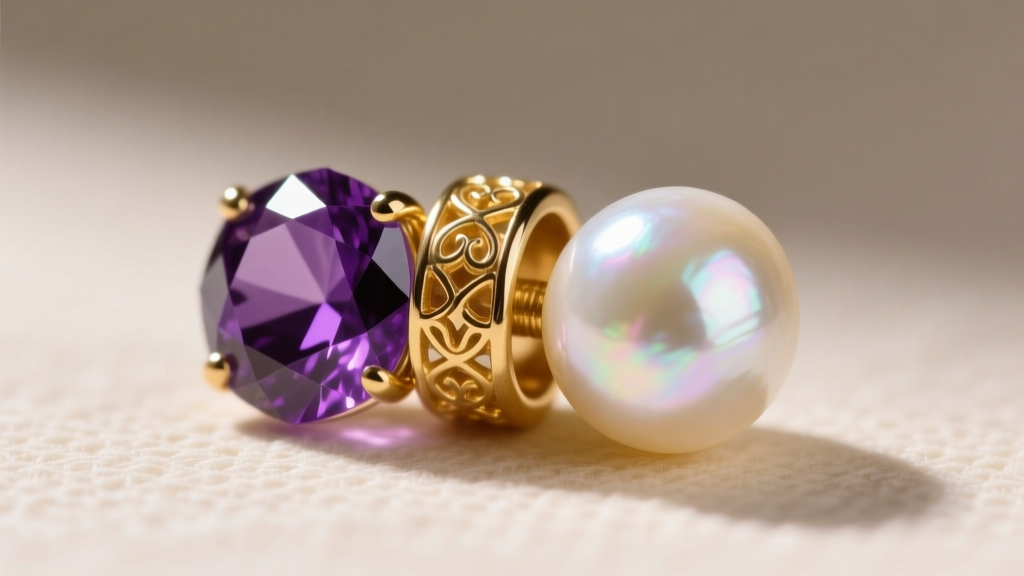
- Micro-Spacer Beads: Insert 1.5mm to 2mm seamless sterling silver or 14k gold rondelle spacers between every amethyst and pearl. The metal takes the friction, sparing the nacre.
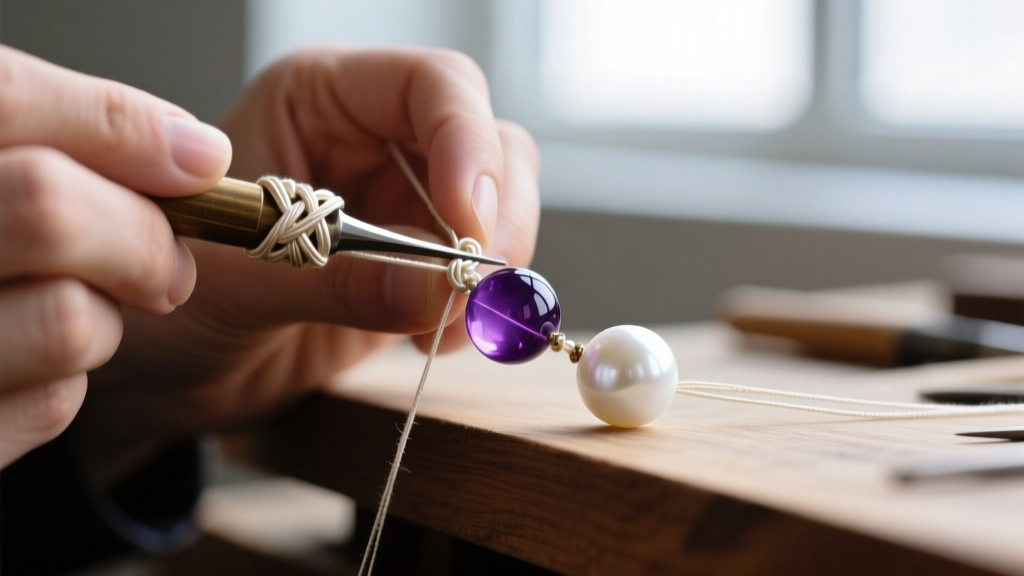
- Hand-Knotting: Every single pearl and amethyst drop must be separated by a hand-tied knot using high-grade silk or nylon cord.
Stringing Material Comparison for Mixed Hardness
| Material | Tensile Strength | Knot Security | Verdict for Amethyst & Pearl |
|---|---|---|---|
| Natural Silk (Griffin) | Moderate | Excellent (Traditional) | Best for drape, but degrades with sweat. Requires annual restringing. |
| Nylon (PowerPro) | Very High | Good (Slippery) | Excellent durability, but knots can loosen if not sealed with micro-drops of hypoallergenic glue. |
| Stainless Steel Wire | Extreme | Poor (Cannot Knot) | Avoid. Wire will saw through the pearl drill holes over time due to friction. |
| Kevlar Cord | Extreme | Moderate | Overkill and too stiff for delicate pearl draping. Not recommended. |
The Cleaning Paradox: Solving the Care Dilemma
The most common way owners destroy their jewelry is by applying a blanket cleaning method to a multi-gem piece. The GIA notes that amethyst can generally withstand warm, soapy water and even brief ultrasonic cleaning (provided the stone has no surface-reaching fractures or liquid inclusions). Pearls, however, will be obliterated by these methods.
Ultrasonic cleaners use high-frequency sound waves that create microscopic cavitation bubbles. When these bubbles collapse against a pearl, they literally blast the delicate aragonite platelets off the surface, leaving the pearl pitted and ruined. Steam cleaners will instantly shock the pearl, causing the nacre layers to separate from the nucleus in a catastrophic failure known as delamination.
Step-by-Step Safe Cleaning Protocol
To safely clean your amethyst and pearl necklace without compromising either material, you must use a targeted, low-impact approach:
- Prepare a Neutral Solution: Mix distilled water with a single drop of pH-neutral, phosphate-free dish soap. Avoid ammonia-based cleaners, which will dissolve the pearl's conchiolin protein matrix.
- Target the Amethyst: Dip a soft, baby-bristle toothbrush into the solution and gently scrub the amethyst facets to remove sebum and cosmetic buildup. Do not let the brush bristles aggressively scrub the adjacent pearls.
- Wipe the Pearls: Use a lint-free, damp microfiber cloth to gently wipe each pearl individually. Never submerge the necklace in water, as this will weaken the silk thread and cause the drill holes to trap moisture, leading to internal rot.
- Dry Flat: Lay the necklace flat on a dry cotton towel in a well-ventilated area away from direct sunlight. Never hang a wet silk-strung necklace, as the weight of the water will stretch the thread and create permanent gaps between the knots.
Environmental Degradation: Fading and Drying
Beyond physical abrasion, this specific gemstone pairing presents conflicting environmental needs. Amethyst is notorious for its susceptibility to UV degradation. Prolonged exposure to direct sunlight or intense heat (such as leaving the necklace on a car dashboard) can cause the purple iron-oxide color centers to fade, or in extreme cases, alter the stone's color to a pale yellow or brownish citrine-like hue.
Pearls, on the other hand, require a moderate level of ambient humidity to maintain their structural integrity. If stored in a sealed plastic bag or an overly dry safe deposit box, the conchiolin will dry out, leading to micro-cracking and a phenomenon known as 'crazing' on the pearl's surface. Furthermore, everyday cosmetics, hairsprays, and perfumes contain alcohols and chemicals that will strip the pearl's luster while leaving a filmy residue on the amethyst facets. To solve this, always put your necklace on after applying cosmetics, store it in a soft, breathable flannel pouch inside a wooden jewelry box, and occasionally wipe the pearls with a barely damp cloth to provide necessary moisture.
Professional Restringing: When and How Much
If you notice stretching between the knots, or if the pearls slide freely across the amethyst beads without resistance, your necklace requires immediate professional restringing. Waiting will result in the silk snapping and the loss of your gems.
For a standard 18-inch princess-length necklace, expect to pay between $75 and $150 for professional hand-knotting, depending on your region and the jeweler's expertise. Ensure the jeweler uses properly sized Griffin silk cord. For 6mm to 7mm pearls and amethyst beads, a Size F (0.90mm) or Size G (1.00mm) cord is typically required to ensure the knot is larger than the gem's drill hole (usually 0.7mm to 0.8mm), preventing the knot from pulling through and failing under tension.
A master stringer will use a heated awl to pull the knot tight against the bead without leaving a burn mark on the silk. When commissioning a restring, explicitly ask the jeweler to use a French wire finish at the clasp ends and to double-knot the first three beads near the clasp, as this area experiences the highest degree of mechanical stress and friction during daily wear. By addressing these structural and environmental conflicts, your amethyst and pearl necklace will remain a pristine, wearable heirloom for decades.


