Best Metals for Hebrew Necklace Letters: A Material Comparison
Compare metals for Hebrew necklace letters. Discover how gold, silver, and titanium affect the durability and detail of sacred script jewelry.

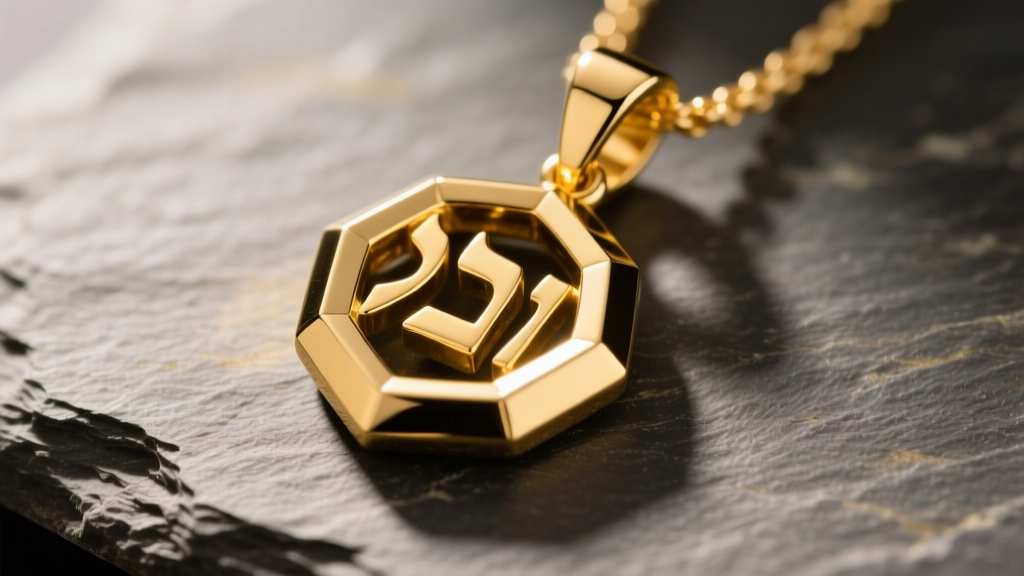
When selecting a necklace featuring sacred script, the typography is only half the equation. The structural integrity, longevity, and visual crispness of hebrew necklace letters depend entirely on the metallurgical properties of the chosen material. Hebrew characters are defined by their stark geometric contrasts—sharp diagonal intersections, delicate vertical stems, and deep interior negative spaces. These design elements present unique engineering challenges for jewelers, as certain metals are prone to casting porosity, stress fractures, or tarnish buildup in the intricate crevices of the script.
In this comprehensive material guide, we analyze how precious and alternative metals interact with the specific geometry of Hebrew lettering, providing you with the technical insights needed to choose a pendant that will last a lifetime.
The Engineering Challenge of Hebrew Script Geometry
Unlike flowing, cursive Latin scripts, Hebrew block letters (Ktav Ashuri) are highly architectural. Consider the letter Shin (ש), which features three vertical stems merging into a single, narrow base. In metallurgy, this convergence point acts as a stress concentrator. If the metal lacks adequate tensile strength or is cast with microscopic porosity, the base of the Shin becomes a primary failure point, susceptible to snapping under the everyday tension of a chain necklace.
Similarly, letters with enclosed negative spaces, such as Mem (מ) or Samekh (ס), require precise manufacturing to maintain crisp interior corners. Soft metals can easily deform during the polishing phase, rounding off the sharp 90-degree angles that define the character's legibility. Understanding these geometric vulnerabilities is the first step in matching the right script to the right alloy.
Precious Metals: Gold and Silver Alloys Analyzed
Precious metals remain the most popular choice for religious and cultural jewelry, but their varying alloy compositions drastically alter their performance when shaped into complex letters.
14k vs. 18k Gold: Hardness and Detail Retention
Gold purity is measured in karats, but for intricate script pendants, the alloying metals (copper, silver, zinc) are what truly matter. According to the Gemological Institute of America (GIA), pure 24k gold is far too soft (approx. 25-30 HV on the Vickers hardness scale) for jewelry.
- 14k Gold (58.5% Gold): With a Vickers hardness of roughly 130-150 HV, 14k gold offers the optimal balance of malleability for casting and rigidity for wear. The delicate upper stem of a Yud (י) or the floating gap in a Het (ח) will maintain its structural integrity in 14k gold without bending when caught on clothing.
- 18k Gold (75% Gold): While prized for its rich, warm color, 18k gold is noticeably softer (approx. 110-120 HV in cast form). For large, bold Hebrew pendants, 18k is luxurious. However, for highly detailed, micro-script necklaces, 18k gold is prone to warping and losing its crisp edge definition over years of friction.
Sterling Silver (925) and the Tarnish Factor
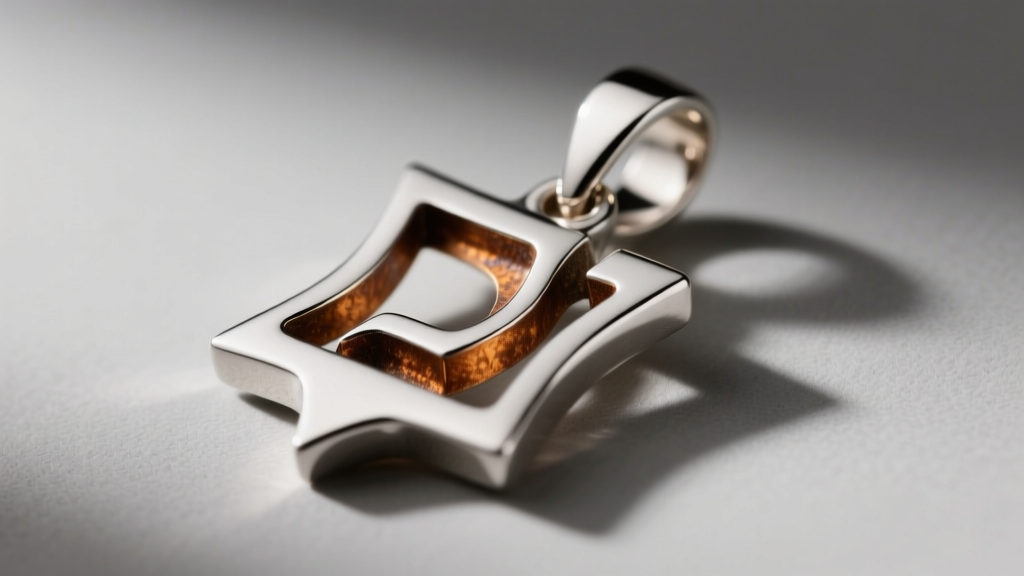
Sterling silver is an alloy of 92.5% silver and 7.5% copper. The copper provides necessary strength, elevating the hardness to about 70-80 HV. However, copper is highly reactive to sulfur compounds in the air and human sweat. In the context of hebrew necklace letters, the deep interior corners of letters like Tzadi (צ) trap moisture and pollutants, accelerating localized tarnishing. While rhodium plating can temporarily prevent this, once the plating wears off the high-friction edges, the recessed areas of the silver script will darken, requiring careful, targeted polishing to avoid removing metal from the letter's face.
Alternative Metals: Titanium and Stainless Steel
For those seeking maximum durability and modern aesthetics, industrial metals offer superior tensile strength, though they require entirely different manufacturing approaches.
Grade 5 Titanium (Ti-6Al-4V)
Titanium is exceptionally strong, lightweight, and hypoallergenic. Grade 5 titanium, alloyed with aluminum and vanadium, boasts a tensile strength of roughly 900 MPa. A Hebrew letter pendant machined from Grade 5 titanium is virtually indestructible under normal wear conditions. The stems of an Aleph (א) will never bend or snap. However, titanium's extreme hardness means it cannot be easily cast using traditional lost-wax methods. Instead, titanium pendants are typically CNC machined or laser-cut from sheet metal, resulting in a flatter, more contemporary 2D aesthetic with sharp, precise edges but limited 3D beveling.
316L Surgical Stainless Steel
316L stainless steel contains molybdenum, which drastically increases its resistance to pitting and corrosion. It is an incredibly cost-effective material for script jewelry. Like titanium, 316L is rarely cast; it is almost exclusively cut using high-powered fiber lasers. Laser cutting yields perfectly sharp interior corners for letters like Kaf (כ), free from the casting seams and porosity that can plague budget-tier cast silver or gold. The primary drawback is weight; a solid steel Chai (חי) pendant will feel noticeably heavier on the neck than its gold or titanium counterparts.
Material Comparison Matrix for Hebrew Pendants
The following table synthesizes the metallurgical data, manufacturing methods, and practical considerations for the most common metals used in Hebrew script jewelry.
| Material | Hardness (HV) | Ideal Manufacturing | Primary Vulnerability | Avg. Price Range (Pendant) |
|---|---|---|---|---|
| 14k Yellow/White Gold | 130 - 150 | Lost-Wax Casting | Prong/stem snagging | $150 - $450 |
| 18k Yellow Gold | 110 - 120 | Lost-Wax Casting | Edge deformation | $250 - $700+ |
| 925 Sterling Silver | 70 - 80 | Casting / Stamping | Crevice tarnishing | $30 - $120 |
| Grade 5 Titanium | 330 - 350 | CNC / Laser Cut | Cannot be resized/repaired easily | $60 - $150 |
| 316L Stainless Steel | 150 - 190 | Fiber Laser Cut | Heavy weight on thin chains | $15 - $50 |
Manufacturing Methods: Casting vs. Laser Cutting
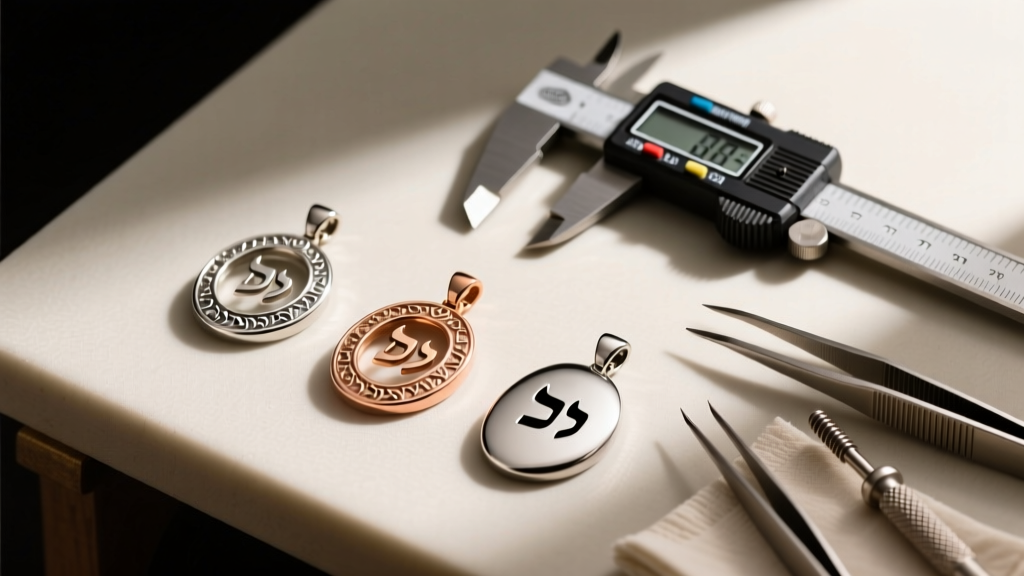
The material you choose inherently dictates how your hebrew necklace letters are brought to life. Lost-wax casting is the standard for gold and silver. It allows for beautiful, rounded 3D bevels and domed surfaces that catch the light, giving the Hebrew letters a traditional, heirloom quality. However, cast metals are susceptible to shrinkage porosity. If a jeweler does not properly vent the wax model of a complex letter like Shema (שמע), microscopic air bubbles can form inside the thin strokes, creating hidden weak points.
Conversely, fiber laser cutting is the standard for steel and titanium. This subtractive manufacturing process vaporizes the metal with pinpoint accuracy. The resulting Hebrew letters possess absolute geometric perfection and razor-sharp interior corners. The trade-off is a lack of depth; laser-cut pendants are essentially 2D silhouettes, often finished with a brushed or matte surface to reduce glare and emphasize the starkness of the script.
Care and Maintenance Based on Material Properties
Proper maintenance of script jewelry requires an understanding of your specific metal's chemical properties. The Jewelers of America recommends tailored care routines based on alloy composition:
- For Cast Gold and Silver: Avoid ultrasonic cleaners if your Hebrew pendant features any inset gemstones or if the lettering has been oxidized (blackened) in the recesses to enhance contrast. Ultrasonic waves can strip intentional oxidation and loosen stone settings. Instead, use a soft-bristled baby toothbrush with mild dish soap to gently agitate dirt out of the tight corners of the letters.
- For Titanium and Steel: These metals are highly resistant to chemical corrosion and can easily withstand ultrasonic cleaning or even a gentle soak in isopropyl alcohol to remove skin oils from the negative spaces of the script. However, because they are often laser-cut with sharp edges, be careful when using microfiber polishing cloths, as the sharp corners of the letters can snag and tear the fabric.
Final Verdict: Choosing Your Script Metal
Ultimately, the best metal for your hebrew necklace letters depends on your lifestyle and aesthetic priorities. If you desire a traditional, three-dimensional heirloom piece with warm luster, 14k gold remains the undisputed champion, offering the perfect metallurgical balance of detail retention and structural rigidity. If you prioritize modern geometry, sharp edges, and absolute invulnerability to bending, a laser-cut Grade 5 titanium pendant will preserve the architectural beauty of the Hebrew alphabet for generations without succumbing to the wear and tear that softens precious metals over time.


