How to Fix a Flipping Circle Cross Necklace: Expert Guide
Is your circle cross necklace constantly flipping upside down? Learn expert troubleshooting tips on bails, chain pairings, and weight distribution.


The Anatomy of the Flip: Why Circle Crosses Rotate
The circle cross necklace—often referred to as a Celtic cross, sun cross, or ringed cross—is a timeless design that carries deep historical and spiritual significance. However, from a structural jewelry design perspective, it presents a unique set of mechanical challenges. The most common complaint among wearers is the pendant constantly flipping upside down or rotating laterally, hiding the design against the chest. To troubleshoot this, we must first understand the physics of the piece.
Unlike a standard Latin cross where the center of gravity sits neatly below a top-mounted bail, the addition of the outer circle alters the weight distribution. The circle adds peripheral mass, creating a wider lateral moment of inertia. If the bail (the loop that connects the pendant to the chain) is too wide or improperly seated, the pendant acts as a pendulum. The heavier lower hemisphere of the circle will naturally seek the lowest gravitational point, but if the chain shifts, the wide outer ring catches on clothing or skin, forcing the cross to rotate. Solving this requires a multi-point approach focusing on the bail, the chain geometry, and the structural integrity of the solder joints.
Bail Troubleshooting: Fixed vs. Sliding vs. Soldered
The bail is the primary pivot point of your necklace. If your circle cross necklace is flipping, the bail is almost always the culprit. Mass-produced pendants often use generic, oversized bails to accommodate various chain types, but this excess space is fatal for a top-heavy circle cross.
Identifying Your Bail Type
- Glue-On or Pinch Bails: Often found on budget sterling silver or gemstone pendants. These rely on adhesive or tension prongs. They are highly prone to loosening over time, causing the pendant to wobble and flip. Fix: Have a jeweler remove the pinch bail and solder a fixed loop.
- Sliding Bails (Tube Bails): A hollow tube that the chain threads through. While sleek, if the tube's inner diameter is significantly larger than your chain's width, the pendant will slide laterally and flip. Fix: Ensure the tube diameter is within 0.5mm of your chain's thickness.
- Soldered Fixed Bails: The gold standard for circle crosses. A solid loop is permanently fused to the top arm of the cross, just inside or directly on the outer circle. This eliminates lateral play and forces the pendant to hang dead-center.
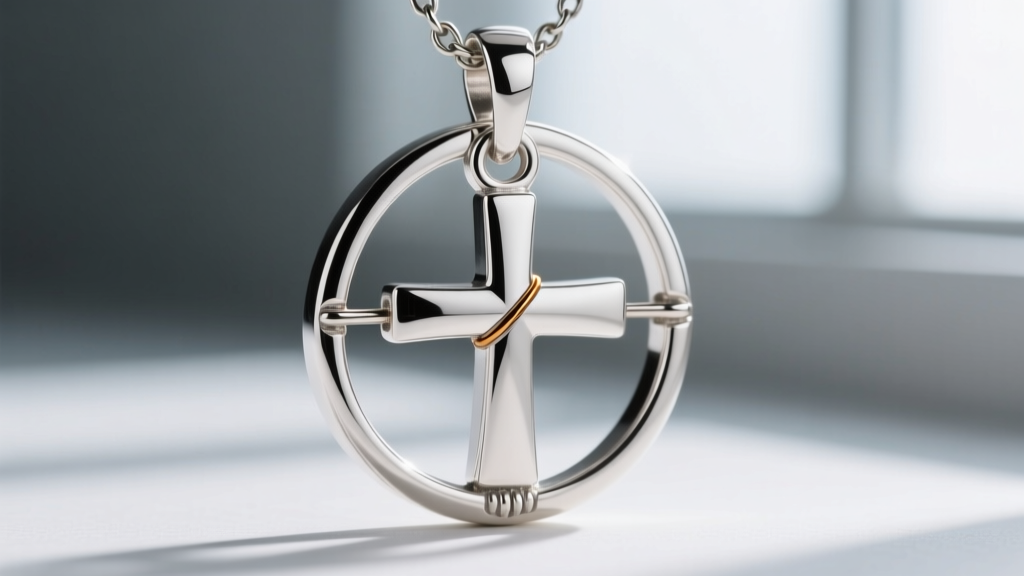
If you are commissioning a custom piece or repairing a high-end 14k gold or platinum circle cross, insist on a soldered fixed bail. According to Rio Grande's jewelry fabrication guides, a properly soldered bail using hard solder (which has a higher melting point and greater structural integrity than easy solder) will withstand decades of daily tensile stress without fatiguing.
Chain Selection: Preventing Snags and Slippage
The open quadrants of the circle cross are notorious snag traps. If you pair a wide, heavy circle cross with a delicate chain, you invite two major problems: the chain slipping through the open gaps of the circle, and the chain breaking under the pendant's dynamic weight.
The "Thread-Through" Problem
When a chain is too thin (e.g., a 0.8mm cable chain), it can easily slip through the top gap between the bail and the inner curve of the circle. Once the chain enters the quadrant, the cross flips, tangles, and can bend the delicate outer ring if pulled. You must match the chain's width and rigidity to the pendant's scale.
| Chain Type | Recommended Width | Compatibility with Circle Cross | Snag / Flip Risk |
|---|---|---|---|
| Cable | 0.8mm - 1.0mm | Poor (Too flexible, slips through quadrants) | High |
| Box | 1.2mm - 1.5mm | Excellent (Rigid links stay centered in bail) | Low |
| Rope | 1.5mm - 2.0mm | Very Good (Heavy weight anchors the pendant) | Low-Medium |
| Wheat | 1.0mm - 1.2mm | Fair (Braided texture can catch on inner circle) | Medium |
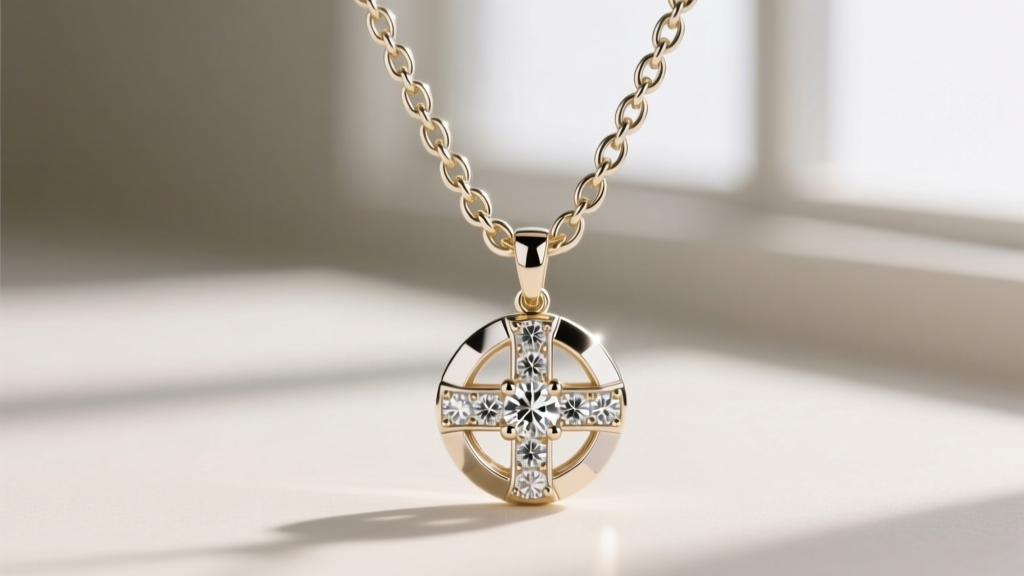
For a standard 1-inch (25mm) circle cross, a 1.5mm 14k gold or sterling silver box chain is the optimal choice. The geometric, angular links of a box chain resist twisting, ensuring the pendant remains facing forward. Furthermore, as noted in GIA's educational resources on precious metals, ensuring your chain's metal hardness matches the pendant (e.g., pairing a work-hardened sterling silver chain with a sterling silver pendant) prevents uneven wear at the friction point inside the bail.
Structural Weaknesses: Solder Joints and Metal Fatigue
A circle cross pendant has at least four primary intersection points where the arms of the cross meet the inner circumference of the outer ring. These joints are structural stress concentrators. When the pendant catches on a sweater or is pulled accidentally, the kinetic energy is transferred directly to these micro-solder joints.
Inspecting the Intersections
Use a 10x jeweler's loupe to inspect the four quadrants. Look for:
- Micro-fractures: Hairline cracks in the solder seam, indicating metal fatigue.
- Porosity: Tiny pinholes in the solder joint, a result of trapped gases during the initial torch soldering process.
- Fire Scale: Dark, oxidized patches on sterling silver joints, which can weaken the metal over time if not properly polished and sealed.
If you find a failing joint, do not attempt a DIY repair with standard craft glue or soft solder. A professional jeweler should use laser welding. Laser welders use a concentrated beam of light to fuse metal in a fraction of a second, creating a heat-affected zone (HAZ) of less than a millimeter. This is critical for circle crosses that feature pave diamonds or delicate milgrain detailing on the outer ring, as traditional torch soldering would melt the surrounding settings or burn the gemstones.
Daily Wear Maintenance and Tarnish Prevention
The intricate inner curves of the circle cross make it a magnet for skin oils, lotions, and environmental pollutants. Tarnish builds up rapidly in the 90-degree angles where the cross arms meet the ring, particularly in 925 sterling silver due to its copper alloy content. For a deep dive into how copper reacts with sulfur in the air to create silver sulfide (tarnish), refer to GIA's research on metal alloys and reactions.
Cleaning Protocols for Ringed Crosses
- Avoid Standard Polishing Cloths for Inner Curves: A flat cloth cannot reach the deep inner angles of the quadrants. Instead, use a soft-bristled baby toothbrush dipped in a mild solution of warm water and phosphate-free dish soap.
- Ultrasonic Cleaner Warnings: If your circle cross features gemstones (especially emeralds, opals, or fracture-filled diamonds), never use an ultrasonic cleaner. The high-frequency vibrations can shatter inclusions or shake stones loose from their prongs.
- Ionic Cleaners: For plain metal circle crosses (gold, platinum, or un-oxidized silver), an ionic cleaner uses electrolysis to reverse tarnish in seconds without abrasive scrubbing, perfectly preserving the sharp edges of the cross arms.
Summary Troubleshooting Checklist
Before taking your necklace to a bench jeweler, run through this diagnostic checklist to pinpoint the exact cause of your pendant's misbehavior:
- [ ] Check Bail Play: Does the pendant slide side-to-side on the chain more than 2mm? (If yes, resize or replace the bail).
- [ ] Verify Chain Width: Is the chain thinner than 1.2mm? (If yes, upgrade to a rigid box or rope chain to prevent quadrant slippage).
- [ ] Inspect Solder Joints: Are there visible gaps or dark porosity marks where the cross meets the circle? (If yes, request laser welding).
- [ ] Assess Weight Distribution: Is the bottom arm of the cross significantly thicker than the top arm? (If yes, the jeweler may need to add a hidden counterweight or reposition the bail higher on the outer ring).
By addressing the mechanical realities of the circle cross design—specifically the lateral weight distribution, bail tolerances, and chain geometry—you can transform a frustrating, constantly flipping pendant into a perfectly draping, timeless staple of your jewelry wardrobe.


