Troubleshooting Your Egyptian Ankh Necklace: Flipping & Tarnish
Is your Egyptian ankh necklace constantly flipping or tarnishing? Discover expert troubleshooting tips for bail sizing, chain weight, and metal care.

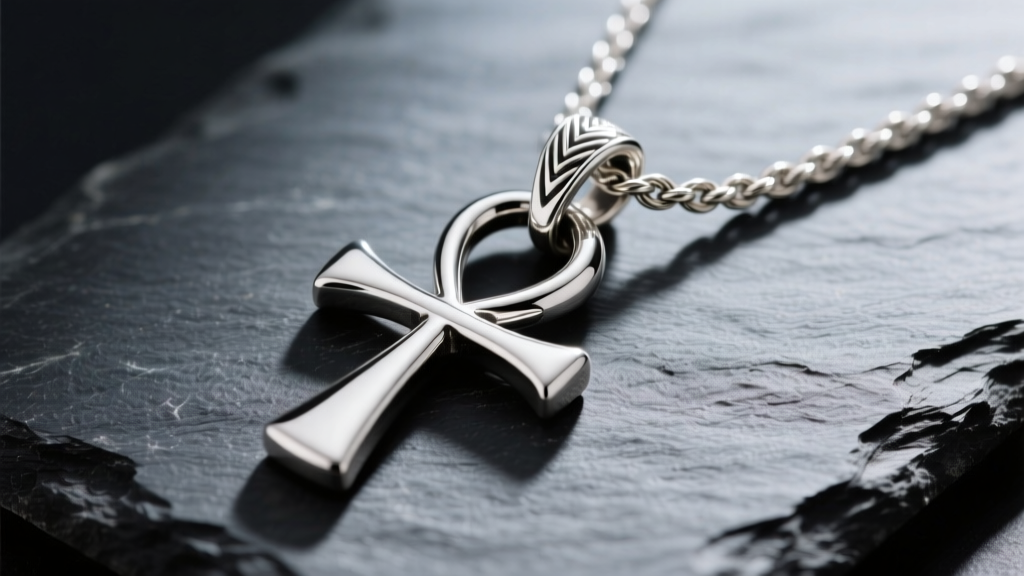
The Egyptian ankh is one of the most recognizable symbols in history, representing eternal life and cosmic balance. However, translating this ancient, top-heavy symbol into modern jewelry introduces a unique set of mechanical and chemical challenges. If your Egyptian ankh necklace constantly flips upside down, tarnishes prematurely, or suffers from chain fatigue, you are experiencing the physical realities of wearing an asymmetrical pendant. This guide dives deep into the metallurgy, physics, and structural engineering required to troubleshoot and permanently fix your ankh necklace.
The Physics of the Flip: Why Your Ankh Won't Lay Flat
The most common complaint among ankh wearers is the 'pendant flip.' The ankh's defining feature—the crux ansata or looped top—creates an uneven center of gravity. Unlike a symmetrical teardrop or circular medallion, the ankh's mass is heavily concentrated in the upper loop and the horizontal crossbar. When suspended from a chain, gravity pulls the heaviest part downward, often causing the pendant to invert or rest at an awkward 45-degree angle.
Bail Friction and Loop Sizing
The primary culprit for a flipping ankh is bail friction. The bail is the loop that connects the pendant to the chain. If the inner diameter (ID) of the bail is too tight against the thickness of your chain, the pendant loses its ability to rotate freely. Instead of swinging naturally and settling right-side up, the friction locks the pendant in whatever position it was last bumped into.
- The Fix: Measure your chain's width. A standard 1.2mm cable chain requires a bail with an inner diameter of at least 4.5mm to allow for a full 360-degree rotation without binding.
- The Bail Type: Avoid 'hidden bails' or 'tube bails' on ankhs. A traditional soldered jump-ring bail or a wide, tapered V-bail allows the pendant's top loop to act as a secondary pivot point, naturally righting the heavy bottom stem.
The Center of Gravity Problem
If your bail is correctly sized but the ankh still flips, the issue is chain drape. A lightweight chain lacks the tensile stiffness to counterbalance the heavy top loop of a solid metal ankh. To solve this, you must introduce a counter-drape. Switching from a lightweight cable chain to a 2.0mm wheat chain or a 2.5mm rope chain adds enough structural weight below the pendant to anchor the bottom stem, forcing the loop to remain upright.
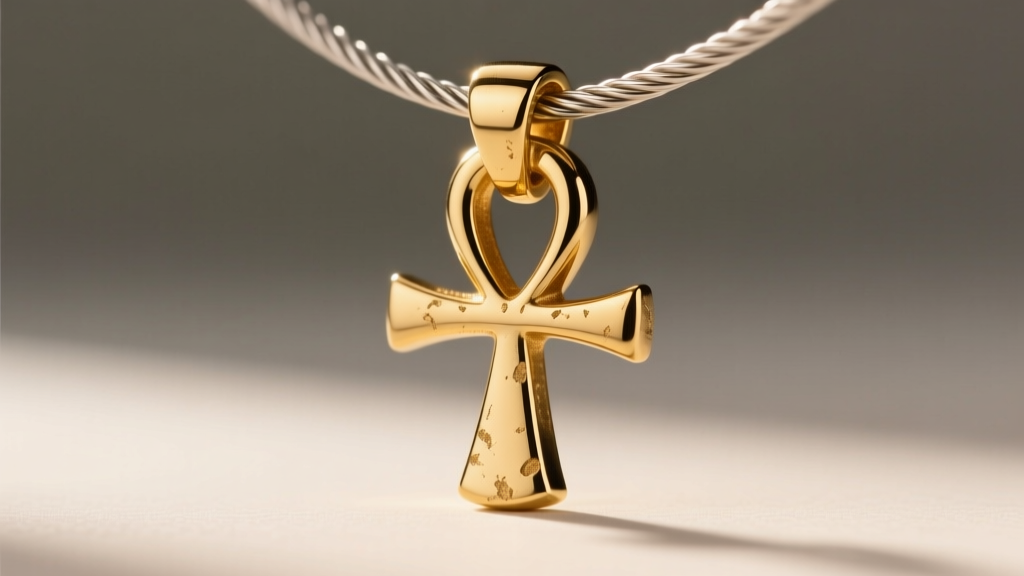
Material Breakdown: Troubleshooting Tarnish and Reactivity
Because the ankh is a popular tourist and fast-fashion motif, many necklaces are crafted from inferior base metals with microscopic layers of flash plating. When exposed to the slightly acidic pH of human sweat (typically between 4.5 and 7.0), these metals degrade rapidly. According to the Gemological Institute of America (GIA), understanding your metal's exact composition is the first step in halting chemical degradation.
| Metal Composition | Common Failure Mode | Troubleshooting & Care Protocol |
|---|---|---|
| 925 Sterling Silver | Silver sulfide tarnish (blackening) from sulfur in the air and skin oils. | Use an aluminum foil, baking soda, and hot water ion-exchange bath. Avoid abrasive pastes that strip the silver layer. |
| Brass / Bronze Alloy | Verdigris (green oxidation) and skin discoloration due to copper content reacting with sweat. | Polish with a specialized brass compound (e.g., Brasso). Coat the back of the pendant with a micro-layer of clear jewelry sealant to block skin contact. |
| Zinc Alloy (Tibetan Silver) | Pitting, gray dullness, and structural crumbling. Cannot be polished back to a shine. | Irreversible. Clean only with a dry microfiber cloth. Keep entirely away from moisture and chemical dips. |
| Gold Vermeil (Silver base) | Wear on the high-relief edges exposing the silver underneath, leading to localized galvanic corrosion. | Do not use ultrasonic cleaners. Gently buff with a treated gold-polishing cloth. Store in an anti-tarnish ziplock bag with silica gel packets. |
Chain Snapping: Solving the Top-Heavy Pendant Dilemma
A solid cast sterling silver or brass ankh pendant typically weighs between 15 and 25 grams. While this may not sound heavy, the dynamic stress placed on the chain during daily movement creates a 'guillotine effect' at the weakest points: the clasp and the jump rings.
Gauge Thickness vs. Dynamic Stress
Many ankhs are sold with decorative but structurally weak 0.8mm to 1.0mm box chains. A 1.0mm box chain has a static tensile strength of roughly 4 to 6 pounds. However, when a 20-gram ankh swings and suddenly stops (such as when you bend over or jog), the kinetic shockload can momentarily exceed the chain's yield strength, causing the links to stretch, warp, or snap entirely.
The Expert Solution: Retire the delicate box chain. Re-string your ankh on a minimum 1.5mm curb chain or a 2.0mm Figaro chain. These styles feature interlocking, flattened links that distribute kinetic shock across multiple contact points rather than concentrating it on a single soldered seam. Furthermore, ensure the jump ring connecting the pendant to the chain is soldered closed. An unsoldered jump ring will inevitably twist open under the torque of a heavy, swinging ankh.
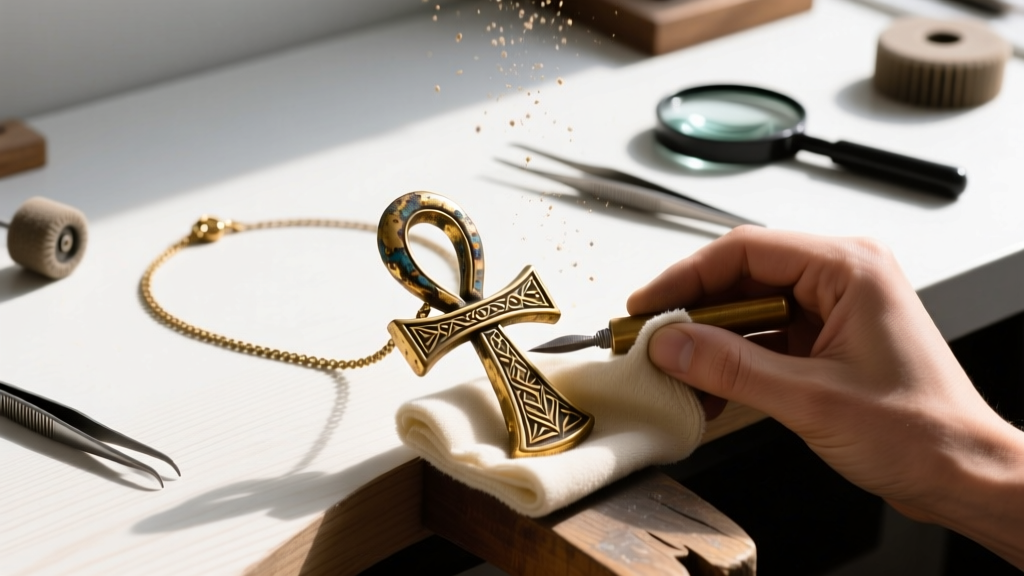
Step-by-Step Restoration for Vintage or Damaged Ankhs
If you have inherited or purchased a vintage ankh necklace that has suffered from decades of neglect, aggressive polishing can destroy its historical value. Many high-quality ankhs feature intentional 'antiquing'—a process where liver of sulfur is applied to the recessed areas of the hieroglyphic engravings to create contrast. Standard silver dips will strip this oxidation, leaving the pendant looking flat and artificially bright.
Jeweler's Rule of Thumb: Never submerge an intricately engraved or antiqued ankh in a liquid chemical dip. The capillary action will pull the harsh chemicals deep into the engravings, causing microscopic pitting that cannot be reversed.
Instead, utilize a targeted mechanical cleaning approach. Use a soft-bristled fiberglass scratch brush to gently polish only the raised, high-relief surfaces of the ankh. This removes surface tarnish while perfectly preserving the dark, oxidized patina in the deep grooves of the symbol. Follow this by rubbing a small amount of Renaissance Wax into the metal. This micro-crystalline wax creates a moisture-impermeable barrier that halts further oxidation without altering the visual depth of the pendant.
Final Thoughts on Ankh Maintenance
An Egyptian ankh necklace is more than just a decorative accessory; it is a structural puzzle. By diagnosing the specific mechanical failure—whether it is bail friction causing the pendant to flip, inadequate chain gauge leading to tensile fatigue, or improper metallurgical care resulting in irreversible tarnish—you can restore your piece to perfect condition. Always match your chain's drape and thickness to the exact weight and dimensions of your specific ankh, and treat the metal with the chemical respect it requires. With these troubleshooting protocols in place, your ankh will remain a flawless symbol of life for decades to come.


