How to Stop Your Triangle Pendant Necklace From Flipping Upside Down
Is your triangle pendant necklace constantly flipping upside down? Discover expert troubleshooting tips, bail fixes, and chain pairings to keep it flat.


There are few things more frustrating in jewelry styling than a geometric pendant that refuses to cooperate. You carefully put on your favorite triangle pendant necklace, check the mirror, and step out the door—only to glance down ten minutes later and find the triangle has flipped upside down, pointing awkwardly at your collarbone. This isn't just a minor annoyance; it is a fundamental physics problem compounded by improper chain selection and bail design.
As a stylist and jewelry technical consultant, I see this issue daily. Geometric shapes, particularly triangles, are notoriously prone to rotational shifting. In this comprehensive troubleshooting guide, we will dissect the mechanics of why your triangle pendant flips, how to upgrade your hardware to prevent Z-axis rotation, and the exact chain profiles that provide the necessary friction to keep your necklace perfectly positioned.
The Physics of the Flip: Why Triangles Misbehave
To solve the flipping problem, we first need to understand the center of mass. Unlike a circular or teardrop pendant, which has a relatively centralized or bottom-heavy weight distribution, a triangle's center of gravity is located at the intersection of its medians—roughly one-third of the way up from the base. When a triangle is suspended from its top vertex, it acts essentially as a plumb bob.
If the chain shifts even two millimeters off-center on the nape of your neck, the suspension point moves. Gravity immediately forces the pendant to rotate until its center of mass is perfectly aligned directly beneath that new suspension point. Because the top vertex of a triangle is a sharp, narrow pivot point, it offers almost zero rotational resistance. Equilateral triangles tend to flip slightly less often than elongated isosceles triangles, but both are highly susceptible to this pendulum effect.
Troubleshooting Bail and Jump Ring Failures
The bail—the loop that connects the pendant to the chain—is the primary failure point for geometric necklaces. Mass-produced triangle pendants often feature a simple, glued-on tube bail or a flimsy 20-gauge (0.81mm) soldered loop. These allow the pendant to swing freely not just side-to-side (X-axis), but also front-to-back (Z-axis), which is the exact motion that causes the flip.
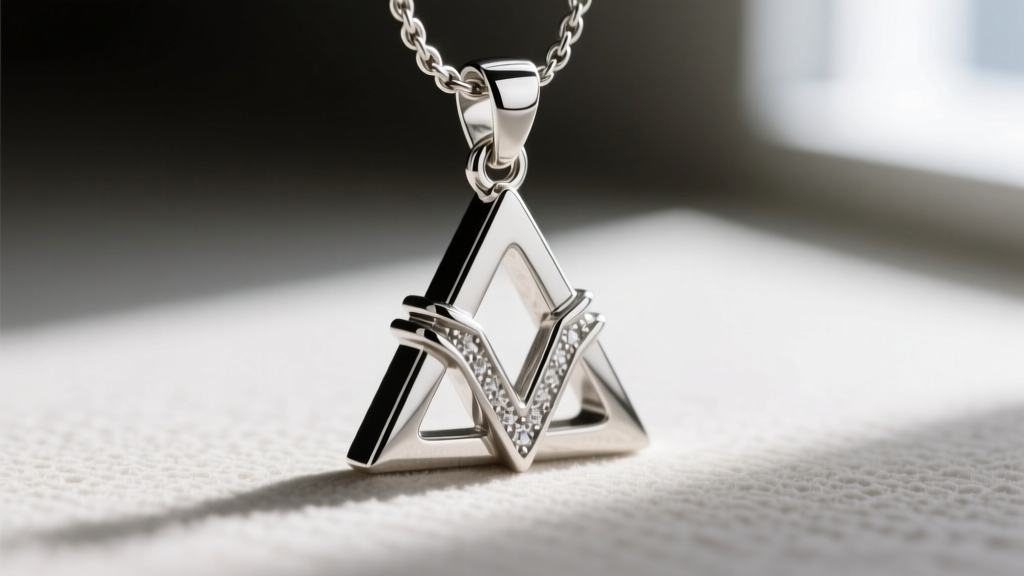
Upgrading to a Fixed V-Bail
The most effective bench jeweler solution is replacing a standard loop bail with a fixed V-bail. A V-bail is soldered directly to the top edge of the triangle at two distinct points, creating a rigid triangular bridge. According to the Rio Grande Learning Center, multi-point soldering drastically reduces the pivot radius. By restricting the pendant's ability to tilt forward and backward, the V-bail forces the necklace to lay flat against the sternum. When having a V-bail custom-soldered, request 18-gauge (1.0mm) or 16-gauge (1.3mm) wire to ensure the structural integrity of the connection point.
The Hidden Bail Alternative
If you prefer a seamless look where the chain appears to thread directly through the metal, a hidden bail (or internal channel bail) can work, but only if the channel is precisely milled. If the channel is too wide, the chain will bunch up, creating a shifting suspension point. Ensure the internal channel diameter is no more than 0.5mm wider than your chain's thickness.
Chain Selection Matrix for Geometric Pendants
Even with a perfect bail, the wrong chain will guarantee a flipped pendant. Chains with flat, smooth surfaces act like tracks, allowing the bail to slide and shift across your collarbone. You need chains with high surface friction and multi-directional links that "grip" the bail and resist sliding.
| Chain Type | Surface Friction | Rotational Resistance | Ideal Triangle Weight | Verdict |
|---|---|---|---|---|
| Box Chain | Low (Flat surfaces) | Poor | Under 2 grams | Avoid: Promotes sliding and flipping. |
| Cable Chain | Medium | Fair | 2 - 5 grams | Acceptable: Better than box, but can still twist. |
| Rope Chain | High (Textured) | Excellent | 5 - 12 grams | Highly Recommended: Twisted links grip the bail. |
| Wheat Chain | Very High (Woven) | Superior | 8 - 15+ grams | Best Overall: Maximum friction, lays perfectly flat. |
As shown in the matrix above, a woven wheat chain or a tightly twisted rope chain provides the necessary drag to keep the suspension point centered on your neck. If you are wearing a heavy, solid 14k gold triangle pendant weighing over 8 grams, pairing it with a delicate 1.2mm box chain is a guaranteed recipe for constant flipping and eventual chain breakage.

Advanced Fixes: Counterweights and Tensioning
If you are deeply attached to a specific chain and pendant combination that refuses to behave, you can employ a few advanced styling hacks used by editorial jewelers to manipulate the necklace's tension.
The Counterweight Method
The flip happens because the front of the necklace slides, shifting the suspension point. You can anchor the suspension point by adding a counterweight to the back of the neck. Thread a small, dense bead—such as a 3mm or 4mm 14k gold rondelle or a high-density silicone tension bead—onto the chain directly opposite the clasp. This weight rests at the nape of your neck, pulling the chain taut and preventing the front from sliding side-to-side. This simple fix solves the flipping issue for 90% of stubborn geometric pendants.
The Clasp-Shift Technique
Alternatively, move the clasp from the back of the neck to the front, hiding it beneath the triangle pendant itself (if the pendant is large enough). By anchoring the chain's connection point at the bottom center of your chest, you eliminate the back-of-neck sliding entirely. This requires a chain with a small, discreet lobster clasp and a jump ring large enough to connect the two ends at the pendant's bail.
Maintenance: Protecting Sharp Edges and Flat Surfaces
Troubleshooting the flip also involves maintaining the physical integrity of the triangle's sharp vertices. The top vertex, which bears the brunt of the bail's friction, is highly susceptible to wear. Over time, a standard jump ring will saw through the top corner of a soft metal triangle, such as 925 sterling silver or 10k gold.
The GIA Gem Encyclopedia notes that metal durability and wear rates are heavily dependent on alloy composition and work hardening. To prevent the bail from cutting into the pendant, ensure the inside of the bail is smoothly polished and, ideally, rhodium-plated if using white gold or silver to reduce galvanic friction. Furthermore, the sharp bottom corners of triangle pendants are notorious for snagging on knitwear and silk. If your triangle frequently catches on clothing, ask a bench jeweler to lightly "ease" or chamfer the bottom vertices with a cup bur, removing the microscopic burrs that act like tiny hooks.
Expert Bench Tip: Never use a standard split ring to attach a triangle pendant. The overlapping wire of a split ring creates an uneven surface inside the bail, causing the pendant to tilt forward and increasing the likelihood of the Z-axis flip. Always use a perfectly flush, soldered jump ring or a seamless solid loop.
By understanding the physics of geometric weight distribution, upgrading to a rigid V-bail, selecting a high-friction wheat or rope chain, and utilizing counterweights, you can permanently solve the flipping issue. Your triangle pendant necklace will finally lay flat, allowing its clean lines and architectural beauty to take center stage exactly as intended.


