Solving Common Golden Star of David Necklace Problems
Is your golden Star of David necklace tarnishing, tangling, or breaking? Learn expert troubleshooting tips for chain repair, gold plating, and clasp fixes.


A golden Star of David necklace is more than just an accessory; it is a profound symbol of heritage, faith, and identity. However, daily wear exposes these meaningful pieces to environmental stressors, mechanical friction, and chemical reactions that can lead to tarnishing, chain breakage, and pendant flipping. Whether you are wearing a family heirloom or a newly purchased 14k gold piece, understanding the metallurgy and mechanics of your jewelry is essential for long-term preservation. In this comprehensive troubleshooting guide, we address the most frequent issues owners face and provide actionable, expert-level solutions to restore and protect your necklace.
The Metallurgy Problem: Tarnishing and Skin Discoloration
One of the most common complaints regarding a golden Star of David necklace is unexpected tarnishing or the development of a greenish-black residue on the skin. To troubleshoot this, we must first distinguish between solid gold alloys and gold-plated alternatives. Pure 24k gold is highly inert and will not tarnish, but it is far too soft for daily jewelry wear. Therefore, most necklaces are crafted from 14k (58.5% gold) or 18k (75% gold) alloys. The remaining percentage consists of metals like copper, silver, and zinc.
Copper, in particular, is highly reactive to the lactic acid, urea, and salts present in human sweat. When a 14k gold Star of David pendant rests against the chest, the copper alloys can oxidize, creating copper chloride or copper sulfide compounds. This manifests as a dark tarnish on the metal and a green discoloration on the skin. According to the Gemological Institute of America (GIA), environmental factors such as high humidity, exposure to chlorinated pool water, and contact with sulfur-rich foods can drastically accelerate this oxidation process.
Vermeil vs. Standard Plating: The FTC Standards
If your necklace is not solid gold but rather "golden" (plated), the troubleshooting shifts to the integrity of the plating. The Federal Trade Commission (FTC) mandates that for a piece to be classified as gold vermeil, it must feature a sterling silver base coated with a minimum of 2.5 microns of gold. Standard gold plating, often applied over brass or copper bases, can be as thin as 0.175 microns. When this micro-thin layer wears away due to friction against the collarbone, the reactive base metal is exposed, leading to rapid tarnishing and potential nickel-induced contact dermatitis.
| Material Type | Composition | Tarnish Risk | Troubleshooting Fix |
|---|---|---|---|
| 24k Solid Gold | 99.9% Pure Gold | None | N/A (Requires only polishing) |
| 18k Solid Gold | 75% Gold, 25% Alloy | Low | Mild soap wash; professional polish |
| 14k Solid Gold | 58.5% Gold, 41.5% Alloy | Moderate | Remove before sweating/swimming |
| Gold Vermeil | Sterling Silver + 2.5µm Gold | Moderate/High | Avoid friction; re-plate when worn |
| Gold Plated (Brass) | Brass Base + <1µm Gold | Very High | Seal with jewelry shield; replace |
Mechanical Failures: Chain Snaps and Clasp Fatigue
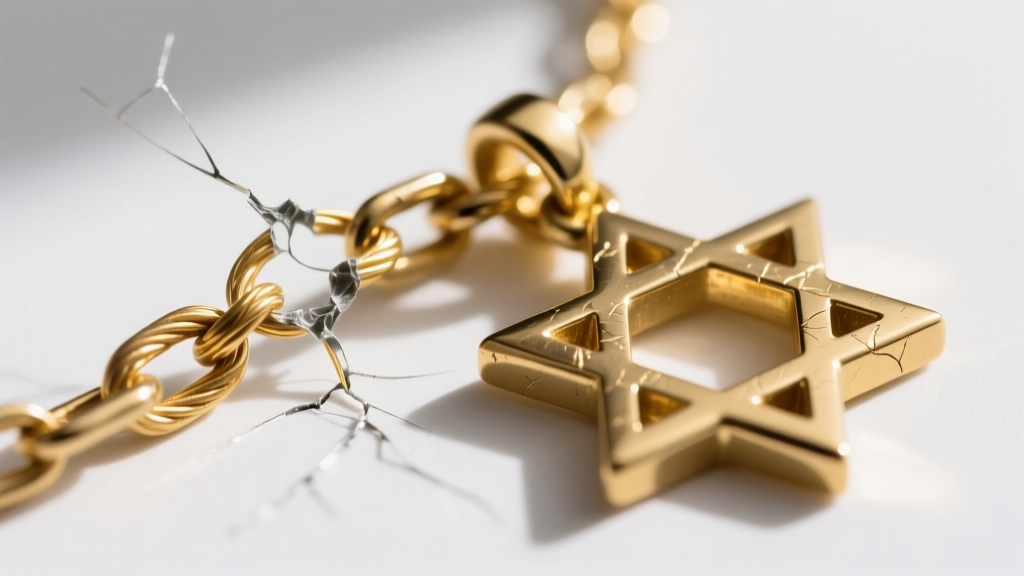
The Star of David features a complex geometric design that often results in a heavier, denser pendant compared to simpler shapes. A frequent mechanical failure occurs when a heavy solid gold pendant is paired with an inadequate chain. Many manufacturers pair 10-gram pendants with delicate 0.8mm or 0.9mm cable chains to keep retail costs down. However, a 0.9mm cable chain has a tensile strength of roughly 3 to 5 pounds. The repetitive micro-tugging caused by the pendant swinging during daily movement induces metal fatigue, usually resulting in a snap at the soldered jump ring near the clasp.
Upgrading the Chain Architecture
To solve this, you must match the chain's structural integrity to the pendant's weight. For a standard 5g to 15g Star of David pendant, upgrade to a 1.5mm to 2.0mm box chain or wheat chain. Box chains feature interlocking square links that distribute weight evenly and offer a tensile strength exceeding 15 pounds. Furthermore, inspect the clasp. Spring ring clasps are notorious for internal spring failure and accidental unhooking. Replacing the spring ring with a 5mm or 6mm lobster claw clasp provides a much more secure, mechanically sound closure that will not easily catch on hair or clothing.
The "Flipping Pendant" Dilemma
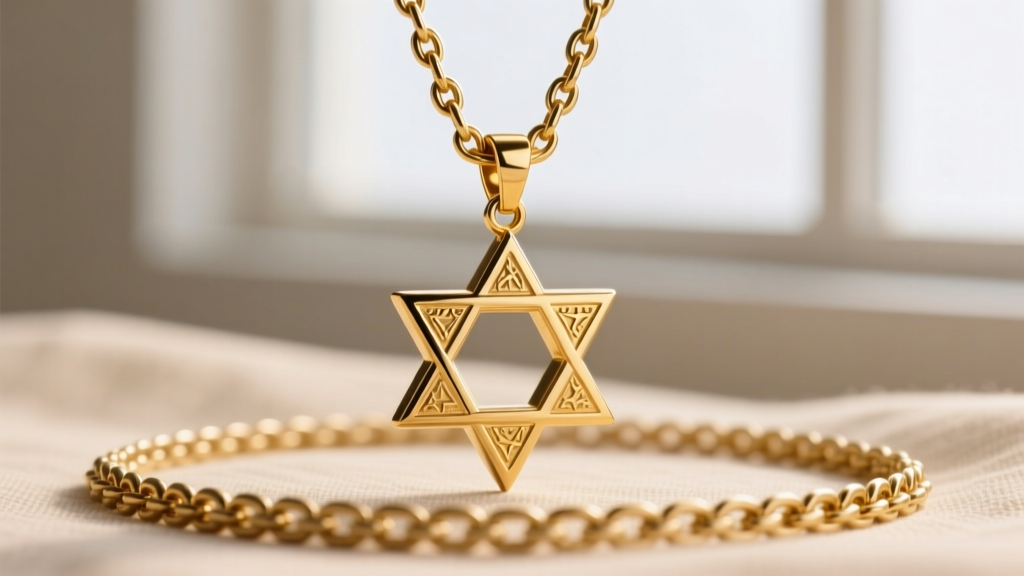
Because the Star of David consists of two overlapping triangles, its center of gravity is perfectly centralized, but its wide horizontal profile makes it prone to flipping upside down or sliding off-center along the neckline. This is rarely a defect in the pendant itself; rather, it is a mismatch between the pendant's bail (the loop that connects it to the chain) and the chain's thickness.
If the bail has an inner diameter of 4mm and you are wearing a 3mm rolo chain, the pendant has too much lateral freedom to slide and flip. The troubleshooting solution involves restricting the pendant's mobility. A professional jeweler can install a hidden silicone stopper bead inside the chain, positioned exactly at the center of the neckline, to anchor the bail in place. Alternatively, you can swap to a flattened snake chain or a herringbone chain, which naturally lays flat against the clavicle and creates enough friction to prevent the bail from sliding laterally. According to Jewelers of America, ensuring the proper chain-to-bail ratio is the most critical factor in maintaining the correct orientation of geometric pendants.
Restoration and Cleaning Protocols
When your golden Star of David necklace loses its luster, the instinct is often to reach for commercial liquid silver dips or heavy chemical polishes. This is a critical error. Many commercial "instant" dips rely on thiourea, a highly toxic chemical that strips away the oxidized copper layer but leaves the gold surface microscopically porous and pinkish. Over time, thiourea will degrade the structural integrity of 14k and 18k gold alloys.
The Safe Surfactant Method
For routine troubleshooting of dullness and buildup, utilize a mild surfactant method. Mix three drops of a phosphate-free dish soap (like Dawn) into a bowl of lukewarm distilled water. Submerge the necklace for exactly 15 minutes to loosen sebum and dead skin cells trapped in the intricate corners of the Star of David. Use a soft-bristled baby toothbrush to gently agitate the crevices. Rinse with distilled water—not tap water, which contains chlorine and calcium that can leave water spots—and pat dry with a lint-free microfiber cloth. For deeper scratches on solid gold pieces, a professional jeweler must use a rouge polishing wheel to remove a microscopic layer of metal and restore the mirror finish.
Summary Checklist for Long-Term Care
- Verify the Karat: Check the hallmark (14k, 18k) to understand your alloy's reactivity to sweat and chemicals.
- Audit the Chain: Ensure your chain is at least 1.5mm thick if your pendant exceeds 5 grams to prevent metal fatigue.
- Upgrade the Clasp: Replace weak spring rings with sturdy lobster clasps to prevent accidental loss.
- Anchor the Bail: Use silicone stoppers or friction-heavy chains (like snake chains) to stop the pendant from flipping.
- Avoid Harsh Chemicals: Never use thiourea-based dips; stick to mild surfactants and professional polishing.
By addressing these specific metallurgical and mechanical vulnerabilities, you can ensure that your golden Star of David necklace remains a pristine, enduring symbol for decades to come.


