Olivia Benson Compass Necklace: Sourcing & Repair Guide
Troubleshoot common Olivia Benson compass necklace replica failures. Learn how to fix foggy glass, broken bails, and source high-quality alternatives.


The Hunt for True North: Why Replicas Fail
Captain Olivia Benson’s compass necklace on Law & Order: SVU is far more than a simple wardrobe prop. For over two decades, it has served as a narrative talisman, symbolizing her unwavering moral compass and her relentless pursuit of justice. Naturally, this iconic piece of television history has sparked a massive demand among fans. However, the market is currently flooded with low-quality, mass-produced replicas that fail to capture the durability and weight of a genuine heirloom piece. As a jewelry specialist, I see countless fans reaching out after their prized 'Benson necklace' has suffered from snapped chains, foggy glass, or severe skin irritation.
The core issue lies in the metallurgy of cheap fandom merchandise. Most budget replicas are cast from Zamak, a zinc alloy mixed with aluminum, magnesium, and copper. While Zamak is cheap to cast, it is highly susceptible to 'zinc pest'—a form of intergranular corrosion that causes the metal to slowly expand, crack, and crumble over time. Furthermore, many online listings deceptively market their pendants as 'Tibetan Silver' or 'Antique Silver.' According to the Federal Trade Commission Jewelry Guides, these terms are often unregulated misnomers for lead, tin, and copper alloys that not only tarnish aggressively but can also trigger severe contact dermatitis.
Troubleshooting Common Compass Pendant Failures
If you already own a replica Olivia Benson compass necklace that is showing signs of wear, do not discard it immediately. Many of the most common failure points can be stabilized or repaired with basic jeweler's techniques. Below is a diagnostic framework for the most frequent issues.
| Symptom | Root Cause | Metallurgical / Repair Fix |
|---|---|---|
| Foggy or Yellowed Glass | Cheap UV-cured resin degrading, or moisture trapped under a poorly seated bezel. | Pop the bezel with a lifter, clean the crystal with 99% isopropyl alcohol, and reseal with G-S Hypo Cement. |
| Stuck Compass Needle | Magnetized debris inside the casing or friction from a bent center pin. | Use a jeweler's demagnetizer on the casing; carefully straighten the pin with fine-tipped brass tweezers. |
| Snapped Bail (Pendant Loop) | Cast too thin; stress fracture from the weight of the pendant swinging. | Have a local jeweler laser-weld a heavy-duty 925 sterling silver V-bail to the pendant's top ridge. |
| Black/Green Skin Staining | Copper or brass base metal reacting to sweat and skin acidity (oxidation). | Apply a micro-thin coat of clear jeweler's lacquer (like ProtectaClear) to the back of the pendant. |
Deep Dive: Reseating a Foggy Compass Crystal
The most common complaint I receive regarding compass pendants is a cloudy or fogged glass face. In cheap replicas, the 'glass' is often a stamped acrylic or low-grade resin that yellows when exposed to UV light and skin oils. If the material itself hasn't yellowed, the fog is likely moisture trapped beneath the bezel. To fix this, you will need a precision bezel lifter tool and a loupe.
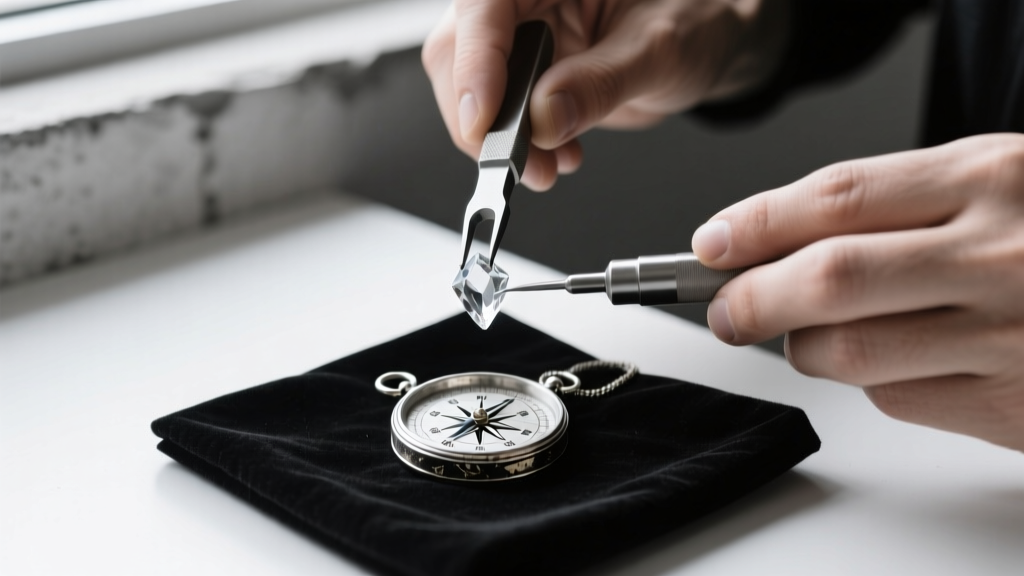
Insert the flat edge of the bezel lifter under the metal lip holding the crystal. Apply gentle, even pressure to pop the tension. Once the crystal is removed, clean both sides with 99% isopropyl alcohol and a microfiber cloth. Avoid using ammonia-based glass cleaners, as they can strip the painted cardinal directions off the underside of the dial. When reseating, apply a microscopic bead of G-S Hypo Cement along the inner rim before pressing the metal bezel back down. This creates a watertight seal that prevents future condensation.
Chain Mechanics: Preventing the 'Snap and Lose'
A genuine brass or bronze compass pendant is surprisingly heavy, often weighing between 15 and 25 grams. Most replica necklaces are sold with flimsy 1mm box chains or hollow rope chains that have a tensile breaking point of roughly 8 to 10 grams. When a heavy pendant swings on a weak chain, the kinetic energy causes 'work hardening' at the links nearest to the clasp. Over time, the metal becomes brittle and snaps without warning, resulting in the tragic loss of the pendant.
Upgrading Your Chain and Clasp
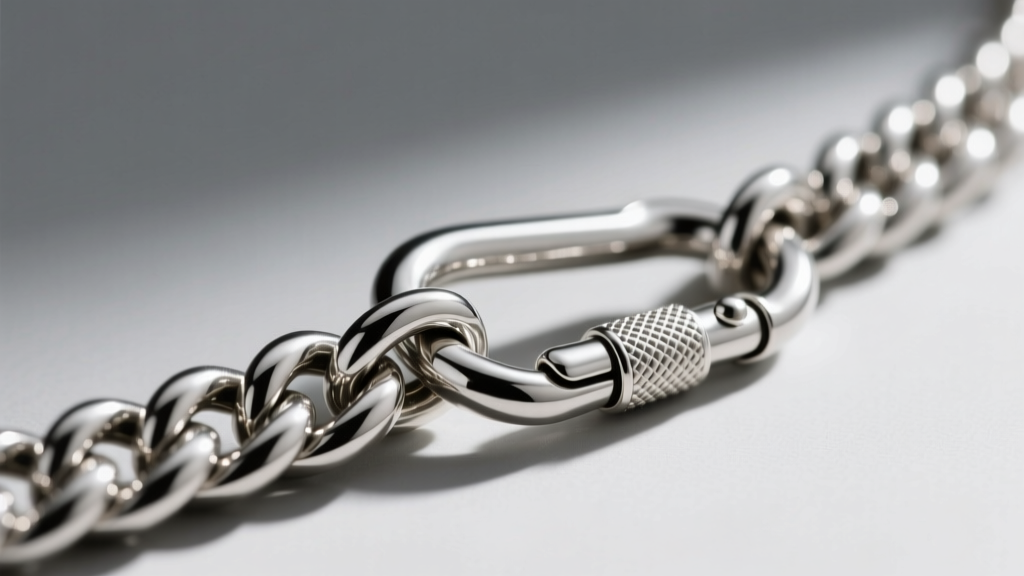
To properly support the weight of a Benson-style compass pendant, you must upgrade the chain architecture. I recommend a 1.5mm to 2.0mm solid Wheat chain or a reinforced Rope chain. Wheat chains feature interlocking, directional links that distribute weight evenly and resist kinking, making them ideal for heavy pendants.
Equally important is the clasp. Standard 5mm lobster clasps often fail because the internal spring mechanism weakens. Upgrade to a 7mm trigger clasp or, ideally, a locking carabiner clasp. A locking carabiner features a secondary screw-down barrel that physically prevents the lever from opening, ensuring your pendant stays secured around your neck even during vigorous activity.
Sourcing a Permanent Replacement in 2026
If your current necklace is beyond repair, or you are looking to invest in a high-quality, permanent homage to the character, you must vet sellers with a critical eye. The secondary market and custom jewelry platforms are rife with misleading listings. Here is your actionable checklist for sourcing a premium compass necklace that will last a lifetime.
- Demand Solid Metals: Look strictly for 925 Sterling Silver, solid 14k Gold, or 316L Surgical Stainless Steel. Avoid anything labeled 'silver-plated' or 'antique bronze' unless the seller provides a metallurgical breakdown.
- Verify the Hallmark: Authentic sterling silver will bear a '925' stamp. As outlined by The Silver Institute, this stamp guarantees the alloy contains 92.5% pure silver. If the pendant is too small for a stamp, request an XRF (X-ray fluorescence) test result from the seller.
- The Magnet Test Caveat: Normally, you would use a magnet to test for silver (silver is non-magnetic). However, because this is a compass pendant, the internal needle is magnetized. Test the chain and the bail with a strong neodymium magnet instead. If the chain pulls toward the magnet, it is steel or iron-plated, not sterling silver.
- Check the Dial Construction: High-end replicas will feature a floating, liquid-filled compass dial rather than a static, painted image. Liquid damping allows the needle to settle smoothly on True North without erratic spinning.
'A compass doesn't just tell you where North is; it reminds you of where you've been and the direction you've chosen to go.' When investing in a piece of jewelry with this much symbolic weight, the physical craftsmanship must match the emotional resonance.
Final Calibration and Care
Once you have secured or repaired your Olivia Benson compass necklace, proper maintenance is key to preserving its antique or polished finish. Store the piece in an anti-tarnish cloth pouch when not in use, and keep it away from humid environments like bathrooms. If you opt for a sterling silver version, remember that sulfur in the air is your enemy. A simple polish with a treated jeweler's cloth once a month will keep the cardinal directions gleaming, ensuring your personal talisman remains as steadfast and reliable as the detective who inspired it.


