Fix Tangling & Flipping in Your Layered Heart Necklace
Stop your layered heart necklace from tangling and flipping. Expert troubleshooting tips on chain weaves, length gaps, and pendant weight ratios.

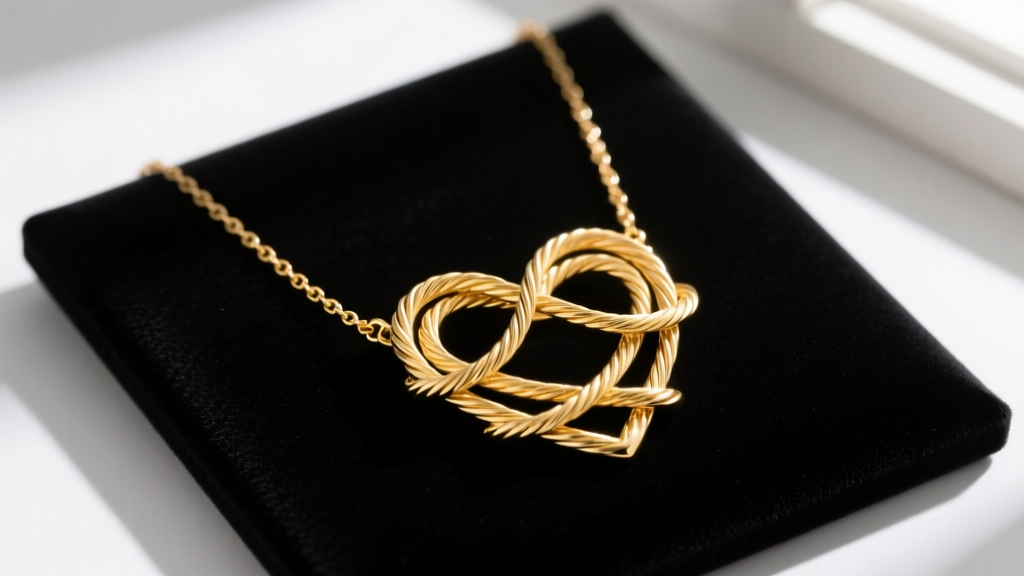
There are few things more frustrating in daily jewelry wear than pulling a beautiful layered heart necklace from your jewelry box, only to find it bound in an impenetrable bird's nest of metal. Layering is a cornerstone of modern personal style, but combining multiple delicate chains with asymmetrical pendants introduces a host of mechanical problems. From relentless tangling to pendants that constantly flip upside down, a layered heart necklace requires precise calibration to function correctly.
As a jewelry stylist and repair specialist, I see these structural failures daily. The issue is rarely the quality of the gold or silver; rather, it is a mismatch of physics, chain geometry, and weight distribution. Below is a comprehensive troubleshooting guide to diagnosing and permanently fixing the most common issues plaguing your layered heart necklaces.
The Physics of Necklace Tangling: Why Heart Pendants Cause Knots
To solve the tangling problem, we must first understand why heart pendants are uniquely prone to knotting compared to round or bar pendants. According to the Gemological Institute of America (GIA), the wearability of a jewelry piece is heavily dictated by its center of gravity. A heart pendant has a wide, bi-lobed top and a tapered bottom. When you move, this asymmetrical shape acts like a pendulum with an uneven weight distribution, causing the pendant to swing laterally and catch on adjacent chains.
Furthermore, the surface friction of the metal plays a massive role. Sterling silver (925) naturally develops microscopic layers of tarnish and oxidation over time, which increases surface porosity and friction. High-polish 14k gold or platinum remains smoother, allowing chains to glide past one another rather than gripping and knotting. If you are layering mixed metals, the varying friction coefficients will almost guarantee a tangle within hours of wear.
Emergency Rescue: The Baby Powder & Needle Technique
Before we discuss preventative hardware fixes, you need to safely untangle your current setup without stretching or snapping the delicate links. Never pull the chains tight; this work-hardens the metal and leads to immediate breakage.
- Step 1: Lay the knotted layered heart necklace flat on a hard, non-porous surface like a glass table or ceramic plate.
- Step 2: Generously dust the knot with talcum baby powder or cornstarch. This acts as a dry lubricant, reducing the friction coefficient between the microscopic metal links.
- Step 3: Using two fine-tipped sewing needles or beading awls, gently work the needles into the center of the knot. Push the links apart laterally rather than pulling them outward.
- Step 4: Once separated, use a soft-bristled toothbrush to remove the powder, then polish with a microfiber cloth.
Troubleshooting Matrix: Chain Weave vs. Pendant Weight
The most common mistake consumers make is pairing the wrong chain weave with a heavy heart pendant. Data from jewelry manufacturing suppliers like Halstead Bead Inc. highlights that different weaves possess vastly different tensile strengths and flexibility profiles. A 20-gauge (0.8mm) cable chain is standard for delicate hearts, but upgrading to an 18-gauge (1.0mm) box chain provides the structural rigidity needed to resist folding and knotting.
| Chain Weave | Tangle Risk | Best Pendant Weight | Troubleshooting Fix |
|---|---|---|---|
| Cable (Standard) | High | Under 2.5 grams | Upgrade to a thicker gauge or switch to a box chain for the base layer. |
| Box | Low | 2.0 - 5.0 grams | Ensure the heart bail is wide enough; box chains do not bend sharply. |
| Rope | Medium | 3.0 - 6.0 grams | Keep away from hair and loose knits; the twisted grooves catch fibers easily. |
| Snake | Extremely High | Under 1.5 grams | Never layer snake chains with other weaves. They act like velcro to cable chains. |
| Figaro | Medium | 3.0 - 7.0 grams | Use only as the longest, bottom layer to prevent the varied links from snagging. |
The 2-Inch Rule: Calibrating Length Differentials
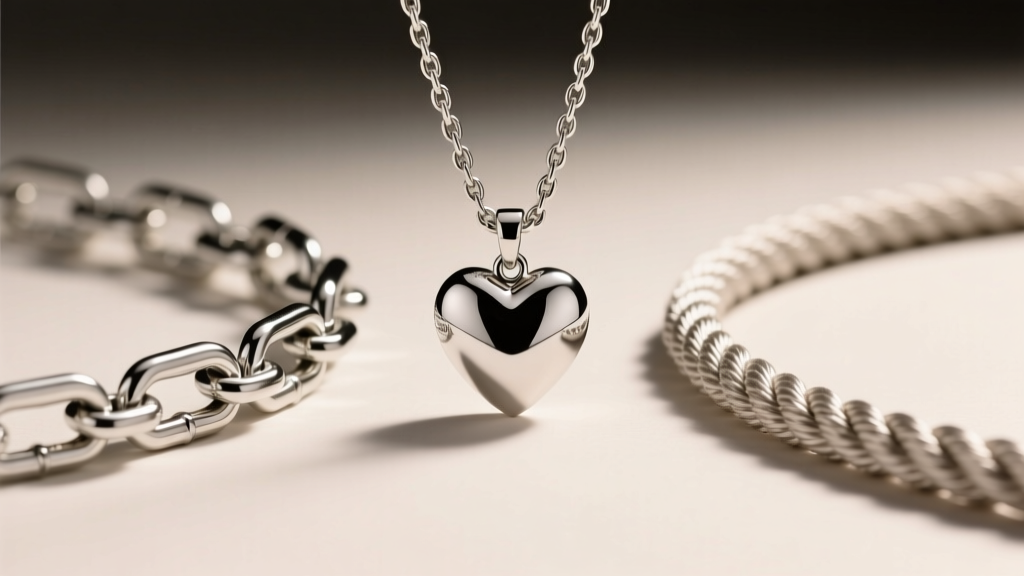
Many pre-made layered heart necklaces on the market feature chains with a mere 1-inch or 1.5-inch length differential (e.g., 15 inches and 16.5 inches). This is a critical design flaw. When the gap is this narrow, the bail (the loop connecting the pendant to the chain) of the shorter necklace rests directly on the links of the longer necklace. Every time you move, the bail acts as a hook, catching the lower chain and creating a friction knot at the sternum.
The Fix: Enforce a strict minimum 2-inch differential between layers. A perfectly calibrated three-layer setup should measure 14 inches (choker), 16 inches (collarbone), and 18 inches (upper chest). This spacing ensures that the heart pendants occupy entirely different spatial zones, physically preventing the bails from interacting with the chains below them.
Solving the 'Pendant Flip' Problem
Another pervasive issue is the heart pendant constantly flipping upside down or sliding to the back of the neck. This happens when the pendant's bail is too large for the chain, or when a simple jump ring is used instead of a fixed bail. Because a heart shape is wider at the top, a loose jump ring allows the pendant to rotate 360 degrees on the chain's axis.
To troubleshoot this, inspect the finding connecting your heart to the chain. If it is a standard circular jump ring, take the piece to a jeweler and have it replaced with a pinch bail or a glue-on tube bail. These specialized findings lock the pendant into a forward-facing orientation. Additionally, ensure your chain thickness does not exceed 60% of the bail's inner diameter. If you force a 1.5mm chain through a 2mm bail, the lack of clearance will force the heart pendant to sit at an awkward, tilted angle, causing it to flip unpredictably.

Hardware Fixes: Spacer Clasps and Counterweights
If you have optimized your chain weaves and length differentials but still experience minor tangling at the nape of the neck, the issue lies in your clasps. Standard 5mm spring ring clasps are lightweight. When you attach three chains and multiple heart pendants to a single neck, the cumulative forward weight pulls the lightweight clasp around to the front of your throat, twisting the chains at the base of your neck.
Implementing Multi-Strand Spacers
The ultimate hardware fix is a multi-strand magnetic spacer clasp. This single finding features two or three distinct loops on each side, locking your layered heart necklace into a rigid, parallel formation at the nape. By preventing the chains from crossing over one another behind your neck, you eliminate 80% of the friction that leads to frontal knotting.
Adding a Counterweight
If you prefer to keep your chains separate, you must add a counterweight to the back of the neck. Upgrading your standard spring ring to a heavy, solid 10mm lobster clasp—or adding a small 3-gram metal 'clasp weight' tag to the existing ring—anchors the back of the necklace. This counter-tension keeps the clasps securely at the nape, allowing the heart pendants to hang freely at the front without dragging the entire setup out of alignment.
Metal Fatigue and Clasp Failure in Multi-Strand Setups
Finally, be aware of the structural toll that layering takes on your jewelry. The dynamic load of three swinging chains generates kinetic stress that far exceeds the static weight of the pieces. A standard 5mm spring ring clasp has a tensile failure point of roughly 2.5 to 3 pounds. A sudden snag on a sweater can generate a spike of 5+ pounds of force, causing the spring ring to pop open or the delicate jump rings connecting your heart pendants to snap.
Routinely inspect the jump rings holding your heart pendants. If the gap in the jump ring has pulled even slightly open, the pendant will eventually slip off and be lost. Have a jeweler solder the jump rings shut, or replace them with seamless, machine-closed rings. By addressing the physics, geometry, and hardware of your setup, your layered heart necklace will transition from a frustrating tangled mess into a flawless, everyday staple.


