How to Fix a Tiny Star of David Necklace: Tangling, Flipping & Breaks
Is your tiny star of David necklace constantly tangling, flipping, or breaking? Discover expert troubleshooting tips to fix chain and clasp issues today.

The Unique Mechanical Challenges of Micro-Pendants
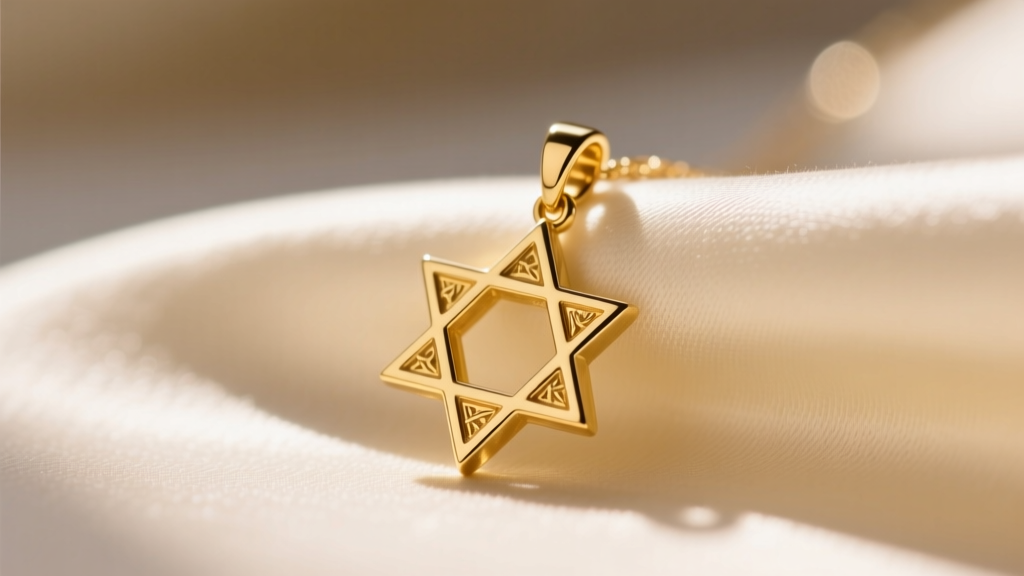
Minimalist faith-based jewelry continues to dominate daily wear trends, but sporting a tiny star of David necklace (typically measuring between 8mm and 12mm) introduces specific mechanical frustrations. Because the pendant is exceptionally lightweight—often weighing less than 0.5 grams—it lacks the gravitational pull required to keep a chain taut and a clasp anchored at the nape of the neck. Furthermore, the geometric hexagram shape, featuring six distinct points, creates a unique center of gravity that makes the pendant prone to flipping upside down or catching on chain links.
If your delicate necklace is constantly knotting, migrating, or breaking, the issue rarely lies with the pendant itself. Instead, it is usually a mismatch in chain geometry, jump ring sizing, or clasp weight distribution. Below, we break down the exact troubleshooting frameworks used by bench jewelers to solve these micro-pendant problems.
Problem 1: The Pendant Keeps Flipping Upside Down
Why the Hexagram Flips
The Star of David is composed of two interlocking triangles. When a bail (the loop that holds the pendant) is soldered to the top point, the center of gravity sits low, which should theoretically keep it upright. However, flipping occurs when the jump ring connecting the pendant to the chain is too large or too thick. If a jeweler uses a standard 18-gauge jump ring with a 3.0mm outer diameter (OD) on a 10mm pendant, the pendant has too much lateral play. It slides along the chain and flips over when you move.
The Soldered Jump Ring Fix
To stop the flipping, the pendant must be restricted from sliding freely. You need a jump ring with an OD no larger than 1.5mm to 2.0mm, crafted from 20-gauge or 22-gauge wire. More importantly, the jump ring should be laser-soldered to the pendant's bail. By soldering the jump ring directly to the bail, you eliminate the gap that allows the chain to slip through and twist the pendant. According to repair standards outlined by Jewelers of America, laser soldering is the safest method for micro-pendants because it applies highly localized heat, preventing any thermal damage to the delicate points of the star.
Problem 2: Chain Tangling and Knotting
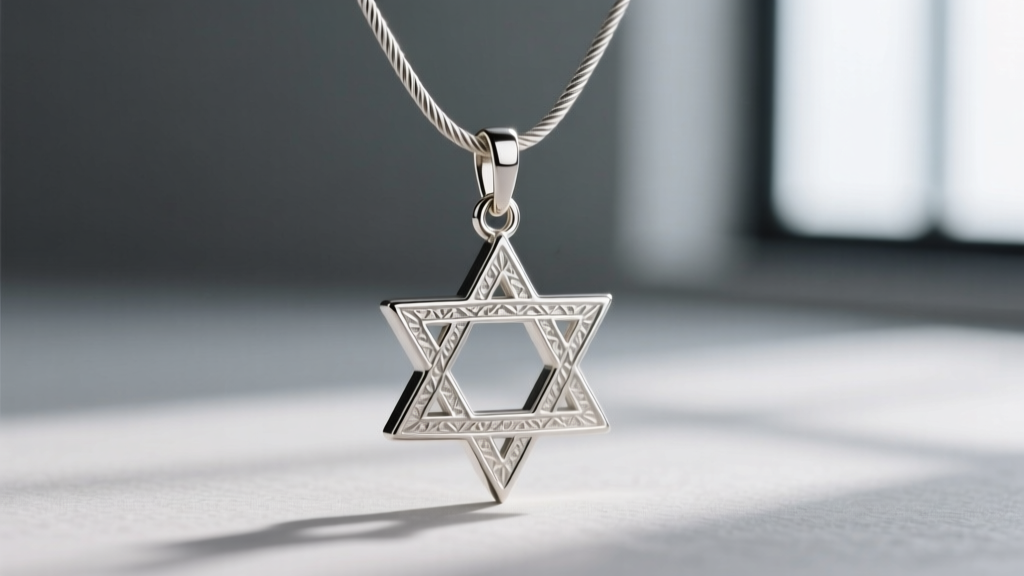
Not all chains are engineered for geometric micro-pendants. The sharp points of a tiny star of David will easily pierce the gaps in certain chain weaves, leading to severe tangling or even tearing the chain apart from the inside.
Chain Type Compatibility Matrix
| Chain Type | Compatibility | Why It Works / Fails |
|---|---|---|
| Standard Cable (0.9mm - 1.2mm) | Excellent | Uniform, tight oval links prevent the star's points from slipping inside the gaps. |
| Box Chain (1.0mm) | Very Good | Square, interlocking links lay flat and offer high tensile strength for lightweight pendants. |
| Snake Chain | Poor | The tight, smooth surface seems ideal, but the micro-grooves catch on the star's points, causing kinks. |
| Herringbone | Terrible | Highly fluid and fragile; the sharp star points will easily snag and permanently bend the flat links. |
| Rope Chain (under 1.5mm) | Fair | The twisted links can trap the pendant's bail, causing it to twist and tangle near the clasp. |
Pro Tip: Avoid chains thinner than 0.8mm. While a 0.5mm thread chain looks incredibly dainty, it lacks the structural integrity to support even a 0.4-gram pendant without stretching or snapping when caught on a sweater. A 1.0mm cable chain offers the perfect visual balance and tensile strength.
Problem 3: The Clasp Slides to the Front of Your Neck
There is nothing more annoying than constantly reaching behind your neck to pull your clasp back to the center. This happens due to a simple physics problem: weight distribution.
Understanding the Weight Imbalance
A tiny 10mm star of David pendant in 14k gold weighs approximately 0.3 to 0.5 grams. Conversely, a standard 5x9mm solid gold lobster clasp can weigh between 0.6 and 0.9 grams. Because the clasp is heavier than the pendant, gravity naturally pulls the heavier component downward, causing the clasp to migrate to the front of your chest.
Counterweight Solutions
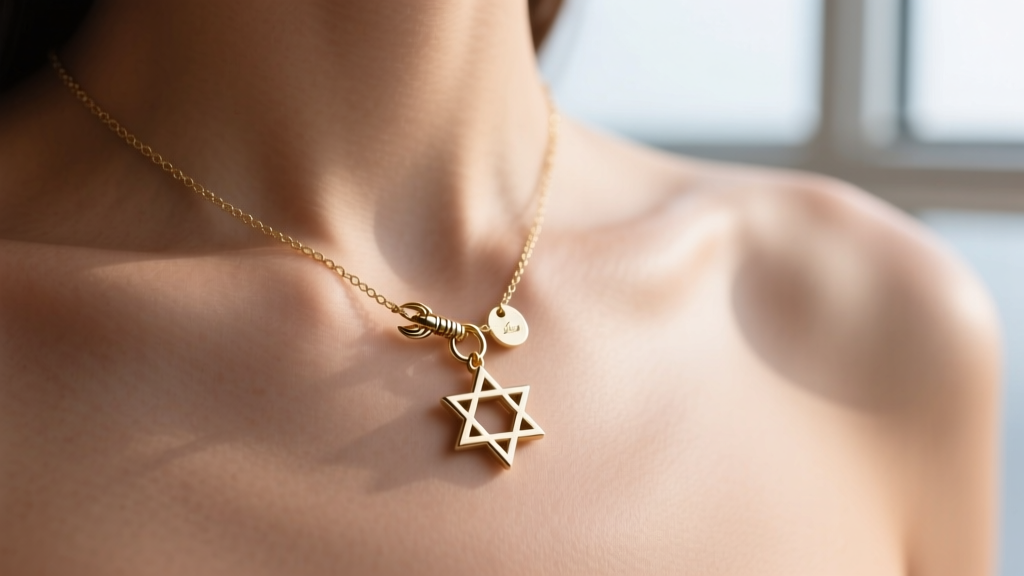
- Add a Counterweight Tag: Have a jeweler solder or attach a small 2mm to 3mm circular metal tag (often called a "counterweight" or "balance tag") on the chain, exactly one inch away from the clasp. This adds just enough weight to the back of the neck to anchor the clasp in place.
- Downgrade the Clasp: Swap the heavy lobster clasp for a smaller 4x6mm spring ring clasp. While spring rings are slightly harder to operate with one hand, they weigh significantly less and help balance the micro-pendant.
- Use a Lighter Chain: If you are using a solid box chain, switching to a hollow-cored or finely milled cable chain can reduce the overall weight of the front drape, allowing the clasp to stay put.
Problem 4: Skin Irritation, Tarnish, and Metal Fatigue
Because a tiny star of David necklace is often worn 24/7 as a sentimental or religious keepsake, it is exposed to sweat, lotions, and shower water continuously. This leads to two major issues: contact dermatitis and rapid plating wear.
The Truth About Gold Plating and Vermeil
Many affordable micro-pendants are made of brass or sterling silver with a thin layer of gold plating. The Federal Trade Commission's Jewelry Guides strictly regulate how these metals can be stamped and sold. Gold vermeil (a thick layer of gold over sterling silver) will eventually wear off at the high-friction points—specifically where the bail rubs against the jump ring and chain. Once the silver or brass base metal is exposed, the friction combined with body acids will cause rapid tarnishing and potential skin irritation.
For a lifelong daily-wear piece, bypass plated metals entirely. Invest in 14k or 18k solid gold, or platinum. According to the Gemological Institute of America (GIA), 14k gold offers the ideal balance of purity and alloy durability (usually mixed with copper, silver, or zinc) to withstand the daily friction of a micro-bail without bending or wearing away.
When to Seek Professional Bench Repair
While you can untangle chains at home using a drop of baby oil and two sewing needles, structural failures require professional intervention. Do not attempt to use standard jewelry pliers to open and close jump rings on a tiny star of David pendant; the torque will easily snap the delicate soldered bail off the star's top point.
What to Expect at the Jeweler
If your chain has snapped or the bail has broken off, ask your jeweler specifically about laser welding. Traditional torch soldering requires heating a large area of the metal, which can melt the ultra-fine points of a micro-star or leave visible fire-scale marks. Laser welding uses a highly focused beam of light to fuse metal at a microscopic level.
Bench Jeweler Insight: "When repairing a tiny star of David necklace, we use a laser welder to add a microscopic drop of 14k gold wire to rebuild a worn-down bail. This restores the structural integrity without altering the crisp, sharp geometry of the star's points. Expect to pay between $45 and $85 for a precision laser repair on a micro-pendant."
By understanding the specific weight dynamics, chain geometries, and metal properties required for micro-jewelry, you can ensure your tiny star of David necklace remains a flawless, tangle-free, and perfectly balanced staple in your daily wardrobe.


