Flat Curb Chain Necklace: Technical Guide to Link Geometry
Discover the metallurgy, link geometry, and weight ratios of a flat curb chain necklace. Expert guide to gauges, clasps, and avoiding kinks.

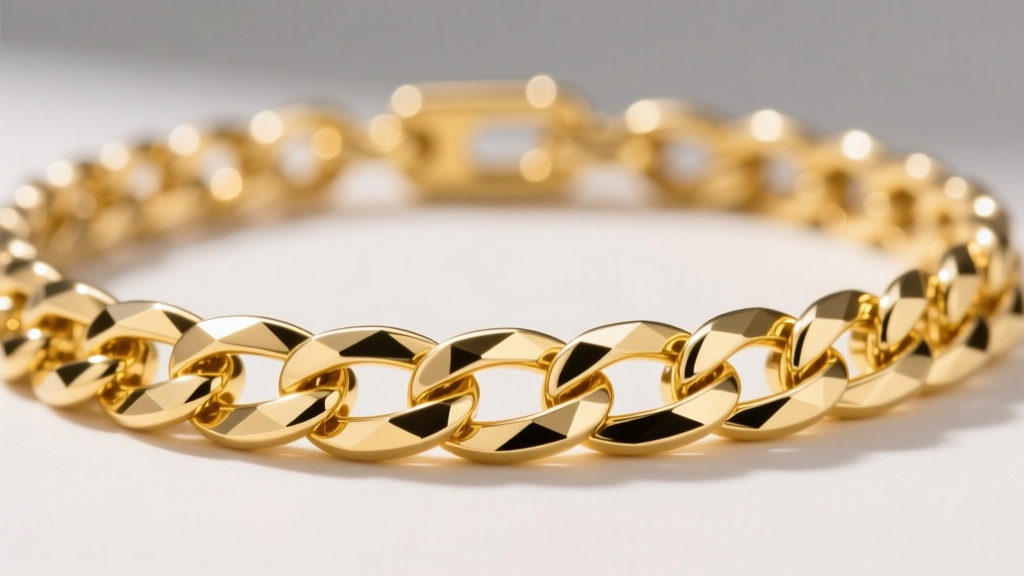
The Anatomy of a Flat Curb Chain Necklace
When evaluating a flat curb chain necklace, most consumers focus solely on the width and metal color. However, from a metallurgical and structural engineering perspective, the true quality of a curb chain lies in its link geometry, pitch, and milling precision. A curb chain begins as a standard cable chain—individual oval links interlocked in a uniform pattern. The transformation into a "curb" occurs when these links are twisted and then passed through a rolling mill or subjected to precision CNC grinding to flatten them into a single, uniform plane.
The defining characteristic of a high-quality flat curb is the interlocking tolerance. If the inner diameter of the link is too large relative to the wire gauge, the chain will feel loose, rattle, and eventually stretch. If the tolerance is too tight, the chain becomes rigid, prone to kinking, and difficult to clean. Expert jewelers look for a "pitch" (the distance from the center of one link to the next) that allows exactly 15 to 20 degrees of lateral articulation. This specific degree of movement ensures the chain drapes fluidly against the clavicle without folding back on itself and creating permanent creases.
Diamond-Cut vs. Flat-Milled Finishes
Not all flat curbs are finished identically. A standard flat-milled curb is pressed between two smooth steel rollers, resulting in a matte or softly polished surface. A diamond-cut curb, however, undergoes an additional CNC lathe process where a diamond-tipped tool shaves microscopic facets into the top edges of the links. This not only increases light refraction, giving the necklace a higher karat visual appearance, but it also slightly reduces the overall weight of the chain. When purchasing a diamond-cut flat curb chain necklace, ensure the faceting is symmetrical; asymmetrical cuts indicate a poorly calibrated lathe, which can create weak points along the outer edges of the links.
Metallurgy and Material Grades
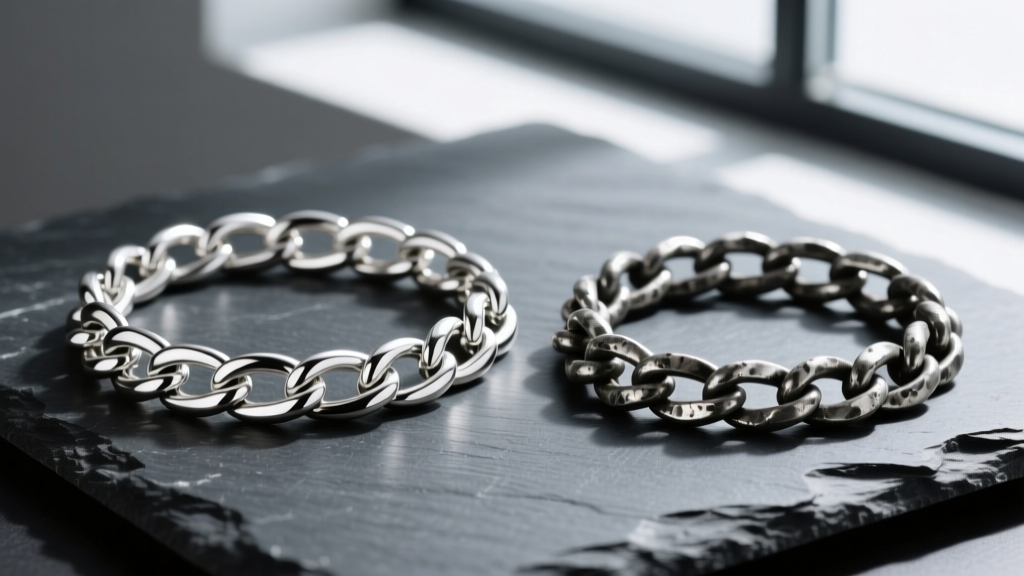
The longevity of your chain is dictated by the Vickers hardness (HV) of the alloy used. Pure 24k gold (approx. 25 HV) and pure silver (approx. 25 HV) are far too soft for the mechanical stress a daily-wear curb chain endures. According to the Gemological Institute of America (GIA), alloying metals are introduced to increase durability and alter color.
- 14k Yellow Gold (approx. 120-150 HV): The optimal choice for a flat curb chain necklace intended for daily wear. The higher copper and zinc content provides exceptional tensile strength, resisting the pulling forces that cause link elongation.
- 18k Yellow Gold (approx. 100-120 HV): Richer in color but noticeably softer. An 18k flat curb over 6mm in width will stretch over time if subjected to the weight of a heavy pendant.
- Sterling Silver (925): Standard sterling (92.5% silver, 7.5% copper) is prone to tarnish due to the copper content reacting with sulfur in the air and skin oils.
- Argentium Silver (935/960): A superior alternative where some copper is replaced with germanium. As noted by the Silver Institute, this elemental swap drastically slows tarnishing and increases the metal's natural hardness, making it ideal for the tight crevices of a curb chain where polishing cloths cannot reach.
Weight-to-Width Ratios: The Density Matrix
One of the most common deceptive practices in the jewelry industry is selling lightweight, wide chains. The structural integrity of a flat curb chain necklace is directly tied to its gram weight per inch relative to its millimeter width. A chain that is wide but suspiciously light is either hollow or heavily alloyed with base metals.
| Width (mm) | Construction | Approx. Grams per Inch | Tensile Strength & Use Case |
|---|---|---|---|
| 3mm | Solid | 0.8g - 1.1g | Low (Best for lightweight pendants) |
| 5mm | Solid | 2.0g - 2.5g | Medium (Ideal for daily standalone wear) |
| 8mm | Solid | 5.0g - 6.5g | High (Statement pieces, high durability) |
| 10mm+ | Hollow | 1.5g - 3.0g | Very Low (Prone to crushing and denting) |
When shopping for a 5mm flat curb, use this matrix as a baseline. If a jeweler lists a 20-inch 5mm solid gold chain at 15 grams, you are being sold a hollow or semi-solid chain, as a true solid 5mm 14k gold chain should weigh closer to 45-50 grams.
Hollow vs. Solid: The Denting Problem
Hollow flat curb chains are manufactured using an electroforming process or by stamping and soldering thin sheets of metal into link shapes. While they offer the imposing look of a 12mm chain at a fraction of the cost and weight, they introduce a catastrophic failure mode: crushing. Because the links are essentially thin shells, any lateral pressure—such as sleeping in the chain, leaning against a hard surface, or accidentally pulling it—will cause the flat top of the link to cave in. Unlike solid links, which can be hammered and reshaped by a bench jeweler, crushed hollow links cannot be repaired. The only solution is to cut out the damaged section and solder the chain back together, resulting in a permanent loss of length.
Clasp Mechanics and Failure Modes

The clasp is universally the weakest point of any necklace, but it is especially critical on a flat curb chain necklace due to the chain's inherent rigidity and weight distribution. Standard spring-ring clasps are entirely inadequate for any curb chain over 4mm. Even heavy-duty lobster clasps present a significant risk: the internal spring mechanism is subject to fatigue, and the lever can be accidentally depressed when the heavy chain shifts against the back of the neck.
The Box Clasp with Figure-8 Safety
For any solid flat curb chain exceeding 30 grams, a box clasp (also known as a tongue-and-groove clasp) is mandatory. The mechanical friction of the folded metal tongue snapping into the receiving box provides a secure hold that does not rely on spring tension. However, a box clasp alone is not enough. It must be paired with a figure-8 safety latch—a secondary wire loop that hinges over a small peg on the opposite side of the clasp. If the primary tongue mechanism fails or is inadvertently pulled open, the figure-8 safety will catch the chain, preventing a costly loss.
Furthermore, inspect the jump rings connecting the clasp to the end links. On high-quality chains, these jump rings are soldered shut. If they are merely pushed together, the lateral torque of a flat curb chain will eventually twist the jump ring open, dropping the necklace.
Maintenance: Preventing Kinks and Stretch
The flat, interlocking nature of a curb chain makes it a magnet for sebum, dead skin cells, and environmental dust, which accumulate in the microscopic gaps between the milled surfaces. Over time, this grime acts as an abrasive paste, accelerating wear at the friction points where the links rub against one another.
To maintain the structural integrity and brilliance of your chain, avoid ultrasonic cleaners if your chain features any diamond-cut facets, as the high-frequency vibrations can occasionally cause micro-fractures in poorly annealed metals. Instead, use a warm bath of distilled water and a few drops of mild, phosphate-free dish soap. Agitate the water gently, then use a soft-bristled baby toothbrush to sweep along the edges of the links. Rinse thoroughly with distilled water to prevent hard water spots, and dry immediately with a microfiber cloth. Always store your flat curb chain necklace laid completely flat or hung vertically; coiling it tightly in a jewelry box will force the links out of their natural pitch, leading to permanent kinking.


