Fossil Shark Tooth Necklace: Authentication & Setting Guide
Discover how to authenticate, grade, and properly mount a fossil shark tooth necklace. Expert tips on enamel preservation, chain gauges, and spotting fakes.

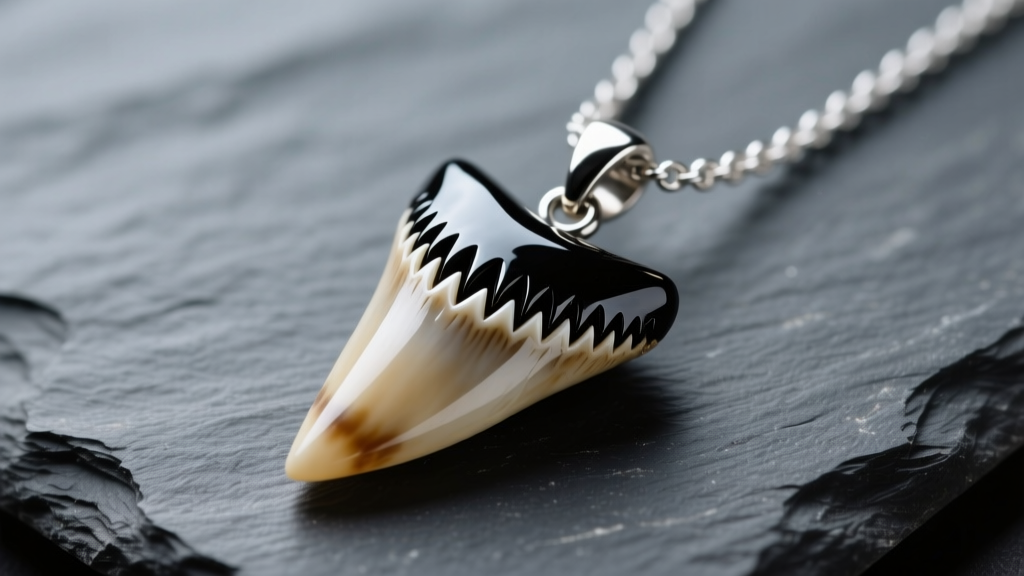
The Anatomy of a Fossilized Shark Tooth Pendant
Creating or purchasing a high-quality fossil shark tooth necklace requires an understanding of paleontology and lapidary science. Unlike modern teeth, fossilized specimens have undergone permineralization over millions of years. The original biological materials have been replaced by minerals from the surrounding sediment. According to mineralogical databases like Mindat.org, the enamel of a fossilized shark tooth is primarily composed of fluorapatite, which registers at a 5 on the Mohs hardness scale. This makes the enamel relatively durable for jewelry, but the underlying dentine and the root (cementum) are significantly more porous and brittle, often scoring between 3 and 4.
When evaluating a specimen for a pendant, you must examine three distinct zones: the crown (covered in enamel), the serrations (if present, as in Carcharocles megalodon), and the root lobes. The transition zone between the crown and the root, known as the bourrelet, is a common failure point for stress fractures if the piece is mounted incorrectly.
Authentication: Spotting Resin Casts and Composites
As the popularity of paleo-jewelry has surged in 2026, the market has been flooded with sophisticated replicas. Spotting a fake fossil shark tooth necklace is critical for both collectors and jewelers. Here are the primary non-destructive testing methods used by gemologists and paleontologists:
- Thermal Conductivity Test: Genuine fluorapatite and fossilized dentine feel noticeably cold to the touch and take longer to warm up against the skin compared to synthetic resins or plastics, which quickly match ambient temperature.
- Ultraviolet (UV) Fluorescence: Under a 365nm UV flashlight, natural fossilized enamel typically remains inert or shows very faint, patchy fluorescence from surrounding matrix minerals. Conversely, modern epoxy resins and polyurethane casts will often glow with a bright, uniform milky-blue or greenish hue.
- Magnification of Serrations: Using a 10x jeweler's loupe, examine the serrated edges. Natural serrations show microscopic chipping, asymmetrical wear, and natural growth bands. Molded casts often feature perfectly uniform, rounded serrations with tiny air bubbles trapped in the crevices.
For a comprehensive breakdown of species identification and natural wear patterns, the Florida Museum of Natural History provides an excellent reference database for authentic shark dentition.
| Feature | Genuine Fossil | Resin Cast | Composite (Real Root / Fake Crown) |
|---|---|---|---|
| Temperature Feel | Cold, slow to warm | Warm, matches room temp | Mixed (Cold root, warm crown) |
| UV Light Reaction | Mostly inert / dull | Bright, uniform glow | Glowing crown, dark root |
| Weight (vs Size) | Heavy, dense | Noticeably lightweight | Top-heavy imbalance |
| Serration Detail | Asymmetrical, micro-chips | Uniform, rounded, bubbles | Seam line visible at base |
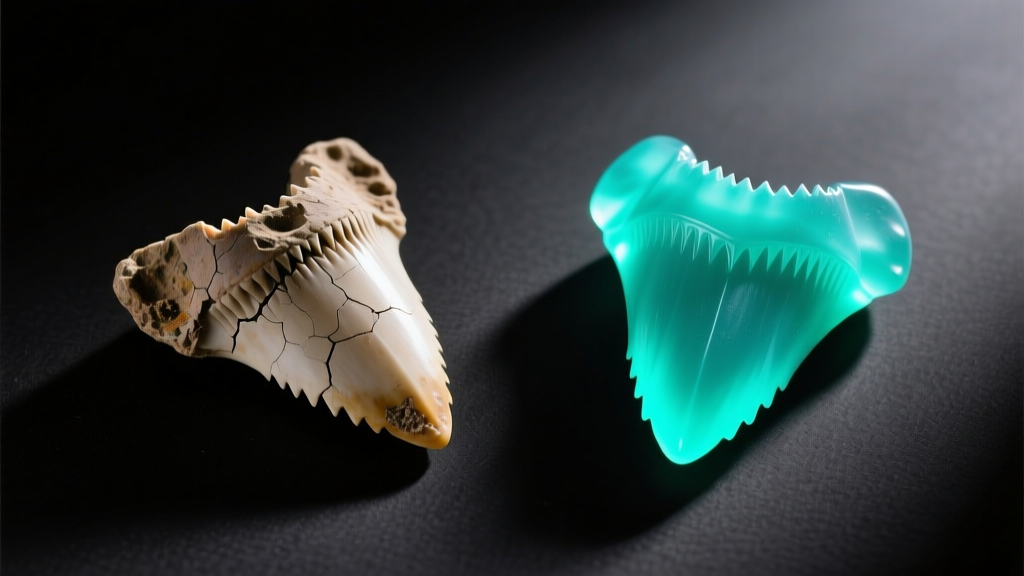
Grading the Fossil: Color, Preservation, and Provenance
The aesthetic and monetary value of a fossil shark tooth necklace is heavily dictated by its color matrix, which is a direct result of the geological environment where it fossilized. Understanding these color profiles helps you price and select the right pendant.
Black and Gunmetal Grey
These teeth fossilized in anoxic (oxygen-deprived) environments, typically deep marine sediments rich in organic matter. The Ouled Abdoun Basin in Morocco is famous for producing pristine, jet-black Otodus and Carcharocles teeth with high-gloss enamel. These are highly prized for formal jewelry due to their striking contrast against precious metals.
Brown, Tan, and Rust
Teeth recovered from oxygenated, iron-rich environments, such as the alluvial deposits of the Cooper River in South Carolina, often exhibit warm brown, tan, or reddish hues due to iron oxide infiltration. While beautiful, the enamel on these specimens is sometimes more matte and prone to micro-cracking.
Blue and Green
Rare and highly sought after, blue and green hues occur when copper or glauconite minerals permeate the dentine during fossilization. These command a premium price and are usually reserved for custom, high-end bezel settings.
Technical Mounting: Preserving the Specimen
The most critical mistake amateur jewelers make when crafting a fossil shark tooth necklace is drilling a hole through the root for a jump ring. Never drill a fossilized tooth. The vibration and pressure from a rotary tool will almost certainly cause micro-fractures in the brittle dentine, eventually leading to the crown snapping off under the dynamic load of daily wear.
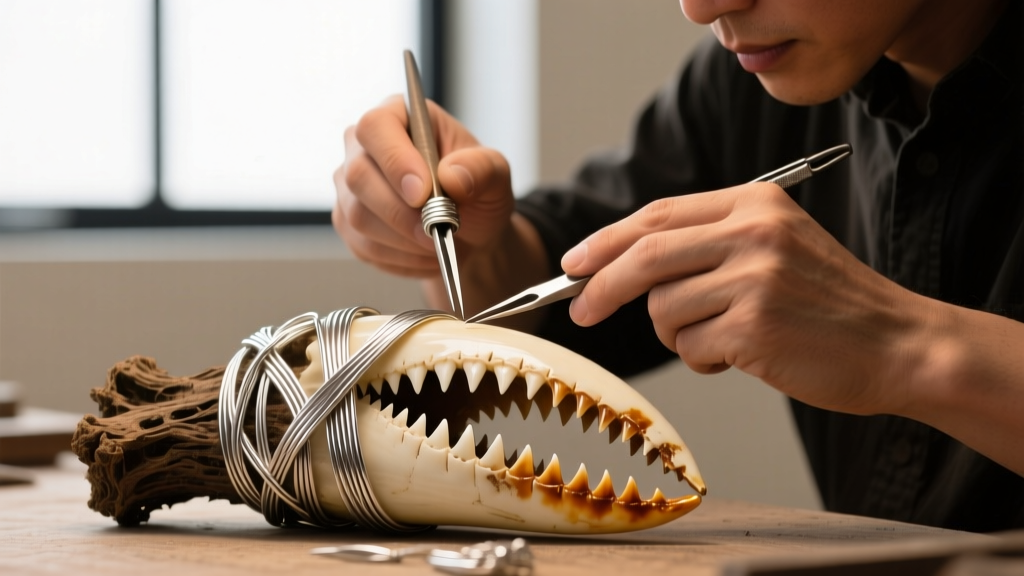
Wire Wrapping Techniques
For a secure, non-destructive mount, wire wrapping is the industry standard. Use 16-gauge or 18-gauge half-hard sterling silver or copper wire. Dead-soft wire is too pliable and will deform under the weight of a heavy Megalodon pendant. The wrap should cradle the root lobes securely, creating a custom bail that distributes the weight evenly across the back of the tooth without putting lateral pressure on the bourrelet.
Custom Bezel and Silicone Cushioning
If you prefer a cast metal setting, a custom bezel must be fabricated to the exact dimensions of the specific tooth. Because no two fossils are identical, off-the-shelf castings will not work. The interior of the metal bezel must be lined with a 1mm layer of jeweler's silicone or felt to act as a shock absorber, preventing the metal from crushing the fragile root cementum during impact.
Chain Selection: Gauge, Length, and Weight Distribution
A large fossilized Megalodon tooth (3.5 to 5 inches) can weigh anywhere from 30 to over 80 grams. Standard jewelry chains will snap under this dynamic load. When selecting a chain for your fossil shark tooth necklace, you must prioritize tensile strength and clasp security.
- Chain Style: Rope, curb, or Figaro chains offer the best structural integrity. Avoid box chains or delicate snake chains, which are prone to kinking and snapping under heavy pendants.
- Gauge and Width: For pendants weighing 30-50 grams, a minimum width of 3.5mm to 4mm is required. For specimens over 50 grams, upgrade to a 5mm to 6mm heavy-duty chain.
- Clasp Mechanics: Discard spring-ring clasps immediately. They lack the spring tension to hold heavy loads and will pop open. Use a heavy-duty lobster clasp (minimum 12mm to 15mm in length) with a reinforced soldered jump ring connecting it to the chain.
- Length: Heavy pendants pull the chain tightly against the back of the neck, which can cause friction and skin irritation. Opt for a 22-inch or 24-inch length so the pendant rests lower on the chest, distributing the weight more comfortably across the collarbones.
Care and Maintenance of Fossilized Enamel
While fluorapatite is relatively hard, the matrix minerals holding the fossil together can be sensitive to harsh chemicals. Never clean your fossil shark tooth necklace in an ultrasonic jewelry cleaner; the high-frequency cavitation can shake loose fragile serrations or exacerbate hidden cracks in the root. Avoid commercial silver dips or ammonia-based cleaners, which can strip the natural patina from the fossilized dentine.
To clean your pendant, simply use a soft-bristled toothbrush, distilled water, and a mild, pH-neutral soap. Gently brush the enamel and rinse thoroughly. Dry immediately with a microfiber cloth to prevent water spots from forming in the porous root structures. With proper mounting and care, your fossilized pendant will remain a stunning, wearable piece of natural history for decades to come.


