Analyzing The Frida Kahlo Portrait With Thorn Necklace And Hummingbird
Explore the Frida Kahlo portrait with thorn necklace and hummingbird. We analyze the metallurgy, motifs, and modern styling of her iconic jewelry.

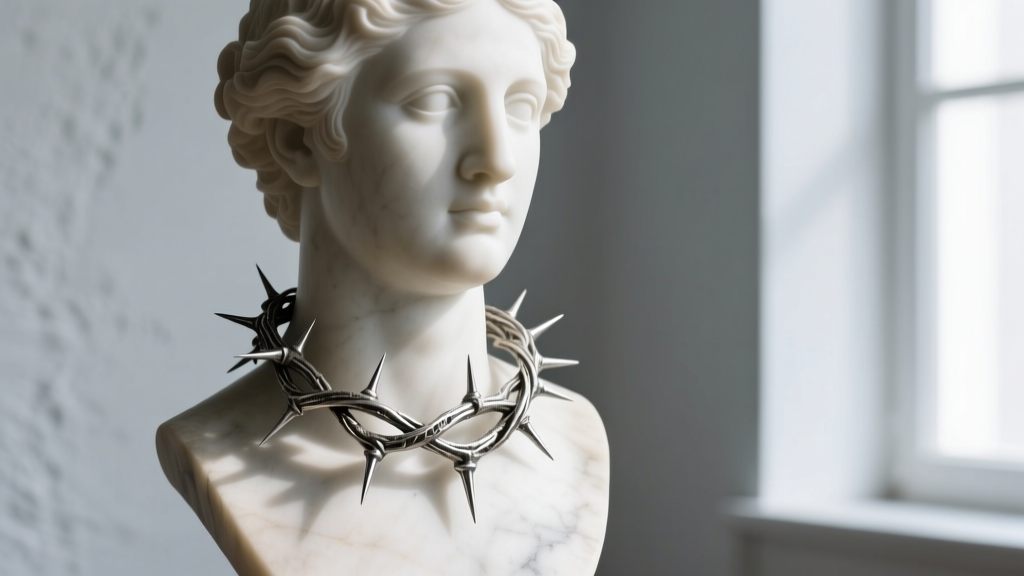
Frida Kahlo’s 1940 masterpiece, Self-Portrait with Thorn Necklace and Hummingbird, remains one of the most intensely analyzed works of 20th-century art. While art historians focus on the painting's surrealist symbolism and biographical pain, jewelry experts and bench jewelers look at the canvas and see a masterclass in botanical adornment, structural tension, and pre-Columbian motif revival. For modern collectors and custom jewelers, the frida kahlo portrait with thorn necklace and hummingbird serves as a technical blueprint for creating nature-inspired, avant-garde statement pieces. In this deep dive, we deconstruct the metallurgy, fabrication mechanics, and styling principles required to translate Kahlo’s iconic thorn choker and hummingbird pendant into wearable, high-end jewelry.
The Thorn Choker: Structural Engineering and Metallurgy
Translating a bramble of thorns into a wearable choker presents a unique structural challenge. The neck is a highly mobile area of the body; a rigid metal circle will not sit flush against the clavicle and will cause severe discomfort. To replicate the wrapping, organic nature of Kahlo’s thorn necklace, modern jewelers must balance rigidity with articulation.
Lost-Wax Casting vs. Hand Fabrication
There are two primary methods for fabricating a thorn necklace. Hand fabrication involves using a 14-gauge (1.6mm) sterling silver or 14k gold wire as a core, wrapping it with 22-gauge (0.6mm) wire to form the thorn protrusions. While this allows for custom fitting, it lacks the organic, asymmetrical bark texture seen in the painting.
The superior method for high-end replicas is lost-wax casting. A jeweler sculpts the thorns in jeweler's wax, allowing for deep undercuts and realistic wood-grain textures. However, a solid cast 925 sterling silver choker of this diameter (approx. 15 inches) would weigh upwards of 180 grams and lack flexibility. To solve this, expert bench jewelers segment the wax model into 5 to 7 curved links. After casting, these segments are connected using hidden 1.5mm steel hinge pins or 18-gauge (1.0mm) gold jump rings, allowing the necklace to drape fluidly over the collarbone while maintaining the illusion of a continuous, unbroken branch.
Clasp Mechanics for Asymmetrical Branches
A standard lobster clasp ruins the organic illusion of a branch necklace. Because the ends of a thorn choker are asymmetrical, jewelers must employ specialized closures. The most effective modern solution is a hidden magnetic clasp. By encasing high-grade N52 neodymium magnets within the hollow-cast ends of the branch, the necklace snaps together seamlessly. The silver or gold shell must be at least 1.2mm thick to prevent the magnetic field from interfering with the metal's structural integrity, ensuring the clasp remains invisible to the eye.
The Hummingbird Pendant: Articulation and Micro-Riveting
In the painting, a lifeless hummingbird hangs suspended from the thorns, a nod to both Mesoamerican mythology and Kahlo’s personal heartbreak. Recreating this pendant requires advanced micro-articulation techniques to ensure the bird moves naturally with the wearer's body.
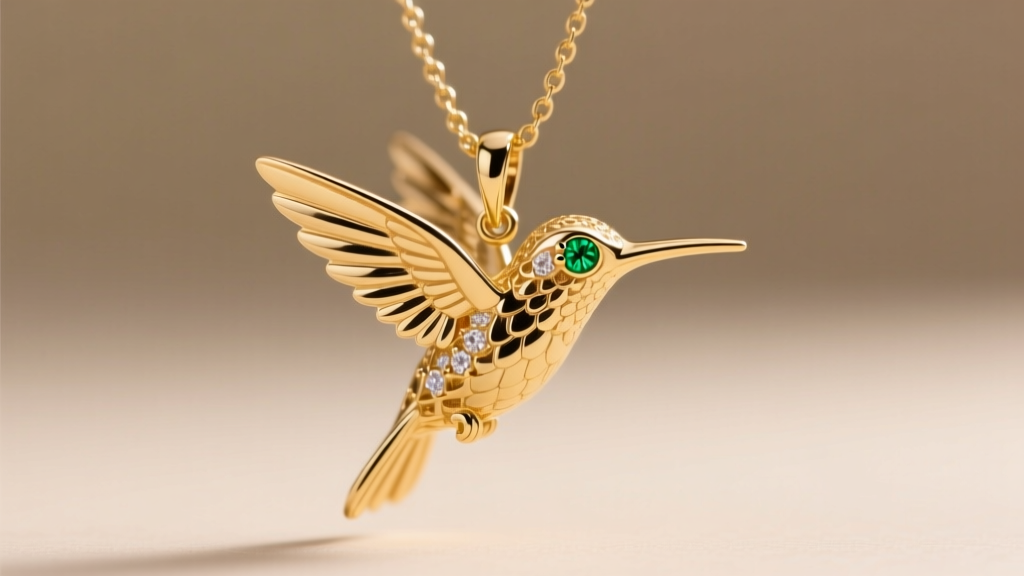
To achieve a lifelike drape, the wings, tail, and head must be separate cast components. Master jewelers use 0.8mm (20-gauge) titanium or gold micro-rivets to connect the wings to the body. Unlike soldered joints, which are rigid, micro-rivets allow the wings to fold and flutter. The eyes of the hummingbird are typically bezel-set with 1.5mm round-cut emeralds or tsavorite garnets, chosen for their high refractive index and historical accuracy to pre-Columbian jade carvings.
The bail mechanics are equally complex. A standard soldered bail cannot be attached to the asymmetrical thorn branch. Instead, jewelers use a European-style hidden bail or wrap a heavy-duty 16-gauge (1.3mm) jump ring directly around a specific thorn, allowing the bird to swing freely without detaching from the choker's structural framework.
Material Specifications for Botanical Jewelry
When commissioning or sourcing a thorn and hummingbird necklace, the choice of metal dictates both the aesthetic and the longevity of the piece. Below is a technical comparison of materials used in high-end botanical jewelry.
| Material | Vickers Hardness (HV) | Patina / Oxidation Capability | Estimated Price Range (Custom 15" Choker) |
|---|---|---|---|
| Oxidized 925 Sterling Silver | 60-70 HV | Excellent (Liver of Sulfur) | $800 - $1,500 |
| 14k Yellow Gold | 120-140 HV | Poor (Requires chemical darkening) | $3,500 - $6,000 |
| 18k Rose Gold | 110-130 HV | Moderate (Natural warm tarnish) | $4,500 - $8,000 |
| Cast Bronze (Silicon Bronze) | 80-100 HV | Excellent (Verdigris / Dark Brown) | $400 - $900 |
For the most accurate recreation of the painting's moody, high-contrast aesthetic, oxidized sterling silver is the superior choice. By applying a liver of sulfur solution and selectively polishing the high points of the thorns with a rouge cloth, jewelers create a chiaroscuro effect that mimics the deep shadows and sharp highlights of Kahlo’s brushwork.
Pre-Columbian Influences and Gemological Accents
Kahlo was an avid collector of pre-Columbian artifacts, and her jewelry choices were deeply informed by indigenous Mexican history. The hummingbird motif is intrinsically linked to Huitzilopochtli, the Aztec god of sun and war, whose name translates to "Hummingbird of the South." Historical Mesoamerican jewelry heavily featured jade, turquoise, and gold.
According to the Victoria and Albert Museum's jewelry archives, the integration of natural, uncut, or cabochon stones was a hallmark of indigenous adornment, contrasting sharply with the faceted diamonds of European colonizers. When designing a modern homage to this piece, expert gemologists recommend avoiding brilliant-cut diamonds. Instead, opt for cabochon turquoise, lapis lazuli, or raw, uncut emeralds set in bezel or flush settings to maintain the historical and geological authenticity of the motif. The Gemological Institute of America (GIA) notes that cabochon cuts better reflect the organic, earthy nature of botanical jewelry, preventing the piece from looking overly formal or anachronistic.
Styling the Thorn Motif: Necklines and Wearability
Wearing a thorn choker in a contemporary setting requires careful styling to avoid looking costumey. The "dark academia" and "avant-garde botanical" aesthetics have brought nature-motif jewelry back to the forefront of high fashion, but the physical geometry of the necklace dictates specific wardrobe pairings.
The 15-Inch Rule and Fabric Snagging
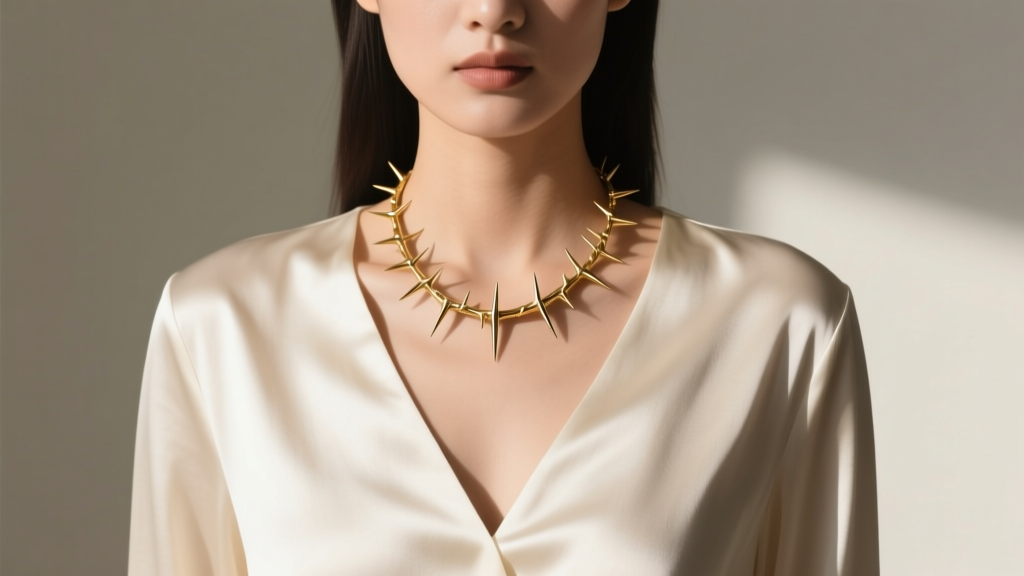
A standard thorn choker sits at exactly 15 inches, resting directly on the hollow of the throat and the clavicle. Because the thorns protrude outward by 4mm to 8mm, they act as natural snag points.
- Avoid: Delicate chiffon, loose-knit mohair, or high-collared lace. The thorns will catch and destroy these fibers.
- Embrace: Heavyweight silk, structured cotton, or bare skin. A deep V-neck or sweetheart neckline provides the necessary negative space, allowing the oxidized silver or gold to contrast sharply against the skin without competing with fabric patterns.
- Layering: If layering, pair the 15-inch thorn choker with a 22-inch or 24-inch heavy rolo chain featuring a single, large geometric pendant. This creates a staggered visual hierarchy that anchors the chaotic energy of the thorns.
Sourcing and Archival Authenticity
For collectors seeking museum-quality context, the original painting and much of Kahlo’s personal archives are housed at the Harry Ransom Center at the University of Texas at Austin. While the exact physical thorn necklace from the painting is widely considered to be a conceptual or temporary assemblage rather than a permanent fine jewelry piece, its impact on modern jewelry design is undeniable.
Today, acquiring a piece inspired by this masterpiece means seeking out artisan bench jewelers who specialize in lost-wax casting and micro-articulation. When commissioning a piece, always request the CAD (Computer-Aided Design) renders or the original wax carvings to verify the hinge placements and clasp mechanics. A true expert will prioritize the kinetic movement of the hummingbird and the ergonomic drape of the segmented thorn branch over sheer metal weight.
Ultimately, the jewelry depicted in the frida kahlo portrait with thorn necklace and hummingbird is a testament to the power of adornment as a narrative tool. By understanding the precise metallurgical and structural requirements to bring these motifs to life, modern jewelry lovers can wear a piece of art history that is as technically brilliant as it is emotionally resonant.


