Angle Necklace Buying Guide: Geometric & Chevron Styles
Discover how to choose the perfect angle necklace. Our buying guide covers chevron, V-bar, and geometric pendants, metals, and chain pairings.

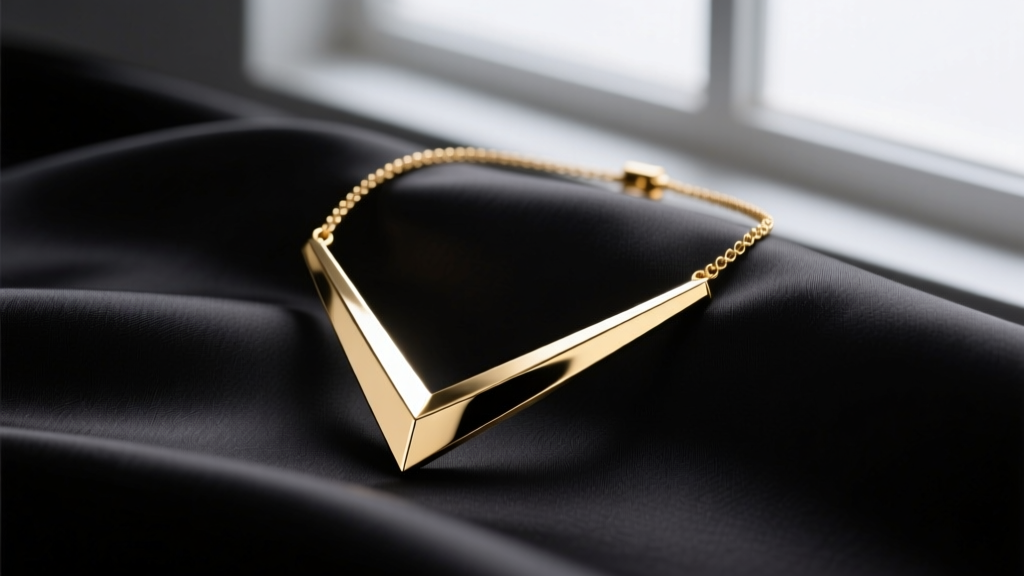
The angle necklace has evolved from a fleeting mid-century modern trend into a permanent staple of architectural jewelry design. Unlike organic, fluid pendants, an angle necklace relies on sharp vertices, intersecting lines, and deliberate geometric vectors to frame the collarbone and draw the eye downward. Whether you are evaluating a minimalist V-bar, a complex asymmetrical chevron, or an open triangle pendant, buying geometric jewelry requires a fundamentally different approach than purchasing traditional gemstone or teardrop pieces.
In this comprehensive buying guide, we break down the structural engineering, metallurgical requirements, and styling frameworks you need to evaluate before investing in an angle necklace in 2026.
The Architecture of the Angle Necklace
When you wear an angle necklace, you are essentially wearing a structural beam. The visual weight of sharp angles creates an elongating effect, mimicking the lines of a V-neckline even when worn over a crew neck. However, this architectural rigidity means the piece does not drape or fold; it sits fixed against the sternum. Because of this, the proportional relationship between the pendant's width, the chain's thickness, and the wearer's clavicle width is critical. A standard angle pendant spans between 35mm and 50mm horizontally. If the horizontal span exceeds 60mm, the sharp ends will catch on clothing and dig into the shoulder joints when the arms cross.
Core Geometric Profiles: What to Look For
The V-Bar and Chevron
The V-bar is the most ubiquitous angle necklace profile, consisting of a solid or tubular horizontal bar intersecting a downward-pointing chevron. When buying a V-bar, pay close attention to the interior angle of the chevron. A narrow 45-degree angle creates an aggressive, highly modern look that elongates the neck but requires a longer chain (18 to 20 inches) to sit properly below the hollow of the throat. A wider 90-degree angle sits higher and works better on 16-inch choker-length chains.
The Intersecting Asymmetrical Angle
Asymmetrical angle necklaces feature overlapping lines that do not perfectly close, often resembling an abstract compass or overlapping architectural beams. The primary buying criterion here is the clearance between the intersecting lines. If the gap is less than 2mm, skin oils and lotion will quickly accumulate in the crevice, tarnishing the metal and making it impossible to clean without an ultrasonic bath.
The Open Triangle
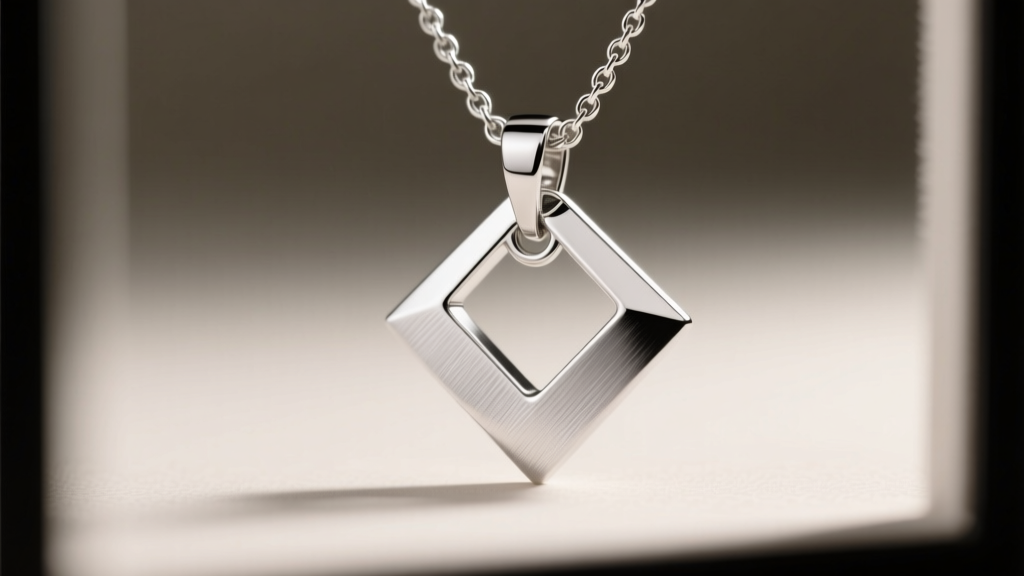
The open triangle removes the bottom horizontal plane, leaving only the two descending angles. This is a lighter, more delicate profile. Look for reinforced vertices; because the bottom point lacks a crossbar for structural support, it is highly prone to bending if snagged.
Metal Grades & Structural Integrity at the Vertices
According to the Gemological Institute of America (GIA), understanding alloy composition is critical when buying precious metals. In geometric jewelry, the vertices (the sharp points) are structural weak points. When casting sharp angles via lost-wax methods, the tips are highly susceptible to porosity—tiny air pockets that weaken the metal matrix. If the metal is too soft, the points will warp or snap under minor tension.
| Metal Grade | Hardness (Vickers) | Best Geometric Profile | Avg. Price Range |
|---|---|---|---|
| 925 Sterling Silver | 60 - 75 HV | Thick, open triangles (requires rhodium plating to prevent corner tarnish) | $45 - $120 |
| 14k Solid Gold | 120 - 150 HV | V-bars and sharp chevrons (excellent edge retention) | $250 - $600 |
| 18k Solid Gold | 85 - 115 HV | Blunter, wider angles (softer, prone to scratching at sharp points) | $400 - $1,100 |
| Grade 5 Titanium | 340+ HV | Ultra-thin, razor-sharp asymmetrical angles (hypoallergenic, indestructible) | $80 - $250 |
For historical and modern context on how geometric motifs have influenced structural jewelry design, resources like Britannica's jewelry archives highlight the shift from purely ornamental shapes to structurally integrated architectural forms.
The Bail Mechanism: Crucial for Angular Pendants
The bail—the loop that connects the chain to the pendant—is the most common point of failure in geometric necklaces. A standard soldered loop bail on a heavy V-bar creates a high center of gravity. This causes the pendant to flip upside down constantly, ruining the geometric aesthetic.
When shopping for an angle necklace, specifically seek out an integrated channel bail or a hidden slide bail. In these designs, the chain threads directly through a hollowed-out channel at the top horizontal plane of the angle. This lowers the center of gravity, locks the geometry flat against the sternum, and prevents the pendant from spinning. If you are buying a vintage or traditional piece with a loop bail, ensure the bail is soldered at a 15-degree forward tilt to compensate for the pendulum effect.
Chain Pairing Framework
Geometric pendants require chains that complement their rigid lines. Avoid organic, twisting chains that clash with the mathematical precision of the angle.
- Box Chains (1.0mm - 1.5mm): The ideal pairing. The square, interlocking links of a box chain mirror the sharp angles of the pendant, creating a cohesive, architectural look.
- Wheat Chains (1.2mm - 2.0mm): Offer a slightly softer, woven texture while maintaining a linear, downward-pointing vector that reinforces the chevron shape.
- Herringbone Chains: Avoid entirely. Herringbone chains are fluid and kink easily; their liquid-like drape completely undermines the structural rigidity of an angle necklace.
- Black Cord or Leather (1.5mm): Excellent for a high-contrast, brutalist aesthetic, particularly when paired with brushed titanium or oxidized silver angle pendants.

Styling by Neckline: A Geometric Approach
Because an angle necklace inherently creates a V-shape, it interacts dynamically with the neckline of your clothing. Use this framework to manipulate visual proportions:
The Crew Neck: A crew neck creates a harsh horizontal line across the collarbone. Pair it with a long (20-inch), sharp 45-degree angle necklace to visually slice through the horizontal block, elongating the torso and softening the shoulder line.
The V-Neck: Never wear a V-bar necklace with a V-neck top unless the angles are drastically different. If the top is a deep plunge, wear a wide, 90-degree shallow angle necklace that sits high on the clavicle to create a contrasting geometric layer.
The Turtleneck: Turtlenecks provide a blank, dark canvas. This is the only scenario where you should opt for oversized, heavy-gauge angle necklaces (spanning 60mm+). The high collar protects the sharp vertices from catching on your skin, allowing the metal to pop against the fabric.
Quality Control Checklist Before You Buy
Expert Inspection Tip: Always inspect the extreme vertices of an angle necklace under direct, harsh lighting. If you see microscopic pitting or a dull, grayish hue at the very tips of the metal, it indicates casting porosity. Reject the piece; the points will eventually snap.
Finally, consider the finish. High-polish finishes on sharp angles can create intense light glare that washes out the geometric lines. In 2026, the industry standard for premium geometric jewelry leans heavily toward brushed matte or satin finishes. These finishes absorb light, emphasizing the physical edges and architectural planes of the metal rather than distracting with reflections. Ensure that if the piece features a two-tone finish (e.g., polished edges with a matte center), the boundary line between the two textures is razor-sharp, with no bleeding of the polishing compound into the matte recesses.


