Expert Care and Cleaning Guide for a Gold Garnet Necklace
Learn how to safely clean, store, and maintain your gold garnet necklace. Expert tips on protecting the gemstone brilliance and gold setting.

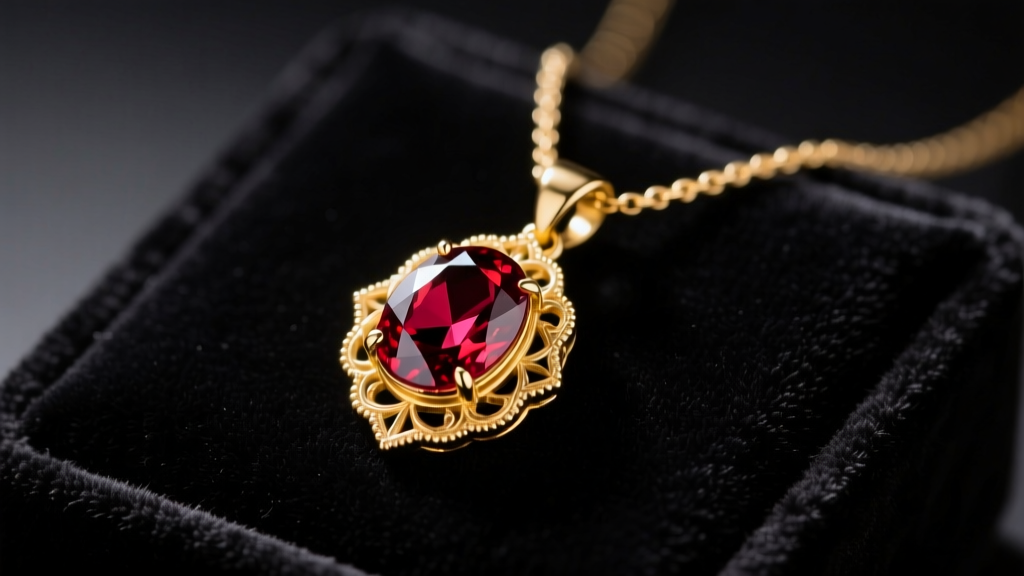
Understanding the Material Science of Your Necklace
To properly care for a gold garnet necklace, you must first understand the physical and chemical properties of its components. Garnet is not a single gemstone, but rather a group of complex silicate minerals. The most common variety used in jewelry is almandine, which boasts a Mohs hardness of 7 to 7.5. While this makes it relatively durable for daily wear, it is still softer than diamonds, sapphires, and rubies, meaning it is susceptible to micro-scratches from harder materials.
Furthermore, garnets lack cleavage planes, which is the tendency of a mineral to break along flat, structural planes. Instead, they exhibit a conchoidal fracture. This means that while a sharp, direct blow is less likely to split the stone cleanly in half, it can easily cause localized chipping or internal fracturing if the necklace is dropped on a hard tile floor or struck against a countertop.
The gold setting also requires specific consideration. Most gold garnet necklaces are crafted in 14k or 18k gold. Pure 24k gold is too soft to securely hold a gemstone, so it is alloyed with metals like copper, silver, and zinc. 14k gold (58.3% pure gold) offers superior tensile strength and prong durability compared to 18k gold (75% pure gold), making it the metallurgical standard for secure, everyday gemstone settings.
The Step-by-Step Home Cleaning Protocol
Routine cleaning is essential to maintain the high refractive index and deep red brilliance of your garnet. Over time, sebum, dead skin cells, and cosmetic residues accumulate on the pavilion (the bottom facet arrangement) of the stone, drastically reducing its light return. Follow this precise protocol to restore your necklace safely:
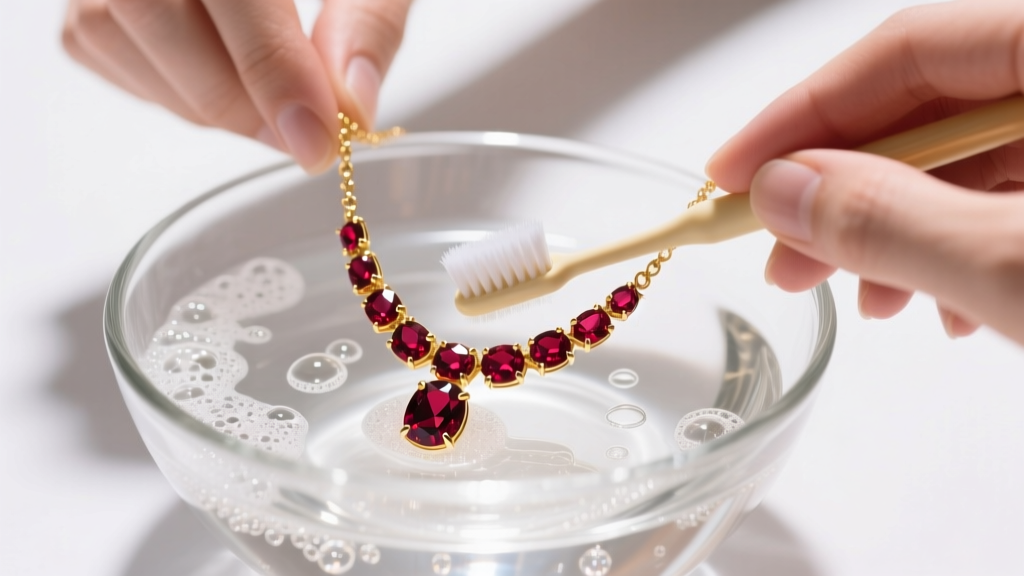
- Step 1: Secure the Environment. Always clean your jewelry over a bowl or a plugged sink lined with a soft towel. Dropping a gold pendant into an open drain is a common and devastating mistake.
- Step 2: Prepare the Solution. Fill a small glass bowl with lukewarm water. Add two to three drops of a mild, phosphate-free dish soap (such as original Dawn). Avoid hot water, as extreme thermal shocks can cause internal stress fractures in garnets.
- Step 3: Soak and Agitate. Submerge the gold garnet necklace and let it soak for exactly 3 to 5 minutes. This loosens hardened debris. Using a brand-new, ultra-soft baby toothbrush, gently brush the back of the garnet and the interior of the gold setting. Use light, circular motions—never scrub aggressively.
- Step 4: Rinse and Dry. Rinse the necklace under a gentle stream of lukewarm distilled water to prevent hard water spots. Pat dry with a lint-free microfiber cloth, ensuring no moisture is trapped beneath the setting's gallery.
The Ultrasonic and Steam Cleaner Debate
Many jewelers use ultrasonic and steam cleaners, but these tools carry significant risks for garnet jewelry. According to the Gemological Institute of America (GIA), while solid, untreated garnets can generally withstand ultrasonic vibrations, the risk profile changes dramatically if the stone has internal characteristics.
'Ultrasonic cleaners use high-frequency sound waves to create microscopic cavitation bubbles that implode, generating intense localized heat and shockwaves. If your garnet contains liquid inclusions, internal fractures, or has been fracture-filled with a glass-like resin, an ultrasonic cleaner can easily shatter the stone from the inside out.' - Master Gemologist Appraiser Guidelines
Steam cleaners pose a similar thermal shock risk. Because garnets are often cut with deep pavilions to maximize color saturation, the sudden blast of high-temperature steam can cause rapid, uneven expansion, leading to catastrophic failure. For home care, stick strictly to the manual soaking and brushing method outlined above.
Chemical Hazards and Stress Corrosion
The gold alloy in your necklace is highly vulnerable to specific household chemicals. Chlorine is the most destructive enemy of karat gold. When 14k or 18k gold is exposed to chlorinated pool water, hot tubs, or harsh household bleach, the non-gold alloy metals (like copper and zinc) react chemically. This leads to a phenomenon known as stress corrosion cracking.
Stress corrosion occurs when the chemical attack combines with the physical tension already present in the metal (such as the tension of a prong bent tightly over the girdle of a garnet). The prongs can become brittle and snap off without warning, resulting in the loss of your gemstone. Always remove your gold garnet necklace before swimming, bathing, or cleaning with chemical agents.
Additionally, apply all perfumes, hairsprays, and lotions before putting on your necklace. The alcohols and aerosolized polymers in cosmetics can leave a dull, cloudy film on the garnet's table facet that is difficult to remove with standard soap and water.
Structured Maintenance and Inspection Framework
Proactive maintenance is the difference between a necklace that lasts a decade and one that loses its center stone. Implement this structured inspection framework to monitor the health of your jewelry. The American Gem Society (AGS) recommends professional check-ups, but home inspections are equally vital.
| Maintenance Task | Frequency | Action Required |
|---|---|---|
| Visual Prong Check | Weekly | Inspect under bright light. Ensure no prongs are lifted, snagging on fabric, or visibly worn flat. |
| Deep Home Cleaning | Bi-Weekly | Execute the 4-step lukewarm soapy soak and soft-bristle brush protocol to remove sebum buildup. |
| Clasp & Jump Ring Test | Monthly | Gently tug the chain near the spring ring or lobster clasp. Check the jump ring for gaps or metal fatigue. |
| Professional Jeweler Visit | Annually | Have a jeweler check prong tension with a loupe, tighten the setting if necessary, and professionally polish the gold. |
Proper Storage to Prevent Micro-Scratches
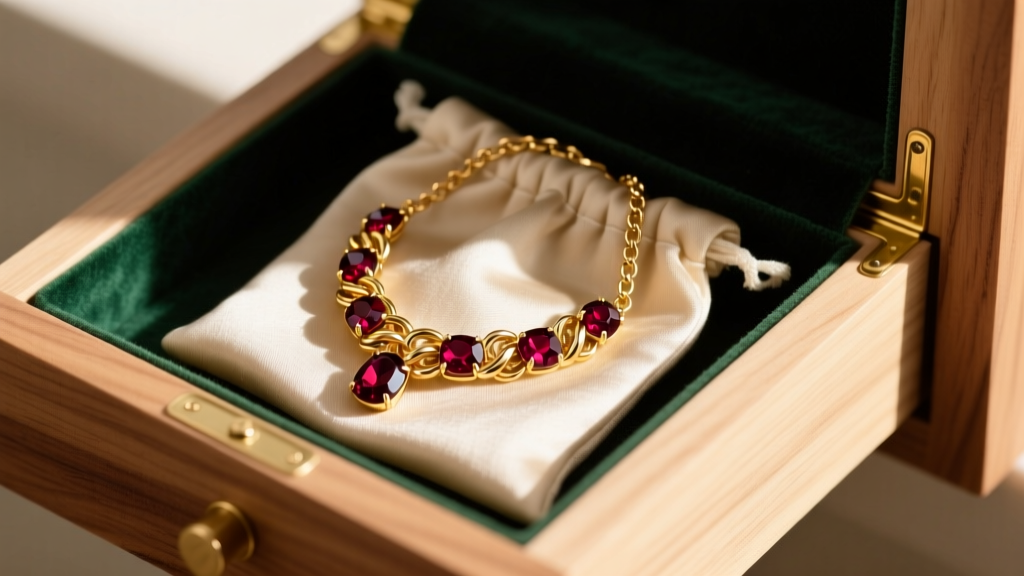
How you store your gold garnet necklace when it is not being worn directly impacts its long-term condition. Tossing it into a communal jewelry box alongside diamonds or sapphires is a guaranteed way to scratch the gold setting and potentially the garnet itself. Remember, a diamond (Mohs 10) will effortlessly scratch a garnet (Mohs 7.5).
Always store your necklace individually. The ideal storage method is to fasten the clasp to prevent the chain from tangling, then place the necklace inside a soft, anti-tarnish flannel pouch or a dedicated compartment lined with untreated cotton. If you live in a high-humidity environment, consider placing a small silica gel desiccant packet in the jewelry box drawer to absorb ambient moisture and slow the oxidation of the gold's alloy metals.
When to Seek Professional Jeweler Intervention
While home care is excellent for routine maintenance, certain situations require the tools and expertise of a professional bench jeweler. If your garnet becomes loose and rattles within the setting, stop wearing the necklace immediately. Continuing to wear it will cause the stone to grind against the gold prongs, wearing away the metal from the inside and eventually chipping the gemstone's girdle.
Furthermore, if the gold chain develops a kink or the clasp mechanism becomes stiff, do not attempt to bend it back into shape with pliers. Karat gold work-hardens when bent, and amateur manipulation often leads to the chain snapping. A jeweler can easily solder a broken link or replace a worn clasp spring, ensuring your gold garnet necklace remains secure and beautiful for generations.


