The Anatomy of a Gold Lightning Bolt Necklace: Casting & Karats
Explore the technical anatomy of a gold lightning bolt necklace. Learn about lost-wax casting, karat durability, and optimal chain pairings for daily wear.

The Engineering Behind the Motif
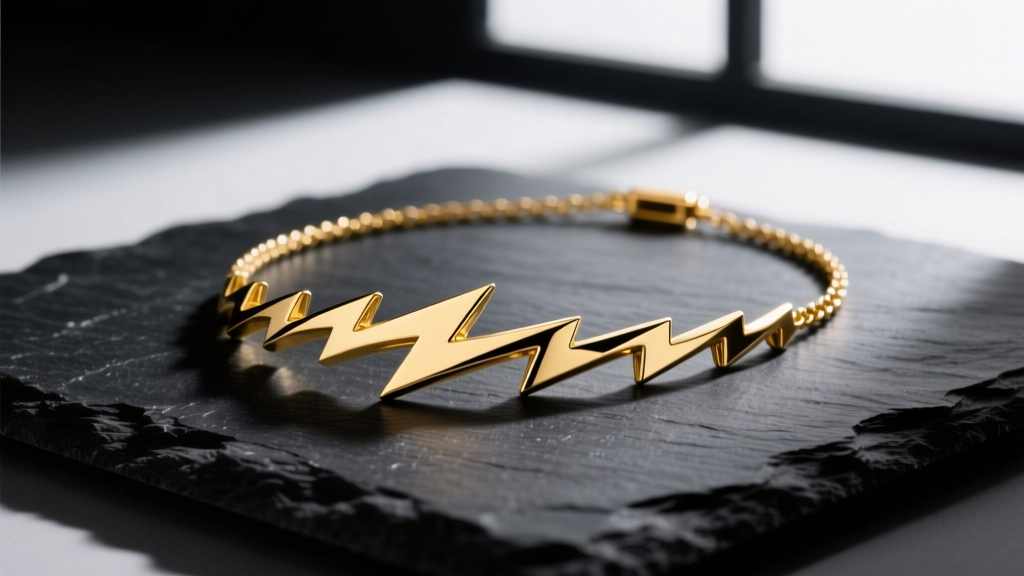
The lightning bolt is one of the most iconic silhouettes in contemporary jewelry, symbolizing energy, rebellion, and sudden inspiration. However, from a manufacturing and metallurgical perspective, a gold lightning bolt necklace presents a unique set of engineering challenges. Unlike symmetrical pendants such as circles or hearts, the lightning bolt is highly asymmetric, featuring acute angles, elongated extremities, and an uneven weight distribution. These geometric traits dictate everything from the karat selection and casting method to the placement of the bail and the choice of the accompanying chain. In this deep dive, we explore the technical anatomy of the lightning bolt pendant, providing you with the expert knowledge needed to evaluate quality, durability, and structural integrity.
Metallurgy and Karat Selection: 14K vs. 18K for Asymmetric Pendants
When selecting a gold lightning bolt necklace, the karat weight is not merely a measure of purity; it is a critical determinant of structural durability. Pure 24K gold is far too malleable for jewelry, measuring roughly 25-30 on the Vickers Hardness (HV) scale. To create wearable jewelry, gold is alloyed with metals like copper, silver, and zinc. The sharp, acute points of a lightning bolt motif are highly susceptible to impact damage, bending, and 'tip rounding' during the manufacturing tumbling process.
Vickers Hardness and Tip Integrity
An 18K gold alloy (75% pure gold) typically exhibits a Vickers Hardness of around 120-130 HV. While it offers a rich, saturated yellow hue, it remains relatively soft. If an 18K lightning bolt pendant is dropped or caught on heavy fabric, the sharp tips are prone to micro-bending. Conversely, 14K gold (58.5% pure gold, alloyed heavily with copper and silver) achieves a Vickers Hardness of 140-160 HV. This increased tensile strength makes 14K gold the superior choice for preserving the razor-sharp geometry of the lightning bolt's extremities. According to the Gemological Institute of America (GIA), the specific copper-to-silver ratio in 14K yellow gold not only increases hardness but also improves the metal's flow characteristics during casting, ensuring the sharp corners of the mold are completely filled without porosity.
Manufacturing Methods: Lost-Wax Casting vs. Die Striking
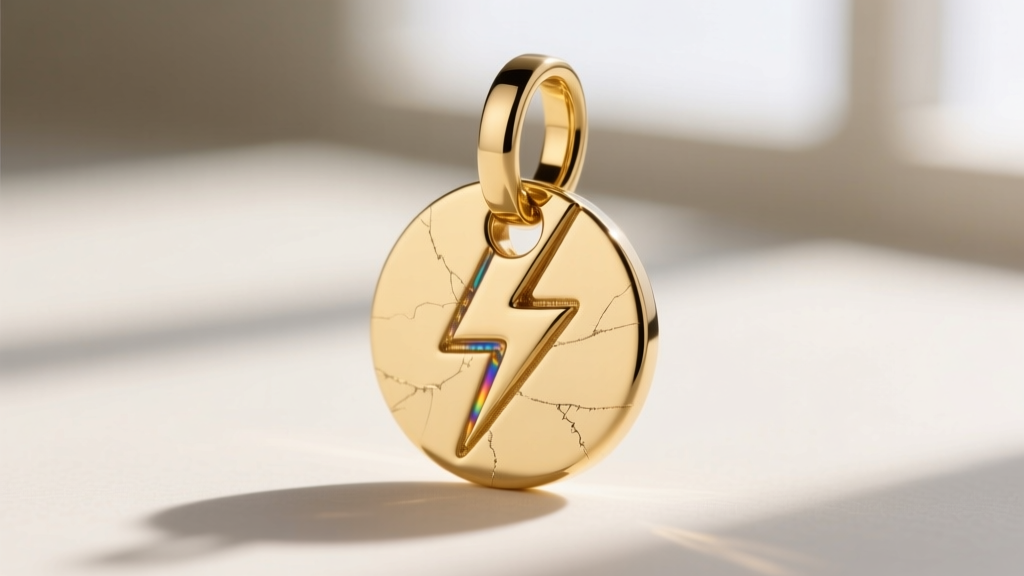
The method used to form the gold lightning bolt necklace drastically affects its density, edge sharpness, and overall longevity. While some mass-market fashion jewelry utilizes die striking, fine jewelry predominantly relies on lost-wax casting for complex motifs.
The Challenge of Casting Acute Angles
In lost-wax casting, a 3D wax model is encased in investment plaster, burned out, and replaced with molten gold. The primary technical hurdle with a lightning bolt design is 'shrinkage porosity' at the sharp tips. As molten gold enters the narrow, acute angles of the mold cavity, it cools rapidly. If the casting temperature or flask temperature is not perfectly calibrated, the metal will freeze before completely packing into the tip, resulting in microscopic voids or rounded edges. Master jewelers mitigate this by using vacuum-assisted casting machines, which pull the dense molten gold into the extremities with greater force than traditional centrifugal casting.
| Method | Density & Porosity | Edge Sharpness | Best Application |
|---|---|---|---|
| Lost-Wax Casting (Vacuum) | High density, low porosity | Excellent for 3D bevels | Fine jewelry, detailed motifs |
| Lost-Wax Casting (Centrifugal) | Moderate density, risk of tip porosity | Good, may require hand-finishing | Standard commercial jewelry |
| Die Striking | Extremely high density (work-hardened) | Limited to flat, 2D profiles | Thin, lightweight, flat pendants |
The Bail: Hidden Failure Points and Center of Gravity
The bail—the loop that connects the pendant to the chain—is arguably the most critical component of a gold lightning bolt necklace. Because the lightning bolt is an irregular, elongated shape, its center of gravity (CoG) is rarely aligned with its geometric top center. If a jeweler naively solders a standard bail to the exact top-middle of the bolt, the pendant will hang crookedly, tilting heavily to one side.
Calculating the Offset Bail
To achieve a plumb, visually balanced hang, expert jewelers must calculate the CoG and place the bail slightly off-center, usually hovering over the upper-middle 'strike' of the bolt rather than the absolute top tip. Furthermore, the method of attachment matters. Soldered bails on thin, flat lightning bolts can create a weak point if the solder joint is subjected to lateral torque. High-end manufacturers often utilize an integrated cast bail (where the loop is formed as part of the original wax model) or employ laser welding to attach a heavy-duty jump ring to the reinforced flat back of the upper bolt segment. Laser welding provides a localized, high-heat bond that prevents thermal damage to the surrounding polished gold, a technique highly recommended by industry authorities like the Santa Fe Symposium on Jewelry Manufacturing Technology.
Chain Pairing: Load Distribution for Elongated Motifs
A gold lightning bolt necklace is only as strong as the chain that supports it. Elongated, asymmetric pendants act like pendulums. As the wearer moves, the bolt swings, creating kinetic friction against the chain and occasional snagging forces against clothing. Selecting the wrong chain type is a common failure mode that leads to kinking and eventual breakage.
Optimal Chain Architectures
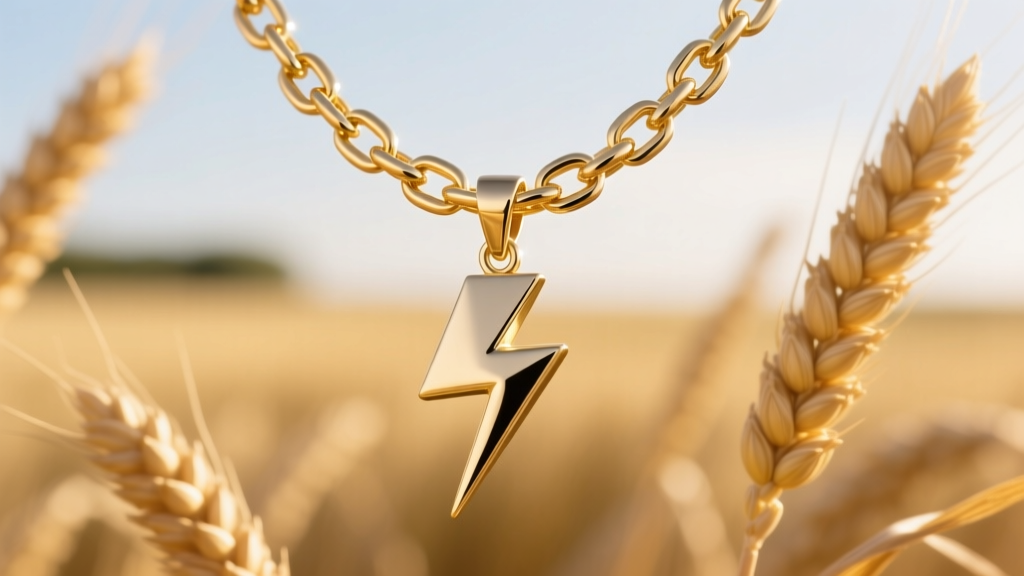
- Wheat (Spiga) Chains: Composed of interlocking oval links woven in the same direction, wheat chains offer exceptional tensile strength and a smooth, rounded profile that prevents the sharp edges of the bail from causing internal abrasion.
- Box Chains: Made of square, interlocking links, box chains provide a sturdy, geometric aesthetic that complements the sharp lines of the lightning bolt. They are highly resistant to kinking, though they can catch on chest hair or fine knits if the links are too loose.
- Cable Chains: The traditional choice. For a lightning bolt pendant, ensure the cable chain features soldered links. Unsoldered cable links will easily pull apart under the pendulum swing of a heavy gold bolt.
Chains to Avoid
Avoid Snake Chains and Herringbone Chains for lightning bolt pendants. Snake chains consist of tightly wound metal bands that are notoriously prone to kinking. Once a snake chain kinks under the weight and swing of an asymmetric pendant, the structural integrity is permanently compromised. Herringbone chains, while beautiful, lay flat against the skin and lack the tensile flexibility required to support a swinging, elongated motif without bending out of shape.
Pricing Tiers and the 2026 Market Value
When evaluating a solid gold lightning bolt necklace in 2026, consumers must look beyond the aesthetic and understand the pricing structure. With the World Gold Council reporting sustained high spot prices for gold, the cost of raw materials heavily influences the final retail price. However, labor and finishing make up a significant portion of the premium.
What You Are Paying For
A high-quality 14K solid gold lightning bolt pendant (weighing approximately 3 to 5 grams) should retail between $350 and $600, excluding the chain. If you encounter a 'solid gold' bolt priced significantly lower, it is likely a hollowed-out casting (electroformed) or a very low-weight stamped piece that will dent upon minor impact. True luxury pieces featuring 18K gold with hand-chased bevels and diamond-set accents will push the price into the $1,200 to $3,000 range. Always verify the hallmark and request the exact gram weight from the jeweler to calculate the intrinsic gold value versus the craftsmanship premium.
Conclusion
A gold lightning bolt necklace is far more than a trendy accessory; it is a feat of micro-engineering. From the precise alloy ratios required to maintain the sharpness of the tips to the physics of the offset bail and the tensile strength of the paired chain, every element must be meticulously executed. By prioritizing 14K gold for durability, seeking out vacuum-cast or die-struck manufacturing, and pairing the pendant with a high-integrity wheat or box chain, you ensure that your lightning bolt necklace remains a structurally sound and visually striking staple in your jewelry collection for decades to come.


