Gold Mezuzah Necklace Value Guide: Pricing and Purity
Discover how to assess the true value of a gold mezuzah necklace. Learn pricing tiers, gold purity standards, and craftsmanship red flags.

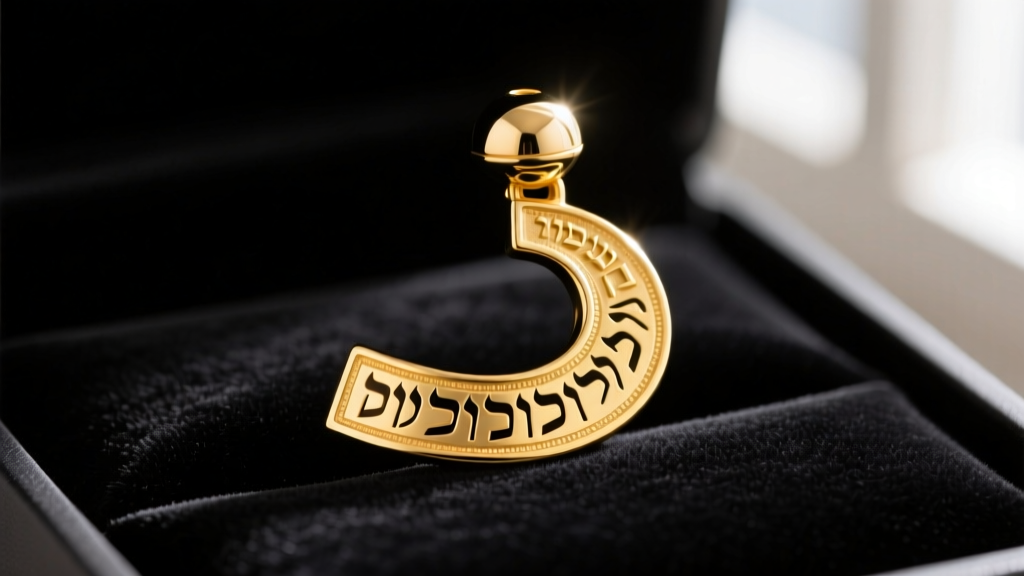
The Dual Value of a Gold Mezuzah Necklace
When shopping for a gold mezuzah necklace, buyers are navigating two entirely different markets simultaneously: the precious metals market and the religious Judaica market. This duality creates a unique pricing landscape where emotional and spiritual significance often masks inflated retail markups. To make a financially sound decision, you must separate the intrinsic melt value of the gold from the craftsmanship premium, while also accounting for the religious authenticity of the scroll (klaf) inside.
Whether you are purchasing a piece for a Bar Mitzvah gift, a personal statement of faith, or an heirloom investment, understanding the metallurgical and structural realities of these pendants is critical. This guide breaks down the exact pricing formulas, material grades, and structural red flags you need to evaluate before making a purchase.
Calculating Melt Value vs. Retail Premium
The foundation of any gold jewelry assessment is the melt value—the raw worth of the gold content based on current market spot prices. You can track live market rates via authoritative financial resources like Kitco or the World Gold Council. However, retail jewelry always carries a premium to cover casting, polishing, design, and overhead.
To calculate the base melt value of a pendant, use this formula:
- Step 1: Determine the current spot price of pure (24k) gold per gram.
- Step 2: Multiply by the purity percentage (e.g., 0.585 for 14k, 0.750 for 18k).
- Step 3: Multiply by the exact gram weight of the pendant.
Example: If pure gold is trading at $65.00 per gram, a 14k gold pendant (58.5% pure) has a base melt value of $38.02 per gram. If the pendant weighs 3.5 grams, the raw gold is worth $133.07. A fair retail price for a basic, mass-cast pendant typically ranges from 80% to 150% above the melt value, placing a fair retail price between $240 and $330. If a vendor is charging $800 for this exact 3.5-gram piece without any gemstones or artisan hand-engraving, you are paying a "tourist trap" or "brand name" premium that holds no resale value.
Gold Purity: 14K vs. 18K vs. 24K in Religious Jewelry
The karatage of the gold drastically affects both the color profile and the structural integrity of the mezuzah case. Because a necklace pendant is subject to friction against clothing and occasional impacts, durability is a primary concern.
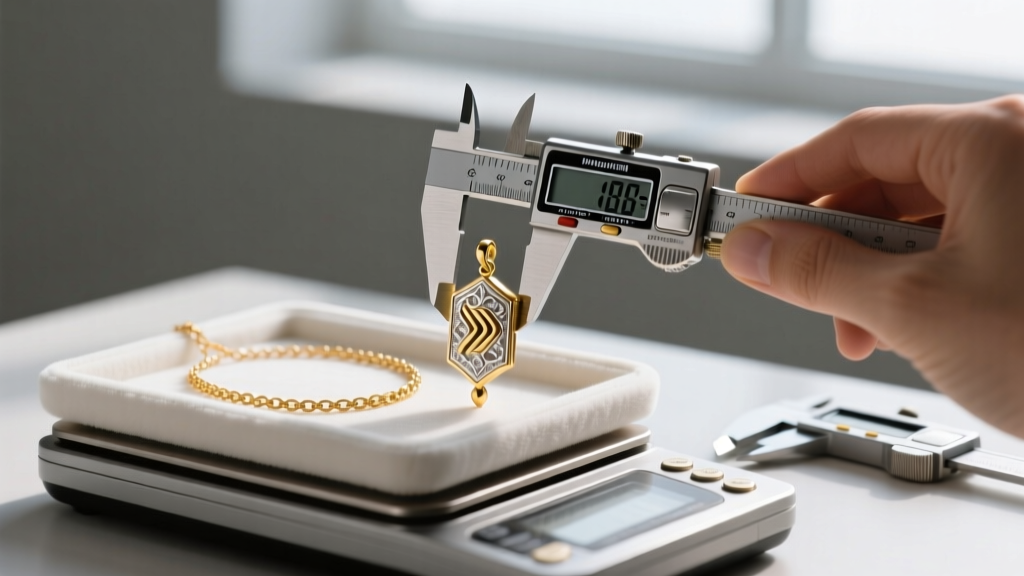
14K Gold (58.5% Pure)
The industry standard for daily-wear religious jewelry. The alloy mix (typically copper, silver, and zinc) provides excellent tensile strength, ensuring the bail (the loop that holds the chain) and the delicate cap of the mezuzah will not bend easily. It offers a warm, classic yellow hue and is the most budget-friendly option.
18K Gold (75.0% Pure)
Prized for its rich, deep yellow color and higher intrinsic value. However, 18k gold is noticeably softer. If the mezuzah features intricate filigree or a delicate hinge mechanism to open the case, 18k gold may wear down or warp over decades of daily use. It commands a 30% to 50% price premium over 14k equivalents.
24K Gold (99.9% Pure)
While culturally significant in some Middle Eastern markets, 24k gold is entirely unsuitable for a functional, wearable mezuzah pendant. It is far too malleable; a simple squeeze can dent the casing, and the threading loop will stretch and snap under the weight of a chain. Avoid 24k for wearable pendants.
Solid vs. Hollow Construction: The Weight Illusion
One of the most common deceptive practices in the Judaica jewelry market is selling hollow, electroformed pendants at solid-gold prices. Hollow construction allows manufacturers to create large, visually impressive mezuzah cases that weigh a fraction of their solid counterparts.
How to Identify Hollow Pendants
- The Heft Test: A standard solid 14k mezuzah pendant (approx. 15mm - 20mm tall) should weigh between 3.0 and 6.0 grams. If it feels suspiciously light (under 1.5 grams) despite its large volume, it is hollow.
- The Sound Test: Gently tap the casing with a wooden toothpick. Solid cast gold produces a dull, dense thud. Hollow gold produces a slightly resonant, metallic click.
- Repairability: Hollow pendants are essentially unrepairable. If a hollow case dents, the goldsmith cannot easily solder or hammer it out without collapsing the structure. Solid cast pendants can be polished, soldered, and restored for generations.
The Scroll (Klaf) Factor: Does it Impact Jewelry Value?
From a purely financial standpoint, the parchment scroll inside the gold casing does not add to the resale value of the metal. However, from a spiritual and functional standpoint, it is the most critical component of the piece. According to the comprehensive guidelines on Chabad.org, a kosher mezuzah must be handwritten by a certified scribe (Sofer STaM) on specially prepared parchment.
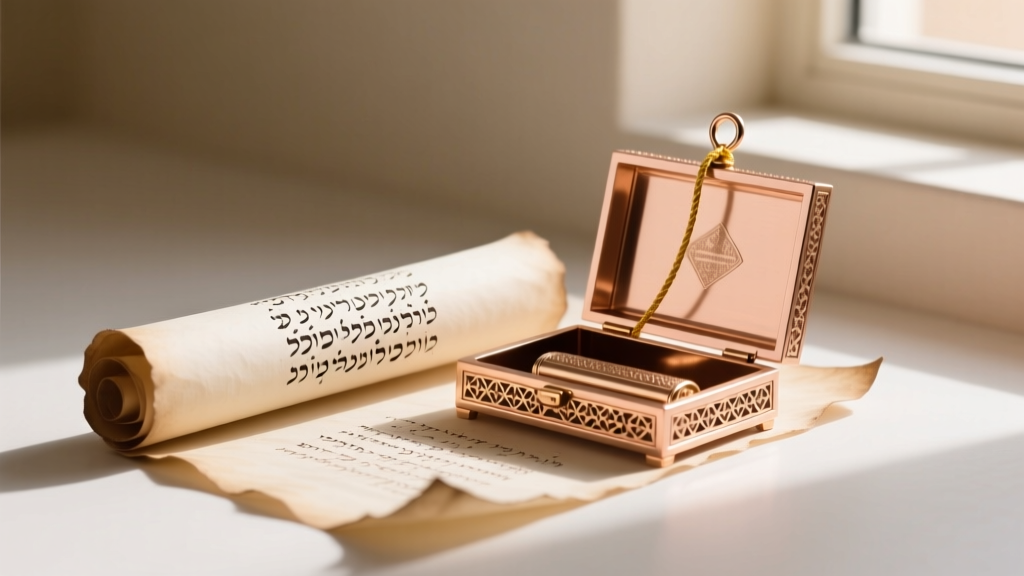
Mass-produced, budget-tier gold mezuzah necklaces often ship empty, or worse, they contain a machine-printed paper replica that holds zero religious validity. If you require a kosher scroll, you must factor in the cost of a miniature, jewelry-sized klaf. A certified Sofer STaM will typically charge between $45 and $90 for a miniature scroll that fits inside a necklace pendant. Always ask the jeweler if the included scroll is "kosher" and "handwritten," and request a certificate of authenticity from the scribe if purchasing a high-end piece.
Chain Pairing: Budgeting for Structural Integrity
A common budgeting mistake is spending $500 on a solid gold mezuzah pendant and pairing it with a flimsy, $40 chain. The pendant acts as a pendulum, placing immense localized stress on the chain's links. If your solid pendant weighs 5 grams, a standard 0.8mm cable chain will eventually snap at the clasp or the jump ring.
The Golden Rule of Chain Pairing: The chain should be rated to hold at least three times the weight of the pendant. For a 4-gram mezuzah, you need a chain with a minimum breaking strength of 12 grams. Opt for a 1.5mm Box Chain or a 2.0mm Rope Chain in matching 14k or 18k gold. Budget an additional $180 to $350 for a high-quality, solid-link chain with a secure lobster clasp.
2026 Pricing Tiers: What You Should Actually Pay
Use this structured framework to evaluate quotes from jewelers, online Judaica stores, and boutique designers. Prices assume a standard gold market environment and reflect fair retail margins.
| Tier | Construction & Purity | Weight Range | Estimated Fair Retail Price | Best Use Case |
|---|---|---|---|---|
| Entry-Level | Hollow 10k or 14k Gold | 1.0g - 2.0g | $120 - $220 | Occasional wear, tight budgets, children's gifts |
| Standard | Solid Cast 14k Gold | 3.0g - 5.0g | $350 - $600 | Daily wear, Bar/Bat Mitzvah, long-term durability |
| Premium | Solid 18k Gold, Hand-Engraved | 5.0g - 8.0g | $750 - $1,200 | Heirloom pieces, luxury gifts, deep color preference |
| Diamond Accent | Solid 14k/18k + Melee Diamonds | 4.0g+ (plus stones) | $900 - $2,500+ | Fashion-forward religious jewelry, milestone anniversaries |
Sourcing and Hallmark Verification
When purchasing a gold mezuzah necklace, always inspect the hallmark. A legitimate piece will be laser-engraved or stamped with "14K", "18K", or "585"/"750", alongside the manufacturer's trademark. Be highly skeptical of pieces sold in tourist-heavy areas near the Western Wall or airport kiosks, where "14k" stamps are occasionally applied to gold-plated brass or low-karat alloys. If buying from an independent online artisan, require a video call to see the piece weighed on a calibrated digital scale and inspected under a jeweler's loupe.
Expert Appraisal Tip: Never pay a premium for "Israeli Gold" as a distinct metallurgical category. Gold is a global commodity; an ounce of 14k gold mined in South Africa and cast in Tel Aviv has the exact same intrinsic melt value as 14k gold cast in New York or London. You are paying for the design, the labor, and the religious certification—not the geographic origin of the metal.
Final Assessment Checklist
Before finalizing your purchase, run the piece through this quick value-assessment checklist:
- Is the exact gram weight listed on the invoice?
- Does the price align with the current spot price plus a reasonable 100% retail markup?
- Is the pendant solid cast, or electroformed/hollow?
- If a scroll is included, is it certified kosher and handwritten?
- Is the accompanying chain thick enough (minimum 1.5mm) to support the pendant's weight without snapping?
By treating the gold mezuzah necklace as both a precious metal asset and a sacred artifact, you ensure that your investment holds its financial worth while honoring its profound spiritual purpose.


