Gold Sunflower Necklace: Karat, Enamel & Cast Guide
Discover how to choose a durable gold sunflower necklace. Compare 14k vs 18k gold, enamel techniques, and casting methods for floral jewelry.

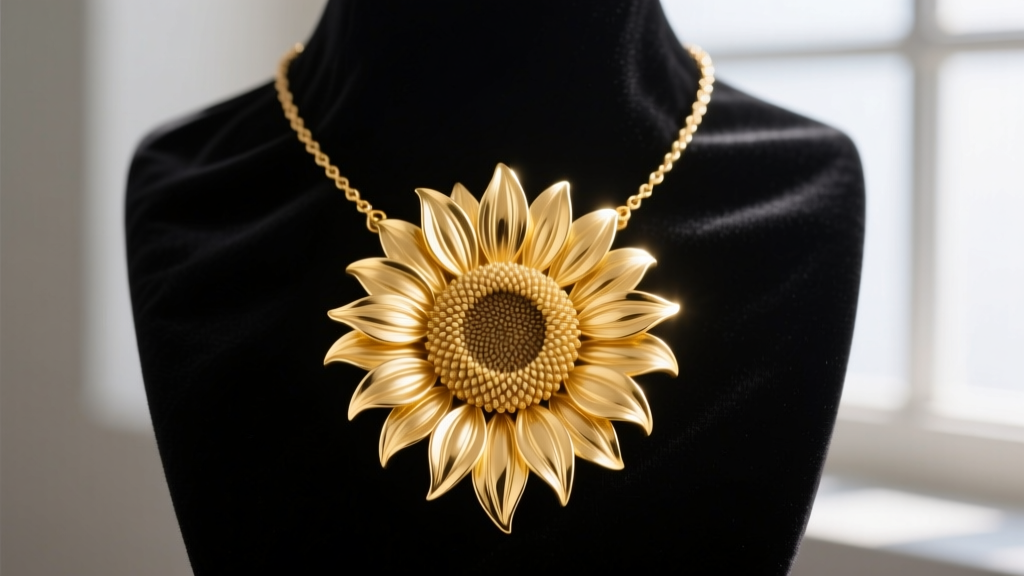
The Anatomy of a Gold Sunflower Necklace
A gold sunflower necklace is more than just a seasonal trend; it is a complex piece of botanical jewelry that requires precise metallurgy and manufacturing to capture the flower's intricate geometry. The defining features of a high-quality sunflower pendant include the high-relief seed head (the disc florets), the radiating petals (ray florets), and the structural integrity of the bail. Because sunflowers require deep texturing and delicate, elongated petal shapes, the choice of gold karat and manufacturing method directly dictates the necklace's lifespan, detail retention, and resistance to deformation.
When evaluating a gold sunflower necklace, consumers often focus solely on color, overlooking the mechanical properties of the alloy. A pendant with paper-thin petals might look delicate, but if struck in the wrong karat, it will bend irreparably upon catching on a sweater. Below, we break down the exact material properties, casting techniques, and enamel applications that separate heirloom-quality floral jewelry from mass-produced costume pieces.
Karat Comparison: 10k, 14k, 18k, and 22k Gold
The purity of gold is measured in karats, but in botanical jewelry, purity is inversely proportional to durability. Pure 24k gold is far too malleable (Vickers Hardness of ~25 HV) to hold the crisp edges of a sunflower petal. Jewelers alloy gold with copper, silver, and zinc to increase tensile strength. According to the Gemological Institute of America (GIA), the specific ratio of these alloy metals not only changes the color but drastically alters the work-hardening characteristics of the metal.
| Gold Karat | Purity | Vickers Hardness (Approx) | Detail Retention | Best Use Case |
|---|---|---|---|---|
| 10k Gold | 41.7% | ~150 HV | Excellent (Rigid) | Everyday wear, thin stamped pendants |
| 14k Gold | 58.5% | ~135 HV | Very Good | Intricate 3D cast sunflowers, prong settings |
| 18k Gold | 75.0% | ~120 HV | Good (Softer) | Heirloom pieces, rich yellow color, enamel work |
| 22k Gold | 91.6% | ~60 HV | Poor (Too Soft) | Flat, minimalist designs only (Avoid for 3D) |
For a highly textured gold sunflower necklace, 14k gold is the optimal choice. It provides enough hardness to prevent the elongated petals from warping if the pendant is accidentally pressed against a hard surface. If you prefer the richer, buttery hue of 18k gold, ensure the pendant features a thicker structural base plate beneath the petals to compensate for the softer alloy.
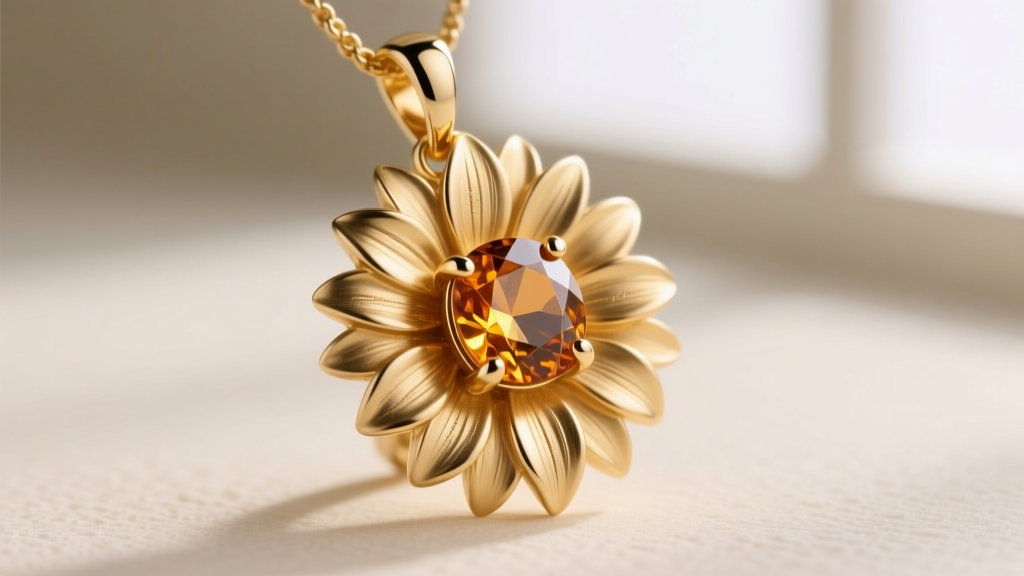
Casting vs. Stamping: How Petal Details Are Formed
The manufacturing technique used to create the sunflower motif fundamentally impacts the pendant's weight, porosity, and edge definition. There are two primary methods used in modern jewelry production for floral motifs.
Lost-Wax Casting for 3D Sunflowers
High-end, three-dimensional gold sunflower necklaces are created via lost-wax casting. A master model is carved in wax, encased in investment plaster, and burned out in a kiln. Molten gold is then injected into the cavity using a vacuum or centrifugal force. This method allows for deep undercuts, meaning the seeds in the center of the sunflower can be deeply recessed and highly textured. However, poor temperature control during casting can lead to gas porosity—tiny pinholes on the gold surface that ruin the smooth finish of the petals and trap dirt over time.
Die Striking for Flat Pendants
Minimalist, flat-profile sunflower pendants are typically die-struck. A hardened steel die stamps the sunflower shape out of a sheet of gold under immense pressure. This process compresses the gold's molecular structure, making it exceptionally dense and hard. While die-struck pendants lack the 3D depth of cast pieces, they are incredibly resistant to bending and are often more affordable, ranging from $150 to $350 for a 14k piece, compared to $600+ for a heavy cast equivalent.
Enamel and Gemstone Accents: Adding Color to the Bloom
While solid gold is beautiful, many collectors seek a gold sunflower necklace that incorporates color to mimic the flower's natural vibrancy. This is achieved through vitreous enamel or center-set gemstones.
Champlevé vs. Plique-à-Jour Enamel
In champlevé enamel, the jeweler uses a burr to carve out shallow troughs in the gold petals, leaving the gold walls intact. These troughs are filled with finely ground glass powder and fired in a kiln at approximately 800°C. Once polished, the gold veins separate the vibrant yellow and green glass, creating a stained-glass effect. Plique-à-jour, conversely, removes the gold backing entirely, allowing light to pass through the translucent enamel like a tiny window. While plique-à-jour is breathtaking, it is highly fragile; a single drop onto a tile floor will shatter the enamel petals.
Center Seed Gemstones
The center of the sunflower (the seed head) is often highlighted with a cluster of gemstones. Brown diamonds (champagne diamonds) are the premier choice for their earthy, natural inclusions that mimic real seeds. For a more budget-friendly option, jewelers use faceted smoky quartz or citrine cabochons. Ensure the center stone is secured with at least four prongs or a heavy bezel; glue-set stones in floral jewelry frequently fail when exposed to the thermal shock of hot water or direct sunlight.
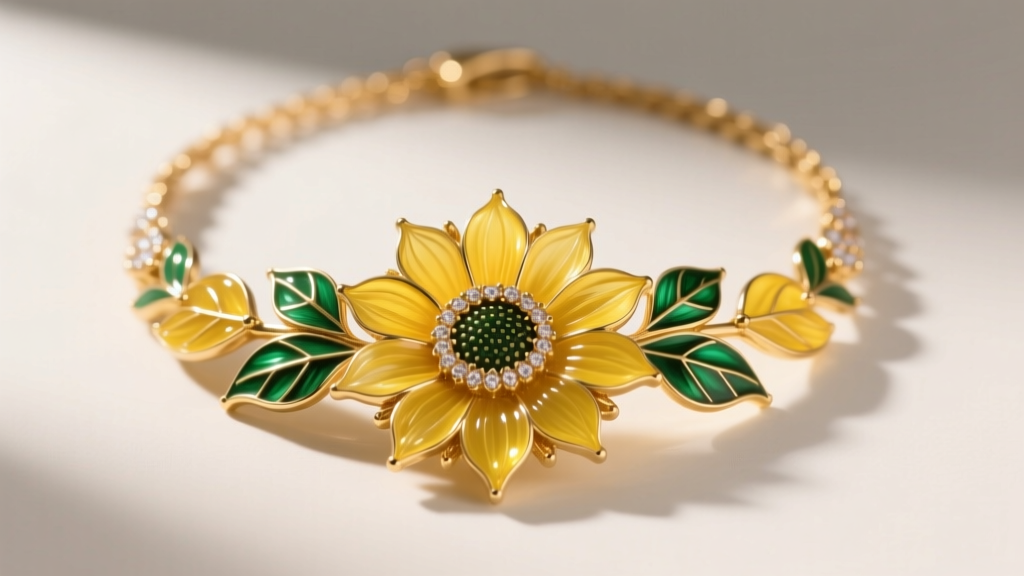
Chain Selection and Clasp Hardware
A detailed sunflower pendant requires a chain that complements its organic aesthetic without overpowering it. Avoid thick, blocky chains like Cuban links, which clash with the delicate floral geometry. Instead, opt for a Wheat (Spiga) chain or a Rope chain. The woven, twisted links of these chains mimic the fibrous, natural texture of a plant stem.
For the clasp, never accept a standard spring-ring clasp on a heavy cast gold sunflower necklace. Spring rings are notorious for failing under tension. Insist on a lobster claw clasp with a forged jump ring. As noted by Jewelers of America, the structural integrity of the clasp and the soldered jump rings are the most common failure points in necklaces weighing over 5 grams.
Care and Maintenance for Textured Floral Gold
Maintaining a gold sunflower necklace requires specific protocols, especially if the piece features deep texturing or enamel. The intricate crevices of the seed head are magnets for cosmetic oils, lotions, and environmental dust.
- Avoid Ultrasonic Cleaners: If your sunflower necklace features champlevé or plique-à-jour enamel, never place it in an ultrasonic cleaner. The high-frequency acoustic cavitation will cause microscopic fractures in the glass, eventually leading to catastrophic shattering.
- Manual Brushing: Use a baby-soft toothbrush and a solution of warm water with a single drop of mild, phosphate-free dish soap. Gently agitate the bristles over the seed head to dislodge trapped debris.
- Polishing Precautions: Do not use aggressive jeweler's rouge on a textured sunflower. High-speed polishing wheels will round off the crisp edges of the petals and erase the tiny stippled dots in the center. Request a 'light steam clean and hand-polish' from your jeweler.
Expert Insight: When storing a gold sunflower necklace, never toss it loosely into a jewelry box. The protruding petals can easily snag on other chains, causing them to bend or snap off entirely. Always lay the pendant flat in a dedicated microfiber pouch or hang it by the clasp on a padded jewelry valet.
By understanding the metallurgical constraints of gold alloys, the nuances of lost-wax casting, and the fragility of vitreous enamel, you can confidently select a gold sunflower necklace that will retain its botanical brilliance for generations.


