The Anatomy of a Graduated Pearl Necklace: An Expert Sizing Guide
Discover the technical anatomy of a graduated pearl necklace. Learn about nacre thickness, drill hole sizing, and expert knotting techniques.

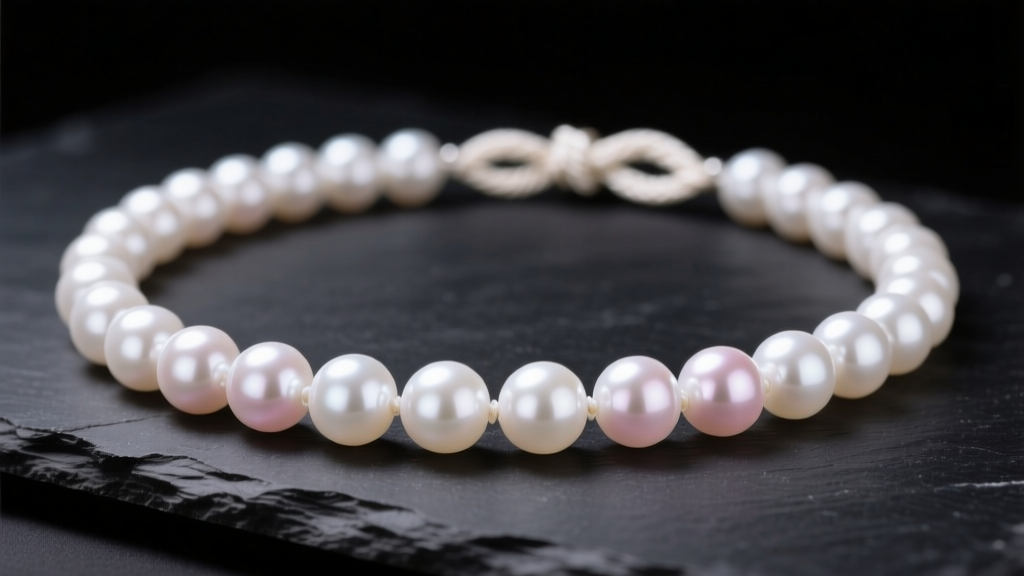
When evaluating fine jewelry, few pieces demand as much technical precision and sorting mastery as a graduated pearl necklace. Unlike uniform strands where a jeweler simply matches a single millimeter size across the entire strand, a graduated strand requires the meticulous matching of luster, overtone, surface quality, and body color across a continuously shifting spectrum of sizes. The result is an elegant, sweeping silhouette that flatters the neckline, but achieving this optical harmony is a masterclass in gemological sorting. In this expert deep dive, we deconstruct the structural anatomy, grading tolerances, and stringing mechanics that separate a mass-market strand from a fine jewelry investment.
The Architecture of Graduation: Millimeter Progression
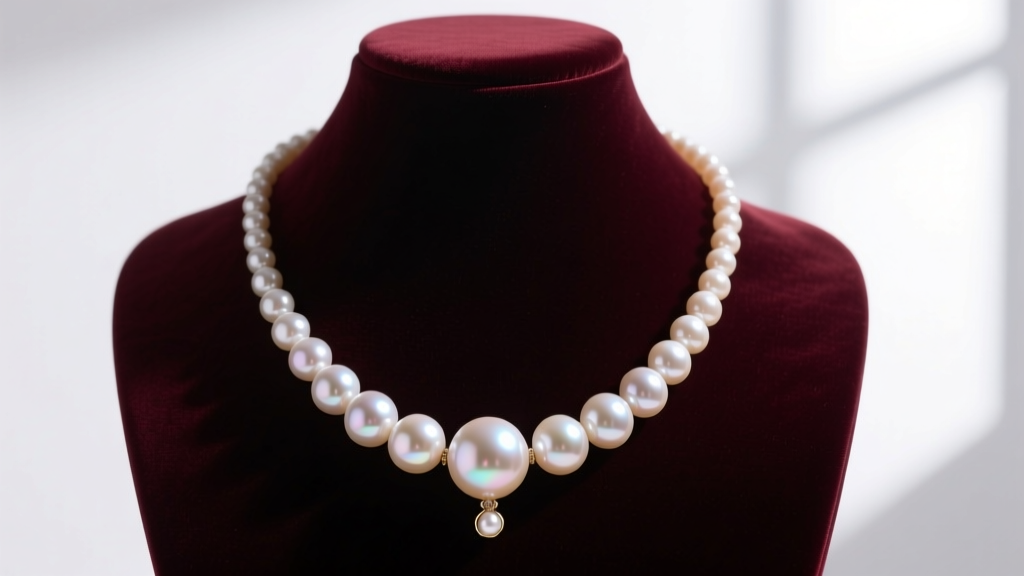
The defining characteristic of a graduated pearl necklace is its symmetrical taper. The largest pearl rests precisely at the center of the nape, with subsequent pearls decreasing in diameter as they approach the clasp. However, this taper is rarely a linear mathematical drop; it is a carefully calibrated curve designed to account for human anatomy and visual perception.
In a standard 18-inch princess-length strand, you will typically find between 47 and 53 individual pearls. The center pearl anchors the design. For a classic Akoya graduated strand, the center pearl might measure 9.0mm to 9.5mm. The 'run'—the sequence of pearls flanking the center—drops in half-millimeter or full-millimeter increments. A high-end strand will utilize half-millimeter drops (e.g., 9.0, 8.5, 8.0, 7.5) for the first five pearls on either side of the center to create a smooth, imperceptible transition. As the strand moves toward the shoulders and collarbone, the drop can become more aggressive, stepping down to 6.0mm or 5.5mm near the clasp.
This non-linear progression is critical. If the pearls decreased at a strict, uniform rate, the necklace would look bottom-heavy and visually awkward when worn. Expert stringers map the progression to the curvature of the neck, ensuring the visual weight remains balanced.
Nacre Thickness and Luster Grading in Graduated Strands
Matching luster across varying sizes is the most formidable challenge in assembling a graduated pearl necklace. Luster—the sharpness and intensity of light reflecting off the pearl's surface—is directly tied to nacre thickness and the crystalline structure of the aragonite platelets. According to the Gemological Institute of America (GIA), nacre thickness is a primary determinant of a pearl's durability and optical performance.
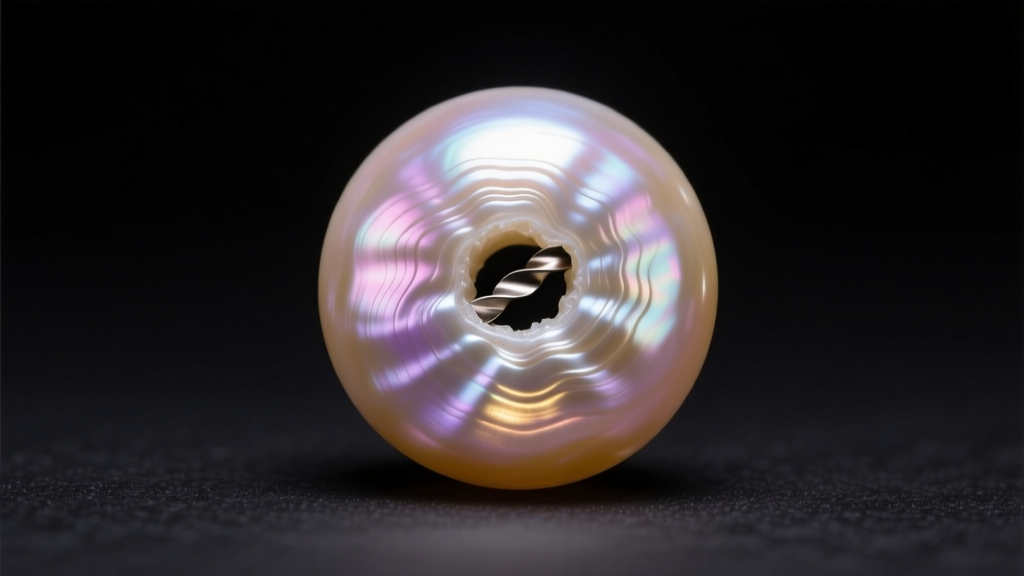
In saltwater Akoya pearls, the nucleus bead is typically made of polished freshwater mussel shell. A 9.0mm Akoya pearl might have a 7.0mm nucleus and 1.0mm of nacre on each side. However, a 6.0mm pearl at the end of the strand might have a 4.5mm nucleus, leaving only 0.75mm of nacre. Because smaller pearls have less surface area and thinner absolute nacre depth, they can sometimes appear 'chalky' or lack the deep, mirror-like orient of their larger counterparts.
To counteract this, elite pearl sorters reserve their sharpest-luster harvest batches specifically for the smaller end-pieces of graduated strands. When evaluating a vintage or contemporary strand, examine the 5mm to 6mm pearls near the clasp. If they exhibit the same sharp, high-contrast reflections as the 9mm center pearl, you are looking at a masterfully curated strand. Mismatched luster, where the center pearls glow but the edges look dull, is a hallmark of commercial-grade assembly.
Silk Knotting Techniques and Drill Hole Tolerances
The structural integrity of a graduated pearl necklace relies entirely on the stringing medium and the knotting technique. Fine strands are exclusively knotted on 100% silk thread. The silk serves two purposes: it prevents the pearls from grinding against one another (which would degrade the nacre over time), and it ensures that if the strand breaks, only a single pearl is lost.
Drill Hole Sizing and Nacre Preservation
Drilling is a destructive process. Every millimeter drilled is nacre permanently removed from the gem. In commercial manufacturing, factories often use a standard 0.8mm or even 1.0mm drill bit for all pearls to speed up production. However, drilling a 1.0mm hole through a 6.0mm pearl removes nearly 17% of its total diameter, severely compromising its structural integrity and value. Expert graders specify micro-drill holes—typically 0.6mm to 0.7mm—for the smaller pearls in a graduated run, preserving maximum nacre weight and structural stability.
Thread Sizing and French Wire
Silk thread is graded by letters, with Size E (approx. 0.32mm) and Size F (approx. 0.40mm) being the industry standards for fine pearls. A master stringer will often use a thicker Size F thread for the 8.0mm+ center pearls, and transition to a finer Size E thread for the smaller end pearls to ensure the knots do not overpower the smaller gems. Furthermore, the final three pearls on each end must be secured with 'French wire' (also known as gimp or bullion)—a microscopic, hollow coil of silver or gold wire. This wire wraps around the silk where it passes through the metal clasp ring, preventing the metal from sawing through the silk thread over decades of wear.
| Pearl Position | Typical Diameter | Drill Hole Size | Silk Thread Grade | Knot Style |
|---|---|---|---|---|
| Center Pearl | 9.0mm - 10.0mm | 0.7mm - 0.8mm | Size F or G | Double Overhand |
| Shoulder Run | 7.5mm - 8.5mm | 0.6mm - 0.7mm | Size F | Standard Overhand |
| Collarbone Run | 6.5mm - 7.0mm | 0.6mm | Size E | Standard Overhand |
| Clasp End Pearls | 5.0mm - 6.0mm | 0.5mm - 0.6mm | Size E (with French Wire) | Half-Hitch / Gimp Wrap |
Pricing Tiers: Akoya vs. Freshwater vs. South Sea
The pricing of a graduated pearl necklace scales exponentially based on the pearl variety, as the difficulty of matching a 'run' increases with the rarity of the base material. According to the Cultured Pearl Association of America, the cultivation time and rejection rates heavily influence final market costs.
- Akoya (Saltwater): The gold standard for classic graduated strands. Known for their sharp, mirror-like luster and perfectly round shapes. A high-quality, 18-inch graduated Akoya strand (9.0mm to 6.0mm) with clean surfaces and thick nacre typically ranges from $2,500 to $6,000. Heritage brands like Mikimoto command premiums exceeding $15,000 due to their proprietary, ultra-strict sorting criteria.
- Freshwater: Modern Edison and high-grade Chinese freshwater pearls can mimic the roundness of Akoyas. However, because they are often solid nacre (beadless) or feature massive nuclei with thin nacre coatings, their luster tends to be softer and more 'satiny.' A premium graduated freshwater strand can be acquired for $400 to $1,200, making it an accessible entry point, though it lacks the sharp optical contrast of Akoya.
- White South Sea (Saltwater): The pinnacle of luxury. South Sea pearls are massive, cultivated in the Pinctada maxima oyster. A graduated South Sea strand dropping from a staggering 18.0mm center to 12.0mm edges is a museum-level collector's item. Because matching the subtle silver or rose overtones across these massive sizes takes years of harvesting, these strands routinely command $40,000 to well over $150,000 at auction.
Expert Troubleshooting: Identifying Structural Flaws
When inspecting a graduated pearl necklace for purchase or appraisal, look beyond the basic shine. Use a 10x jeweler's loupe to examine the drill holes and the silk knots. Here are the critical failure modes to watch for:
'A true masterwork in pearl stringing is invisible. The knots should be tight enough to prevent movement, but supple enough to allow the necklace to drape like liquid fabric. Stiffness is the enemy of the drape.' — Master Pearl Stringer Adage
1. The 'Chalky' Edge Syndrome: As mentioned, smaller pearls often suffer from thinner nacre. Roll the 5mm and 6mm pearls under a direct LED light. If you see a dull, matte patch or a 'window' where the nucleus bead is faintly visible through the nacre, the strand has been poorly sorted or the pearls were harvested prematurely.
2. Overtone Clashing: Pearls possess body color (e.g., white) and overtone (e.g., rose, silver, or cream). In a poorly assembled graduated strand, the center pearls might have a warm cream body color, while the smaller end pearls exhibit a stark, cool silver overtone. This creates a jarring, disjointed look when worn. The entire strand must share a unified overtone family.
3. Stretched Silk and 'Gapping': Hold the strand taut between your hands. If you see gaps of bare silk thread between the knots and the pearls, the necklace has been worn extensively without being re-strung. Silk stretches and degrades with exposure to skin oils and humidity. A gapping strand is a structural liability and requires immediate professional re-stringing, which typically costs $5 to $10 per inch for complex graduated knotting.
Understanding the technical nuances of a graduated pearl necklace transforms it from a simple accessory into a marvel of gemological engineering. By scrutinizing the millimeter progression, nacre consistency, and stringing mechanics, you can confidently identify and invest in a strand that will maintain its structural integrity and breathtaking luster for generations.


