How to Choose, Authenticate, and Style a Templar Necklace
Learn how to choose, authenticate, and style a Templar necklace. Our step-by-step guide covers metal grades, cross variants, and chain pairings.


The Knights Templar remain one of the most enigmatic and influential military orders of the Middle Ages. Today, their legacy lives on not just in history books, but in the enduring popularity of Templar jewelry. Whether you are drawn to the historical mystique of the Crusades, the fraternal symbolism of modern Masonic orders, or simply the bold, geometric aesthetics of medieval crosses, selecting the right piece requires a discerning eye. A Templar necklace is more than a simple accessory; it is a statement piece that demands careful consideration regarding historical accuracy, metallurgical quality, and proportional styling.
In this comprehensive guide, we will walk you through the exact steps to choose, authenticate, and style a Templar necklace, ensuring your investment is both historically respectful and sartorially sharp.
Understanding the Templar Cross: Historical vs. Modern Variants
Before purchasing a Templar necklace, it is crucial to understand that not all medieval crosses are historically accurate to the Knights Templar. The jewelry market is flooded with conflated designs. To make an informed decision, you must distinguish between the primary cross variants used by military orders during the Crusades.
| Cross Variant | Historical Order | Design Characteristics | Modern Styling Vibe |
|---|---|---|---|
| Cross Pattée | Knights Templar | Arms narrow at the center and flare outward to broad, flat ends. | Bold, masculine, historically accurate. |
| Maltese Cross | Knights Hospitaller | Eight distinct points, forming a V-shape at the end of each arm. | Intricate, sharp, often associated with firefighters/police. |
| Jerusalem Cross | Kingdom of Jerusalem | One large central cross potent surrounded by four smaller Greek crosses. | Ornate, religious, highly detailed. |
If you are seeking strict historical accuracy to the Poor Fellow-Soldiers of Christ and of the Temple of Solomon, the Cross Pattée (often called the Croix Pattée) is the definitive choice. According to archival records preserved by institutions like the Victoria and Albert Museum, the Templars adopted this distinct, broad-armed cross as their primary insignia in the 12th century.
Step-by-Step Guide to Selecting the Right Metal and Finish
The material of your pendant dictates its longevity, weight, and how it ages against your skin. Here is how to evaluate the most common metals used in Templar jewelry.
1. 925 Sterling Silver (The Benchmark)
For daily wear, 925 sterling silver is the gold standard. Composed of 92.5% pure silver and 7.5% copper alloy, it offers the perfect balance of malleability and tensile strength. Look for pieces with an "antiqued" or "oxidized" finish, where the recesses of the cross are intentionally darkened to highlight the geometric flaring of the Cross Pattée arms.
2. Bronze and Brass (The Relic Aesthetic)
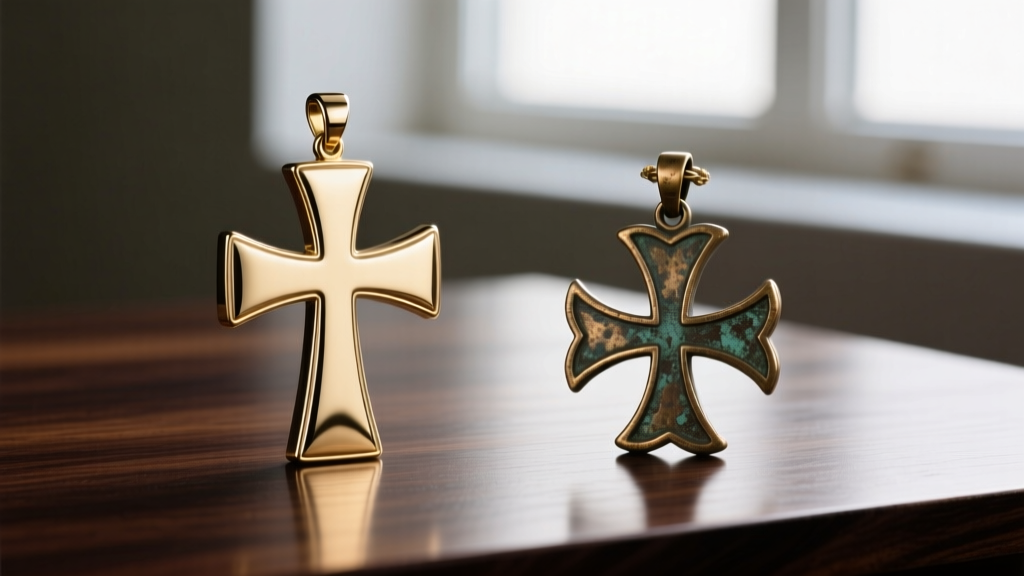
If you want your necklace to look like an excavated artifact, bronze (copper and tin) or brass (copper and zinc) are exceptional choices. These high-copper alloys develop a natural patina over time. However, be aware that raw copper alloys can react with sweat, leaving a greenish residue (verdigris) on your skin. Pro Tip: Coat the back of a bronze pendant with a thin layer of microcrystalline wax, such as Renaissance Wax, to create a breathable barrier against skin oils.
3. Metals to Avoid
Steer clear of Zamak (a zinc alloy) or cheap pewter. These materials are brittle, prone to snapping under the stress of a heavy chain, and often contain nickel or lead that can trigger severe contact dermatitis.
How to Authenticate Vintage and Relic Templar Pendants
The secondary market is saturated with counterfeit "antique" Templar crosses. Use this three-step authentication framework to verify your piece.
- The Neodymium Magnet Test: Precious metals like silver, gold, bronze, and brass are non-magnetic. If your pendant snaps to a strong neodymium magnet, it is likely steel or iron with a thin silver plating. As noted by the Gemological Institute of America (GIA), silver is diamagnetic, meaning it will actually exhibit a very slight repulsion to a strong magnetic field.
- Hallmark Verification: Use a jeweler's loupe (10x magnification) to inspect the bail and the backplate of the cross. Genuine sterling silver will bear a "925", "STERLING", or a recognized maker's mark. Cast pieces that lack any stamping and have seam lines along the edges are likely mass-produced base metals.
- The Ping Test: Gently tap the edge of the pendant with a wooden stick or a plastic pen. Solid sterling silver produces a clear, high-frequency, sustained ringing sound. Base metals like lead-alloy pewter or zinc will produce a dull, short "thud."
"When evaluating historical revival jewelry, the weight of the piece is often a dead giveaway. A genuine solid bronze or silver Templar cross measuring 1.5 inches across should weigh between 12 and 25 grams. Anything under 5 grams of that size is likely hollow-cast or plated resin."
Pairing Your Templar Necklace with the Correct Chain
A common mistake is pairing a heavy, historically styled pendant with a flimsy chain. The chain must match the pendant not just in aesthetic, but in tensile strength and bail diameter.
Proportional Matching Chart
- Light Pendants (3g - 8g): Pair with a 1.5mm to 2.0mm Box or Figaro chain. These chains offer a clean, minimalist backdrop that lets the cross take center stage.
- Medium Pendants (9g - 18g): Pair with a 2.5mm to 3.0mm Rope or Mariner chain. The twisted texture of a rope chain complements the rugged, medieval vibe of a Templar cross.
- Heavy Relic Pendants (19g - 35g+): Pair with a 3.5mm to 5.0mm Cuban or Curb chain. You need the thick, interlocking links of a Cuban chain to support the weight without risking a snapped link.
Critical Bail Check: Always measure the inner diameter of the pendant's bail (the loop the chain passes through). A 3.5mm Cuban chain typically requires a bail with an inner diameter of at least 4.5mm to 5.0mm to allow the chain to drape naturally without kinking.

Styling Frameworks: Necklines and Occasions
How you wear your Templar necklace dictates its visual impact. Follow these structural guidelines for different garments:
The Crew Neck T-Shirt
Opt for a 20-inch to 22-inch chain. This length allows the Cross Pattée to rest just below the collarbone, creating a natural focal point without getting tangled in the fabric's ribbing. A dark, oxidized silver pendant pops brilliantly against a white, heather gray, or black crew neck.
The V-Neck and Henley
A 24-inch chain is ideal here. The elongated drop of the chain mirrors the geometric V-shape of the neckline, drawing the eye downward and elongating the neck. This is an excellent styling choice for a rugged, layered look.
The Button-Down Oxford
You have two options. For a subtle, professional look, wear an 18-inch chain tucked inside the shirt, allowing just the top of the bail to peek out from the unbuttoned collar. For a bold, fashion-forward approach, wear a 24-inch chain over the buttoned shirt, treating the necklace as a statement piece akin to a tie.
Care and Maintenance for Antique and Modern Pieces
Proper maintenance ensures your Templar necklace retains its structural integrity and visual depth.
- For Sterling Silver: Avoid commercial liquid dips, which strip away the intentional oxidation in the crevices of the cross. Instead, use an electrochemical bath: line a bowl with aluminum foil, add boiling water, a tablespoon of baking soda, and a pinch of salt. Submerge the silver for 60 seconds. The ion transfer will remove surface tarnish without damaging the darkened recesses.
- For Bronze and Brass: Clean with a mild paste of lemon juice and baking soda if you wish to restore the bright, polished copper finish. If you prefer the dark, aged patina, simply wipe the piece with a damp microfiber cloth and dry it immediately to prevent uncontrolled verdigris.
- Storage: Store your necklace in an anti-tarnish flannel pouch. Never store silver and bronze pieces together in the same compartment, as the differing metal potentials and off-gassing can accelerate localized corrosion.
Choosing a Templar necklace is an exercise in balancing historical reverence with modern craftsmanship. By understanding the distinct geometry of the Cross Pattée, verifying the metallurgical integrity of your piece, and pairing it with a structurally sound chain, you secure a timeless artifact that commands respect.


