How to Clean and Restore a Half Sun Necklace Safely
Learn how to safely clean, polish, and store your half sun necklace. Expert tips for sterling silver, gold vermeil, and delicate enamel sun rays.

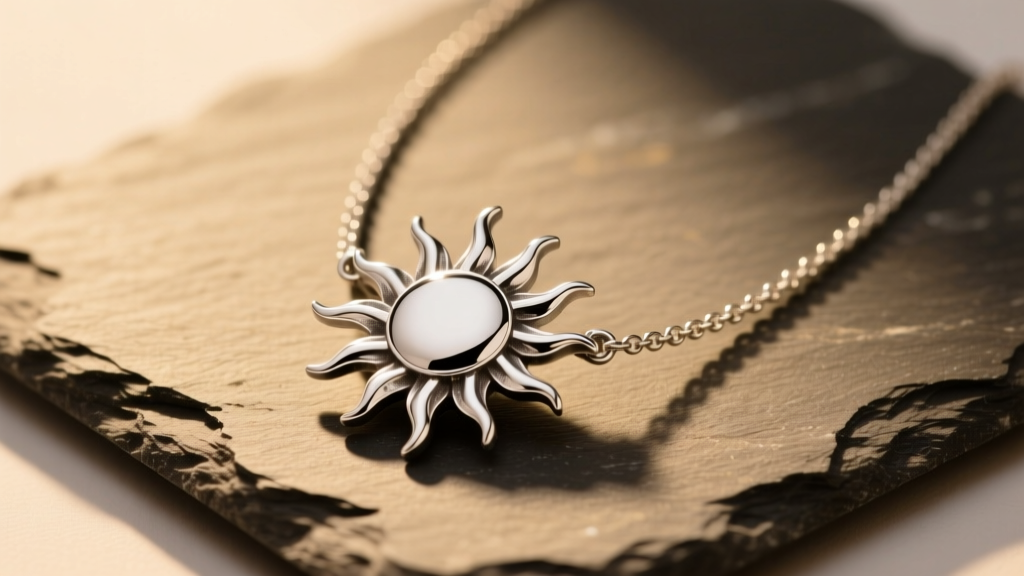
The Anatomy of a Half Sun Necklace: Why It Demands Special Care
The half sun necklace, characterized by its semicircular base and radiating spikes or wires, is a staple of celestial and bohemian jewelry. However, its striking silhouette presents unique maintenance challenges. The radiating rays are often cast or formed from 18- to 20-gauge wire, creating dozens of acute angles where the spikes meet the central base. These junctions act as microscopic traps for sebum, dead epidermal cells, cosmetic residues, and environmental pollutants. Over time, this buildup not only dulls the metal's luster but can also accelerate localized galvanic corrosion, particularly in mixed-metal or soldered designs.
Furthermore, the delicate nature of the sun rays means they are highly susceptible to mechanical damage. Bending, snagging, or aggressive polishing can warp the symmetry of the pendant or, in the case of cast pieces, cause microscopic stress fractures that eventually lead to a snapped ray. Proper care requires a nuanced understanding of your pendant's specific material composition and structural vulnerabilities.
Material Identification: Know Your Sun Pendant
Before applying any cleaning solution, you must accurately identify the metal and any secondary accents. According to guidelines from the Jewelers of America, using the wrong chemical agent on plated or porous metals can cause irreversible stripping or pitting. Review the chart below to determine your pendant's primary material and its corresponding care protocol.
| Material | Tarnish Risk | Recommended Cleaning Agent | Ultrasonic Safe? |
|---|---|---|---|
| 925 Sterling Silver | High (Silver Sulfide) | Mild Soap / Baking Soda Bath | Yes (if no enamel) |
| Gold Vermeil (2.5µm+) | Low (Base can tarnish if worn) | Mild Soap ONLY | No |
| Solid 14k/18k Gold | Very Low | Mild Soap / Ammonia-free cleaner | Yes |
| Brass / Bronze | High (Copper Oxidation) | Lemon / Salt or Ketchup | No |
| Vitreous Enamel Accents | N/A (But chips easily) | Damp Microfiber Cloth ONLY | Absolutely Not |
Step-by-Step Cleaning Routine for Intricate Sun Rays
For routine maintenance of sterling silver or solid gold half sun pendants, a gentle aqueous cleaning is the safest and most effective method. Avoid commercial 'dip' cleaners, as they contain harsh thiourea compounds that can leave a porous, matte finish on the metal, making it tarnish faster in the future.
1. The Soak
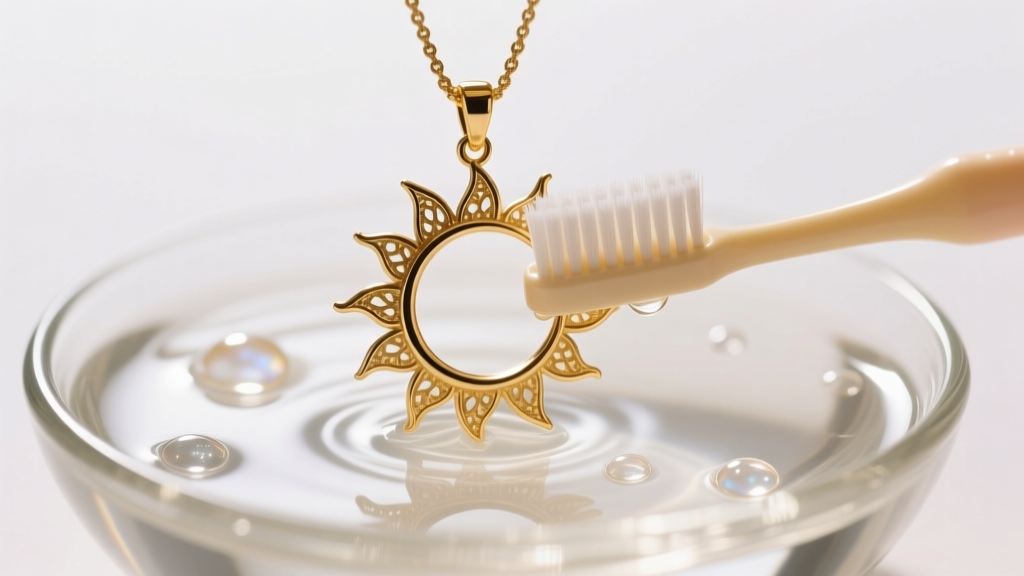
Fill a glass bowl with lukewarm water (never hot, to protect any gemstone or enamel settings) and add three drops of a basic, non-moisturizing dish soap like Dawn. Moisturizing soaps contain lotions and oils that will leave a stubborn film in the crevices of the sun rays. Submerge the necklace and let it soak for 3 to 5 minutes. If your piece is gold vermeil, limit the soak to 2 minutes to prevent water from seeping into any microscopic pores in the gold layer.
2. The Agitation
Remove the pendant from the water. Using a brand-new, extra-soft baby toothbrush (the bristles are typically 0.1mm or finer, which is crucial for preventing micro-scratches on 925 silver), gently brush the base of the sun rays. Brush in the direction of the rays, moving from the center outward. Do not scrub in tight circles, as this can bend 20-gauge wire rays or trap debris deeper into the solder joints.
3. The Rinse and Dry
Rinse thoroughly under a gentle stream of lukewarm water to ensure no soap residue remains. Pat dry with a clean, lint-free microfiber cloth. Avoid paper towels or tissues; their wood-pulp fibers are abrasive enough to inflict microscopic scratches on highly polished gold and silver surfaces. Ensure the area between the bail (the loop holding the pendant) and the chain is completely dry to prevent water-spotting.
Tackling Tarnish: The Science of Silver Sulfide
If your sterling silver half sun necklace has developed a yellow, brown, or black film, you are looking at silver sulfide ($Ag_2S$). This occurs when silver reacts with sulfur compounds in the air, sweat, and certain foods. The Silver Institute recommends addressing tarnish based on the severity and the pendant's finish.
The Electrochemical Aluminum Bath (For High-Polish Silver Only)
For heavily tarnished, high-polish half sun pendants without any intentional oxidation or enamel, an electrochemical bath is a miracle worker. Line a glass bowl with aluminum foil (shiny side up). Place the necklace inside, ensuring it touches the foil. Pour boiling water over the piece, then add two tablespoons of baking soda. You will smell a distinct 'rotten egg' odor (hydrogen sulfide gas) as the reaction occurs. The aluminum, being more reactive, donates electrons to the silver sulfide, converting it back to pure silver while the sulfur bonds with the aluminum. After 3 minutes, remove, rinse, and polish.
Warning: Oxidized and Antiqued Finishes
Many artisan half sun necklaces feature 'antiqued' or 'oxidized' crevices—a deliberate process where the jeweler applies liver of sulfur to darken the recesses, creating high contrast against the polished rays. Do not use the aluminum foil bath or silver dip on these pieces. The chemical reaction will strip the intentional patina, leaving the pendant looking flat and washed out. Instead, use a treated polishing cloth (like a Sunshine cloth) and carefully buff only the raised, polished surfaces of the rays, avoiding the darkened crevices entirely.
Protecting Enamel and Gemstone Accents
Celestial jewelry frequently incorporates enamel to depict the sky behind the sun. It is vital to know which type of enamel your piece features:
- Vitreous Enamel: Made from fused glass powder. It is highly durable against chemicals but incredibly fragile against impact and high-frequency vibrations. Never place a vitreous enamel half sun pendant in an ultrasonic cleaner; the cavitation bubbles will cause micro-fractures, leading to a spiderweb cracking effect.
- Cold Enamel (Epoxy Resin): A painted-on resin that mimics glass. It is highly sensitive to heat and solvents. Water hotter than 140°F (60°C) can soften the resin, causing it to peel or warp. Alcohol-based cleaners will dissolve the glossy topcoat, leaving a cloudy, matte finish.
For any enameled half sun pendant, the Gemological Institute of America (GIA) advises sticking strictly to a damp microfiber cloth for the enameled sections, using the soapy toothbrush method only on the exposed metal rays, taking extreme care not to scrub the enamel borders.
Proper Storage to Prevent Ray Bending and Tangling
The radiating spikes of a half sun pendant are notorious for snagging on other jewelry. Storing this piece in a communal jewelry box is a recipe for bent rays and severely kinked chains. Furthermore, the increased surface area of the sun rays exposes more metal to ambient humidity and sulfur, accelerating tarnish.
The Ideal Storage Protocol
- Isolate: Store the necklace completely alone. Never drape it over other pieces.
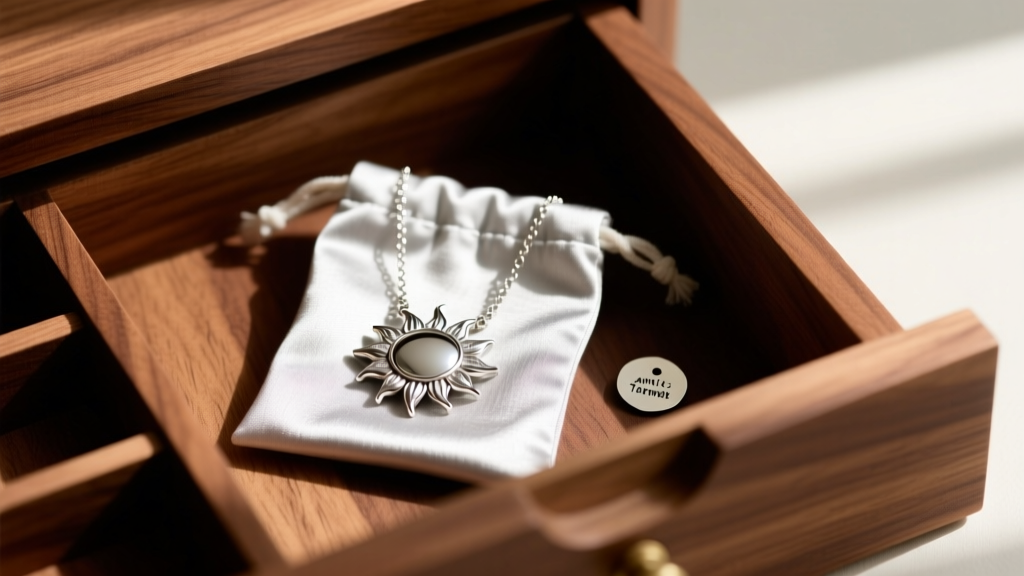
- Use Pacific Silvercloth: Unlike standard anti-tarnish flannel, Pacific Silvercloth is embedded with microscopic silver particles that act as a sacrificial anode, absorbing sulfur and moisture before it reaches your necklace.
- Add an Anti-Tarnish Tab: Drop a 3M anti-tarnish strip into the pouch. These tabs absorb atmospheric sulfides and can protect the metal for up to 6 months in a sealed environment.
- Lay Flat or Hang Securely: If laying flat, ensure the chain is unclasped and laid out in a wide circle to prevent kinking. If hanging, use a dedicated hook where the pendant can hang freely without the rays pressing against a backing board.
Expert Troubleshooting: Common Half Sun Necklace Issues
Even with meticulous care, structural issues can arise. Here is how to handle the most common failures specific to this pendant style:
Bent or Warped Sun Rays
If a wire ray bends, do not attempt to bend it back into place with your fingers. Repeated bending causes work-hardening, making the metal brittle and leading to a clean snap. If the ray is cast, it will snap immediately upon adjustment. Take the piece to a professional jeweler who can use a laser welder to reinforce the joint or gently anneal the metal with a micro-torch before reshaping it with nylon-jaw pliers.
Bail Wear and Tear
The bail (the loop connecting the sun to the chain) experiences constant friction. Over 2 to 3 years of daily wear, a sterling silver chain can act like a microscopic saw, wearing a groove into the top of the bail. Inspect the bail every six months. If you see a deep groove or thinning metal, have a jeweler solder a new jump ring or replace the bail before it snaps and you lose the pendant.
Severe Chain Kinking
Because half sun pendants are often heavy, they are paired with delicate cable or rope chains that kink easily when snagged. To remove a kink, lay the chain flat on a glass surface. Apply a tiny drop of baby oil to the kink to lubricate the links. Use two fine sewing needles to gently tease the overlapping links apart from the center outward. Never pull the chain taut while trying to unkink it, as this will permanently deform the links.


