Hamsa Hand Necklace Meaning: Origins, Metals & Wear Guide
Discover the true hamsa hand necklace meaning, from ancient Levantine origins to technical metal grades and gemstone pairings for daily wear.

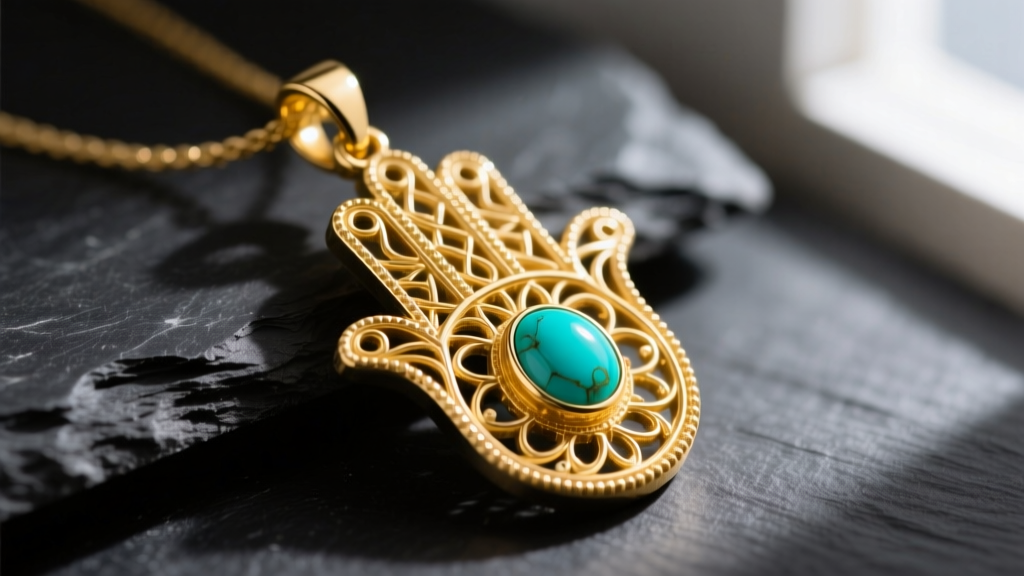
When exploring protective amulet jewelry, few symbols carry the historical weight and cross-cultural reverence of the Hamsa. While mainstream fashion often reduces this ancient motif to a simple bohemian trend, understanding the true hamsa hand necklace meaning requires a deep dive into its Levantine origins, anatomical variations, and the material science required to craft an amulet meant for lifelong, daily wear. As we navigate the jewelry landscape in 2026, discerning collectors and everyday wearers alike are demanding more than just aesthetic appeal; they are seeking metallurgical integrity, authentic craftsmanship, and a profound connection to the symbol's heritage.
Decoding the Hamsa Hand Necklace Meaning and Anatomical Variations
The word Hamsa (or Khamsa) translates literally to "five" in Arabic, representing the five fingers of the hand. Historically, the symbol spans across North Africa, the Middle East, and the Mediterranean, serving as a universal shield against the "Evil Eye" (a malevolent glare believed to cause misfortune). However, from a technical jewelry design perspective, the anatomy of the hand dictates its specific cultural lineage and styling applications.
The Hand of Fatima vs. The Hand of Miriam
- The Hand of Fatima (Islam): Typically depicted with perfect bilateral symmetry. The thumb and pinky fingers are often flared outward and curved to identical degrees. In jewelry casting, this symmetry requires precise wax modeling to ensure the pendant hangs perfectly flush against the sternum without tilting.
- The Hand of Miriam (Judaism): Often features a slightly more naturalistic, asymmetrical hand shape, sometimes with the thumb and pinky curving inward or resembling an actual human hand. Some iterations feature an engraved Star of David in the central palm.
"The Hamsa transcends singular religious boundaries, acting as a shared cultural artifact of protection across the Abrahamic faiths and indigenous North African traditions." — The Metropolitan Museum of Art
Metallurgical Specifications for Amulet Jewelry
Because an amulet is traditionally meant to be worn continuously and touched frequently as a grounding mechanism, the metal must withstand high friction, exposure to skin oils, and environmental oxidation. Selecting the right alloy is critical for preserving the intricate filigree often found in Hamsa designs.
Vickers Hardness and Alloy Selection
Pure 24k gold (Vickers Hardness ~25 HV) is entirely unsuitable for a detailed Hamsa pendant. The prongs, bail, and delicate finger castings would bend under the slightest pressure. Therefore, master jewelers rely on specific alloy blends to achieve a balance of malleability for casting and rigidity for wear.
| Metal Grade | Composition | Vickers Hardness (HV) | Amulet Suitability & Patina Risk |
|---|---|---|---|
| 925 Sterling Silver | 92.5% Ag, 7.5% Cu | ~60-70 HV | Traditional for lunar amulets; high tarnish risk requires rhodium plating or frequent polishing. |
| 14k Yellow Gold | 58.5% Au, Cu/Zn/Ag | ~140-150 HV | Industry standard for daily wear. Excellent durability for intricate Hamsa filigree; resists warping. |
| 18k Yellow Gold | 75% Au, Cu/Ag | ~120-130 HV | Rich, saturated color preferred in high-end Middle Eastern markets; slightly softer, prone to micro-scratches. |
| Platinum 950 | 95% Pt, 5% Ru/Ir | ~130-140 HV | Hypoallergenic and extremely dense. Ideal for heavy, solid-cast Hamsa pendants meant for generational heirlooms. |
Gemstone Inlays: Integrating the Nazar and Precious Stones
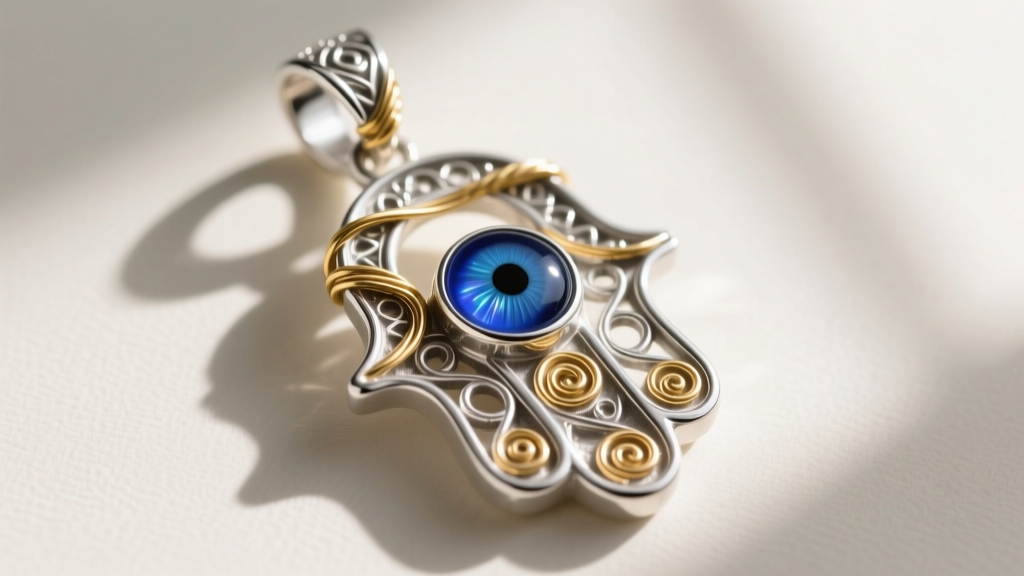
A significant subset of Hamsa necklaces incorporates a central eye motif, known as the Nazar, or features precious stones to amplify specific protective properties. The technical challenge here lies in the setting mechanics. Amulets are subject to percussive shocks (bumping against tables, doorways), meaning standard prong settings are highly discouraged for central stones.
Bezel Setting Requirements for Asymmetrical Stones
For a Hamsa pendant, a full bezel setting is mandatory. This involves wrapping a continuous rim of metal around the gemstone's girdle. According to the Gemological Institute of America (GIA), porous stones like Turquoise (Mohs 5-6) and Lapis Lazuli (Mohs 5.5) are highly susceptible to chipping and chemical degradation from lotions or perfumes. A bezel not only secures the stone against impact but seals the girdle from environmental contaminants.
- Turquoise Cabochons: Require a perfectly flat basket base. If the jeweler uses a hollowed-out backing to save metal weight, the stone can crack inward under thumb pressure.
- Cobalt Blue Glass (Traditional Nazar): Glass has a Mohs hardness of ~5.5 but lacks a crystalline structure, making it prone to conchoidal fracturing. The bezel wire must be annealed and pushed with a bezel rocker using even, radial pressure to avoid shattering the glass eye.
- Diamond Melee Accents: Often pave-set along the fingers of luxury Hamsa pendants. Ensure the melee diamonds are VS clarity or higher, as lower clarity stones (SI2/I1) can fracture during the aggressive metal-pushing process required for micro-pave on narrow finger castings.
Bail Mechanics and Chain Pairings for Pendants
The structural integrity of a Hamsa necklace relies heavily on the bail (the loop connecting the pendant to the chain) and the chain's tensile strength. A standard 20mm to 25mm solid gold Hamsa pendant weighs between 3.5 and 6 grams. This concentrated weight creates a "pendulum effect" during movement, generating localized stress on the chain's jump rings.
Optimal Chain Configurations
- Box Chains (1.2mm - 1.5mm): The interlocking square links distribute weight evenly and resist kinking. A 1.5mm 14k gold box chain has a breaking strength exceeding 20 lbs, making it the safest choice for heavy amulets.
- Wheat Chains (1.0mm - 1.2mm): Braided oval links offer excellent flexibility and a woven texture that complements the organic nature of the Hamsa hand. However, they are difficult to repair if snapped.
- Avoid Cable and Snake Chains: Standard cable chains feature single soldered jump rings that will stretch and open under the pendulum weight of a Hamsa. Snake chains are notorious for trapping skin oils and snapping irreparably when bent.
Orientation and Styling Protocols
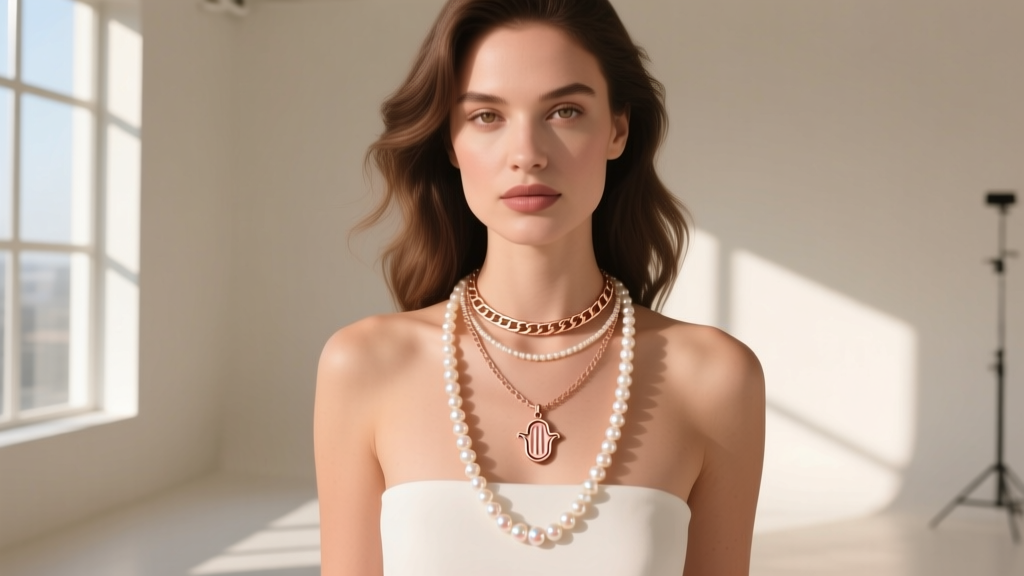
How you orient the pendant alters both its esoteric function and its visual geometry on the neckline.
Facing Up vs. Facing Down
- Fingers Pointing Up (Warding): Traditionally, the hand faces upward to act as a physical and spiritual "stop" sign, blocking negative energy and the Evil Eye from entering the wearer's aura. Visually, this orientation creates a wider, more stable silhouette that sits well on the collarbone (16-inch chain length).
- Fingers Pointing Down (Receiving): In some mystical traditions, the downward-facing hand invites abundance, fertility, and grounded energy into the wearer's life. Anatomically, a downward-facing Hamsa elongates the neckline, making it an ideal candidate for a 20-inch or 24-inch chain layered over linen or silk garments.
Authenticating Craftsmanship: Cast vs. Die-Struck
When investing in a piece that carries deep spiritual significance, the manufacturing method matters. The market is flooded with mass-produced amulets that lack the energetic and structural integrity of artisan-crafted pieces.
Identifying Lost-Wax Cast Artisan Pieces
Authentic, high-quality Hamsa pendants are created using the lost-wax casting method. A master carver sculpts the original design in wax, allowing for deep, three-dimensional filigree and organic, asymmetrical finger curves. When examining a cast piece under a jeweler's loupe, you should look for a slight, natural porosity in the hidden recesses and deep, sharp undercuts in the palm lines that die-stamping cannot achieve.
The Flaws of Die-Struck Amulets
Die-struck Hamsas are punched from a flat sheet of metal using high-pressure hydraulic presses. While this makes the metal incredibly dense and hard, the design is inherently two-dimensional. The edges are often sharp or heavily machine-polished, stripping the hand of its organic, protective warmth. Furthermore, die-struck pendants often feature a soldered-on, hollow "bubble" back to create the illusion of depth, which traps moisture and accelerates skin-level oxidation.
Ultimately, the hamsa hand necklace meaning is inextricably linked to its physical creation. By prioritizing high-tensile alloys, secure bezel settings for protective stones, and authentic casting methods, you ensure that your amulet is not merely a decorative trend, but a resilient, lifelong talisman equipped to navigate the modern world.


