Carnation Necklace Anatomy: Gemstone Carving & Enamel Techniques
Explore the technical anatomy of a carnation necklace. Discover gemstone carving methods, enamel techniques, and chain metallurgy for floral pendants.

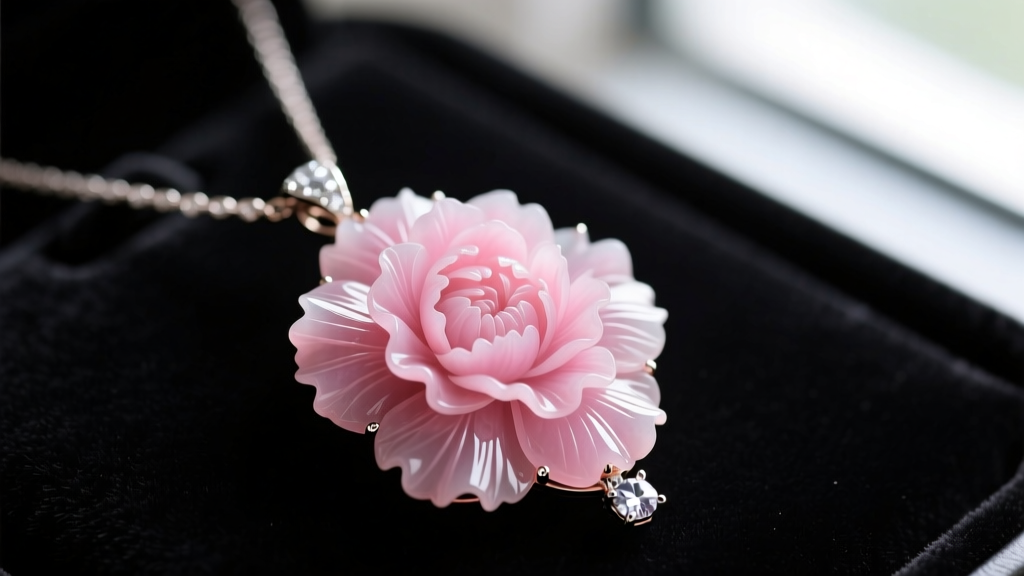
The Engineering of Floral Lapidary Art
The carnation necklace represents a pinnacle of lapidary and metallurgical art. Unlike simpler geometric pendants, the ruffled, multi-layered petals of the carnation (Dianthus caryophyllus) demand extreme precision in both subtractive carving and additive enamel work. As of 2026, while 5-axis CNC micro-milling has entered the commercial jewelry space, the master-crafted carnation pendant remains a benchmark of manual dexterity and material science. Understanding the anatomy of these necklaces requires a deep dive into gemological hardness scales, thermal dynamics of glass fusing, and the tensile strength of precious metal chains.
When evaluating a high-end carnation necklace, collectors and jewelers must look beyond the aesthetic appeal and scrutinize the structural integrity of the piece. A poorly executed floral carving will exhibit tool marks, asymmetrical relief, and structural weak points that can lead to catastrophic failure during everyday wear.
Gemstone Selection & Carving Constraints
The choice of gemstone dictates the tooling, RPM (revolutions per minute) of the carving burs, and the ultimate depth of the petal relief. The two most prominent materials used for premium carnation pendants are jadeite and organic coral.
Jadeite: Toughness vs. Hardness
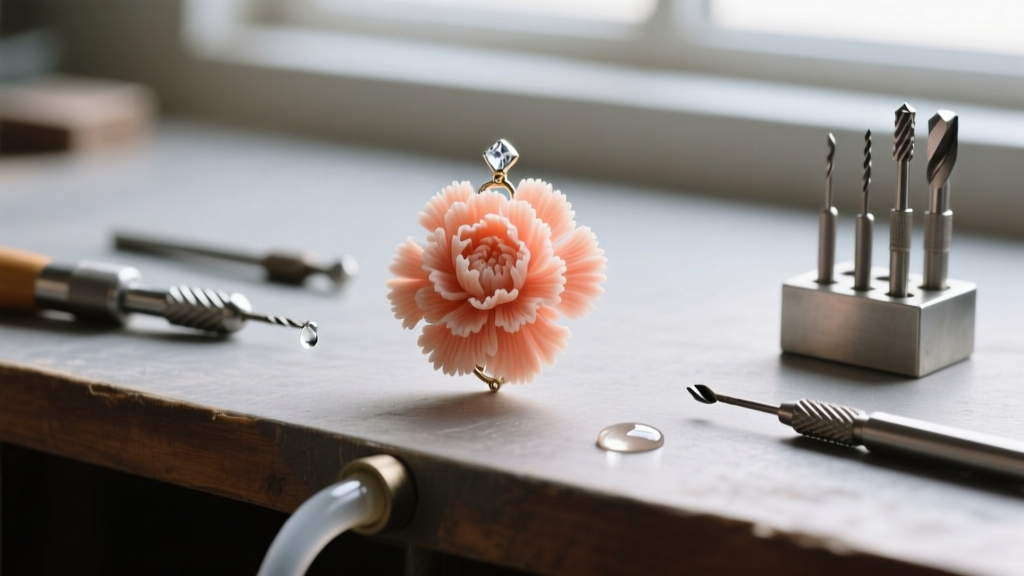
Jadeite (Mohs 6.5–7) is frequently chosen for its interlocking monoclinic crystalline structure, which grants it exceptional toughness—far exceeding its surface hardness. According to the Gemological Institute of America (GIA), this microscopic fibrous interlocking allows lapidaries to carve extremely thin, translucent petal edges without the stone shattering. However, carving jadeite requires diamond-impregnated steel burs operating at 15,000 to 20,000 RPM, coupled with a continuous water drip to prevent thermal fracturing. A master carver will utilize undercutting techniques to create shadows between the carnation petals, giving the illusion of three-dimensional depth from a relatively flat slab of rough.
Organic Coral: The Thermal Shock Risk
Conversely, carving a carnation from precious coral (Mohs 3–4) presents an entirely different metallurgical challenge. Coral is a calcium carbonate organic gem that is highly susceptible to thermal shock. High-speed diamond burs generate friction heat that can cause the coral to craze, crack, or even burn. Artisans must use low-speed pneumatic tools (under 5,000 RPM) and specialized cooling lubricants. The ruffled edges of a coral carnation are particularly prone to micro-chipping during the final polishing stages, requiring the use of ultra-fine diamond pastes (down to 100,000 grit) rather than aggressive tumbling.
Advanced Enamel Applications
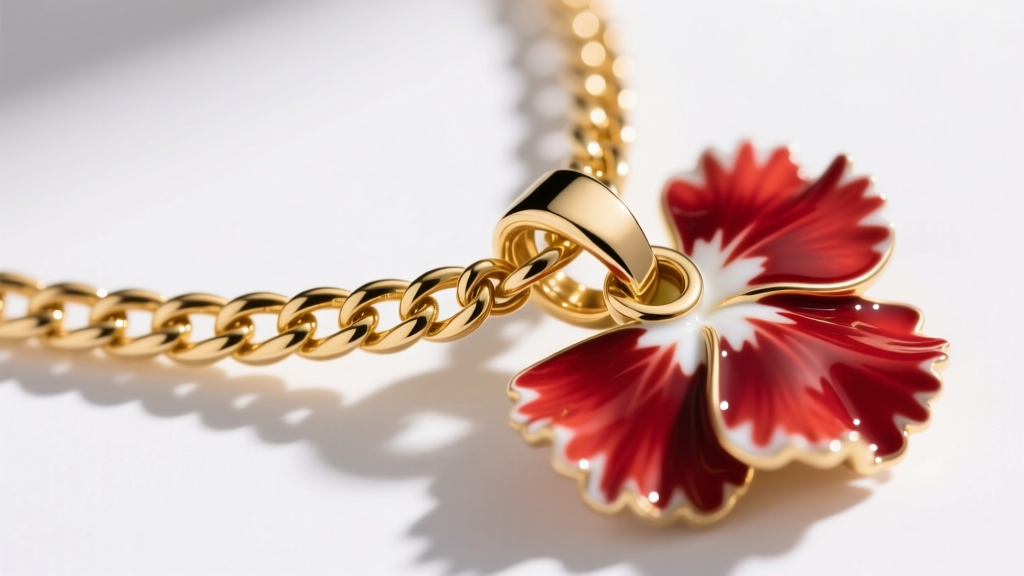
When gemstone carving is substituted or augmented with vitreous enamel, the carnation necklace transitions into a study of thermal expansion coefficients. The metal base (usually 18k gold or platinum) and the silica-based glass frit must expand and contract at identical rates during the kiln firing process, which typically peaks between 750°C and 850°C.
Guilloché vs. Plique-à-Jour
Two primary techniques dominate high-end floral enamel work. The Victoria and Albert Museum notes that historical enameling techniques like Guilloché rely on an engine-turned metal base that refracts light through translucent enamel layers, giving the carnation petals a shimmering, silk-like depth. However, Plique-à-jour is the undisputed king of floral translucency.
'Plique-à-jour is essentially stained glass without a backing. The enamel is suspended within the metal cells of the carnation petals purely by capillary action and surface tension during firing. The failure rate for complex floral plique-à-jour pieces can exceed 40% due to glass cracking during the cooling phase.'
| Technique | Base Metal Requirement | Firing Temp | Durability (Impact) | Cost Multiplier |
|---|---|---|---|---|
| Champlevé | Thick 14k/18k Gold | 780°C - 820°C | High | 1.5x Base |
| Guilloché | Engine-turned 18k Gold | 750°C - 800°C | Medium-High | 3.0x Base |
| Plique-à-Jour | High-Karat Gold/Platinum | 760°C - 840°C | Low (Fragile) | 8.0x+ Base |
Chain Metallurgy & Bail Engineering
A heavily carved jadeite carnation pendant can easily weigh between 15 and 35 grams. Suspending this weight requires careful consideration of chain metallurgy and bail engineering. Many consumers mistakenly assume that higher karat gold is always superior. However, 24k and 22k gold possess very low yield strengths and will easily deform under the pendulum stress of a heavy pendant.
Tensile Strength and Alloy Matrices
For a heavy carnation necklace, 14k gold (58.5% pure gold alloyed with copper, silver, and zinc) offers a significantly higher tensile strength and resistance to work-hardening fatigue than 18k gold. The optimal chain style is a solid wheat (spiga) chain, which distributes lateral stress across four interlocking strands of wire, preventing the kinking that plagues standard cable or box chains.
The Hidden Bail Mechanism
To preserve the uninterrupted silhouette of the carnation, master jewelers utilize a hidden bail. This involves drilling a microscopic channel through the top of the gemstone or embedding a custom-cast platinum loop into the enamel framework. Platinum is preferred for hidden bails due to its high melting point and lack of 'spring-back' memory, ensuring the jump ring remains securely closed even when subjected to accidental snags.
Maintenance & Failure Modes
Proper maintenance of a carnation necklace is highly dependent on its material composition. The deep undercuts and relief carvings that give the petals their lifelike appearance are natural traps for sebum, cosmetics, and environmental dust.
- Jadeite Carnations: Never use ultrasonic cleaners. The high-frequency acoustic cavitation can exacerbate microscopic internal fissures (common in treated or 'B-jade' stones), leading to sudden structural collapse. Clean only with a mild, non-ionic surfactant and a soft-bristled brush.
- Enamel Carnations: Avoid steam cleaning. The rapid temperature differentials can cause the vitreous glass to pop out of the metal cloisons, a failure mode known as 'spalling'.
- Coral Carnations: Keep away from acidic environments and harsh chemicals, including perfumes and hairsprays, which can chemically etch the calcium carbonate surface, leaving the intricate petal edges dull and pitted.
By understanding the rigorous technical demands of gemstone carving, thermal enamel dynamics, and structural chain metallurgy, collectors can properly evaluate, wear, and preserve the intricate beauty of the carnation necklace for generations.


