Hamza Necklace Materials: Gold, Silver, and Titanium Compared
Discover the best metals for your Hamza necklace. We compare gold, silver, titanium, and steel for durability, calligraphy detail, and skin safety.

The Structural Challenge of the Hamza Pendant
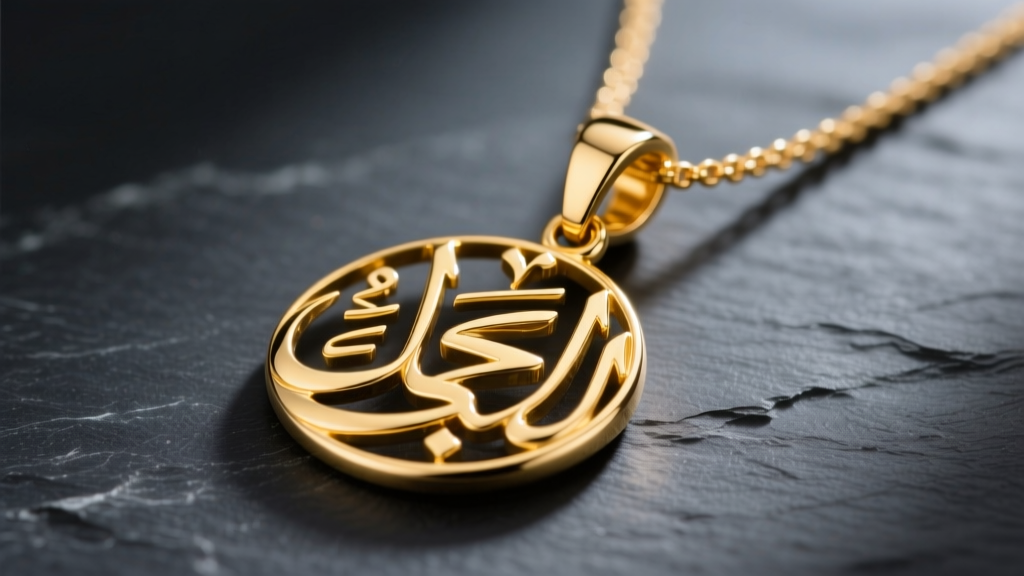
The Hamza (ء) is a unique and profound character in the Arabic alphabet, representing a glottal stop. In the world of cultural and faith-based jewelry, the Hamza necklace has become a powerful symbol of linguistic pride, identity, and spiritual grounding. However, from a metallurgical and jewelry manufacturing perspective, the Hamza presents a fascinating structural challenge. Unlike geometric or blocky pendants, the Hamza is often written with sweeping curves, sharp terminals, and—most critically—floating elements. Whether it appears standalone, seated on an Alif (أ), or resting on a Waw (ؤ), the physical translation of this calligraphy into metal requires careful material selection.
When a jeweler casts a Hamza pendant, the 'floating' dots or the Madda (the wave-like symbol above the Alif) must be connected to the main body of the pendant via microscopic metal struts. If the chosen metal is too soft, these struts will bend or snap under the daily stress of wearing a necklace. If the metal is too brittle or poorly cast, the intricate details of the calligraphy will be lost to porosity. In this comprehensive guide, we analyze the exact material properties of gold, silver, titanium, and steel to help you choose the perfect Hamza necklace for your lifestyle.
Precious Metals: Gold and Silver for Calligraphy
14k vs 18k Gold: Hardness and Detail Retention
Gold is the premier choice for fine Arabic calligraphy jewelry, but the karat weight drastically alters its physical properties. Pure 24k gold is far too soft for jewelry, so it is alloyed with metals like copper, silver, and zinc. According to industry experts at Calla Gold Jewelry, the Vickers hardness (HV) of gold changes significantly based on its purity.
- 18k Gold (75% pure): With a Vickers hardness of roughly 120-130 HV, 18k gold is luxurious and deeply colored but relatively soft. For a Hamza pendant with thick, bold Kufic script, 18k is perfectly fine. However, for intricate Diwani or Thuluth scripts with thin, overlapping strokes, 18k gold may warp over time if caught on clothing.
- 14k Gold (58.3% pure): Boasting a Vickers hardness of 140-160 HV, 14k gold is significantly more durable. It holds sharp, polished edges much better than 18k gold. If your Hamza necklace features sharp, needle-like terminals or delicate floating elements, 14k gold provides the tensile strength necessary to prevent the struts from snapping.
Furthermore, 14k gold flows exceptionally well during the lost-wax casting process, ensuring that the microscopic details of the calligrapher's original pen strokes are perfectly captured in the final metal.
Sterling Silver (925): The Classic Choice and Tarnish Reality
Sterling silver is the most popular entry point for Hamza necklaces, offering a brilliant white luster that contrasts beautifully against the skin. Standard 925 sterling silver consists of 92.5% pure silver and 7.5% copper. The copper is essential; without it, pure silver would be too malleable to hold the shape of the Hamza. However, this copper content introduces a chemical vulnerability: tarnish.
As noted by The Silver Institute, copper reacts with sulfur compounds in the air and on human skin to form silver sulfide, the black tarnish that accumulates in the deep grooves of calligraphy pendants. While this tarnish can sometimes be used intentionally by jewelers as 'oxidation' to make the Arabic letters pop against a polished background, it requires maintenance. Many high-end silver Hamza necklaces are plated with a micro-layer of rhodium to prevent tarnish, though this plating will eventually wear away at high-friction areas like the bail (the loop where the chain passes through).
Alternative Metals: Titanium and Stainless Steel
Grade 23 Titanium (Ti-6Al-4V ELI): Hypoallergenic Excellence
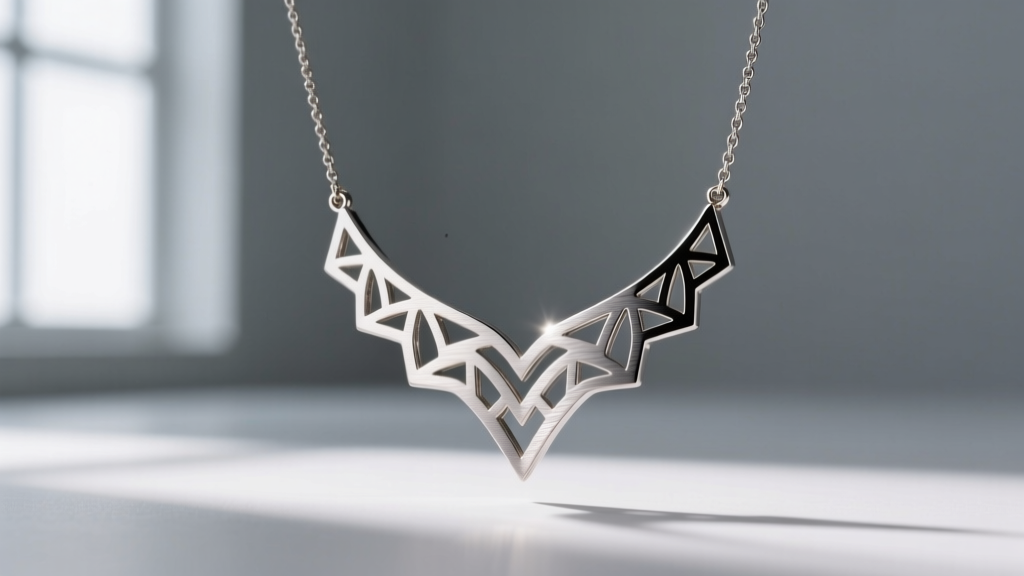
For those with severe metal allergies or those seeking an ultra-lightweight, modern Hamza necklace, Grade 23 Titanium (also known as Ti-6Al-4V ELI) is an engineering marvel. Originally developed for aerospace and medical implants, this alloy is 100% nickel-free and biocompatible. Because titanium has an incredibly high melting point and is difficult to cast using traditional jewelry lost-wax methods, titanium Hamza pendants are almost exclusively created via CNC machining or precision laser cutting.
This manufacturing reality dictates the design: titanium Hamza necklaces are typically 2D, flat-profile pendants with razor-sharp, perfectly precise edges. They lack the rounded, 3D sculptural depth of cast gold or silver, but they offer an indestructible, modern aesthetic that will never bend, tarnish, or cause skin irritation.
316L Surgical Steel: Budget-Friendly but Heavy
Stainless steel, specifically the 316L marine-grade alloy, is a staple in streetwear and mass-market cultural jewelry. It is highly resistant to corrosion and incredibly cheap to produce. However, 316L steel contains trace amounts of nickel, which can trigger contact dermatitis in highly sensitive individuals. From a design perspective, steel is heavy and rigid. It is best suited for large, thick, block-style Hamza pendants where weight and a bold, industrial presence are desired over delicate calligraphic nuance.
Material Comparison Matrix
| Metal / Alloy | Vickers Hardness (HV) | Manufacturing Method | Best Calligraphy Style | Tarnish / Corrosion | Approx. Price Range |
|---|---|---|---|---|---|
| 14k Yellow Gold | 140 - 160 | Lost-Wax Casting | Thuluth, Diwani (Complex) | None (Tarnish-free) | $250 - $600+ |
| 18k Yellow Gold | 120 - 130 | Lost-Wax Casting | Kufic, Bold Naskh | None (Tarnish-free) | $400 - $900+ |
| 925 Sterling Silver | 60 - 70 (Alloyed) | Lost-Wax Casting | All Styles (with rhodium) | High (Silver Sulfide) | $40 - $120 |
| Grade 23 Titanium | 320 - 360 | Laser Cut / CNC | Modern Geometric / Flat | None (Highly inert) | $60 - $150 |
| 316L Steel | 150 - 190 | Die Striking / Casting | Block Kufic, Streetwear | Very Low (Rust resistant) | $15 - $45 |
How Calligraphic Complexity Dictates Metal Choice
The specific Arabic font used for your Hamza necklace should directly influence your material choice. Kufic script is highly geometric, characterized by straight lines and right angles. Because Kufic designs distribute structural stress evenly and rarely feature fragile 'floating' elements, they can be safely executed in softer metals like 18k gold or even thick sterling silver without risking structural failure.
Conversely, Thuluth and Diwani scripts are highly cursive, featuring overlapping letters, sweeping boat-like curves, and intricate dot placements. When a Hamza is integrated into a complex Diwani composition, the jeweler must create a master wax model with deep undercuts. 14k gold or platinum is required here; their specific fluid dynamics during the casting process ensure that the molten metal fills the microscopic crevices of the mold before cooling, preventing 'incomplete cast' flaws that would leave the Hamza looking blurred or porous.
Care and Maintenance by Metal Type
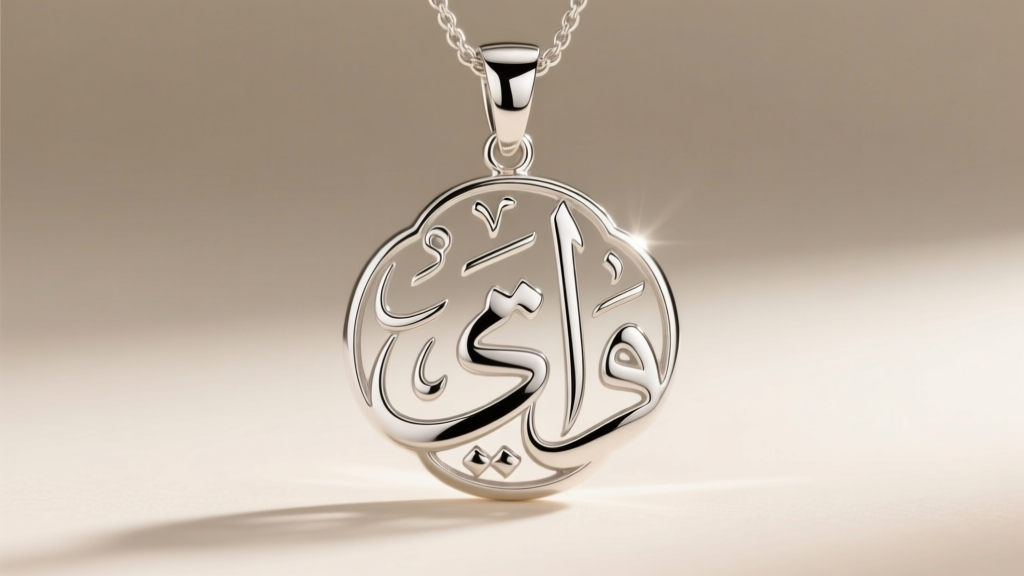
Maintaining the crisp readability of Arabic calligraphy requires keeping the grooves and polished surfaces clean. Here is how to care for your necklace based on its metallurgy:
- Gold and Titanium: These are virtually maintenance-free. A simple soak in warm water with a few drops of mild dish soap, followed by a gentle brushing with a baby-soft toothbrush, will remove skin oils and lotions from the calligraphic grooves. Titanium can withstand ultrasonic cleaners, but gold pendants with gem-set Hamza elements should avoid them.
- Sterling Silver: To remove tarnish from the recessed areas of a silver Hamza pendant, use a specialized silver polishing cloth. Avoid liquid silver dips, as they are highly abrasive and can strip the rhodium plating, leaving the raw 925 silver exposed to rapid re-oxidation.
- Stainless Steel: Steel can be cleaned with standard jewelry wipes or glass cleaner. However, if the steel Hamza pendant has a PVD (Physical Vapor Deposition) black or gold coating, avoid abrasive cloths entirely, as you will wear through the microscopic color layer.
Final Verdict: Choosing Your Hamza Necklace
Selecting the right material for a Hamza necklace is a balance between budget, skin sensitivity, and the specific calligraphic art you wish to wear. If you are investing in a highly detailed, custom-designed Hamza pendant with sweeping curves and floating elements, 14k gold is the undisputed champion, offering the perfect synthesis of casting fidelity, edge retention, and lifelong durability. For those seeking a modern, indestructible, and hypoallergenic piece for daily wear, Grade 23 Titanium offers a sleek, contemporary alternative that will never degrade. Ultimately, understanding the metallurgy behind your jewelry ensures that the profound symbolism of the Hamza is preserved in a medium built to last generations.


