The Hand Necklace Dark Romance Trend: A Technical Guide
Explore the technical anatomy of the hand necklace dark romance aesthetic, from oxidized silver casting to articulated joints and chain pairing.

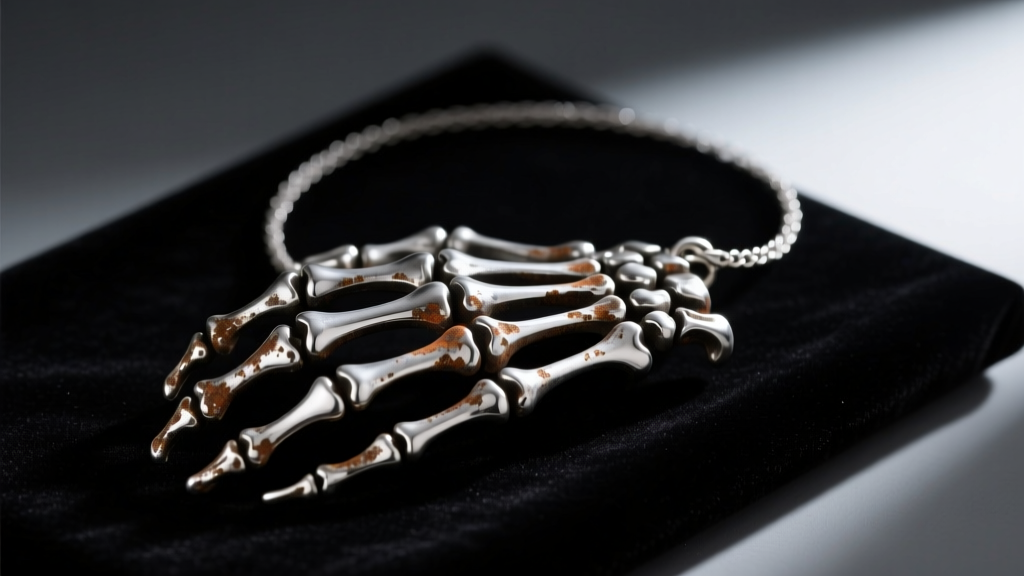
The "dark romance" aesthetic has dominated literary, fashion, and subculture circles over the last decade, but its translation into fine jewelry requires meticulous craftsmanship that goes far beyond simple gothic motifs. The hand necklace dark romance trend is not merely a visual statement; it is a feat of micro-engineering, metallurgical patina work, and historical homage. As we navigate the 2026 jewelry market, artisan jewelers are pushing the boundaries of lost-wax casting and articulation to create pieces that feel both ancient and anatomically precise. Whether you are a collector of macabre elegance or a jeweler looking to understand the mechanics of these complex pendants, this deep dive explores the technical anatomy of the dark romance hand necklace.
The Anatomy of the Motif: Skeletal, Écorché, and Mourning
The hand motif in dark romance jewelry generally falls into three distinct categories, each requiring a different approach to the lost-wax casting process. The first is the Skeletal Hand, which focuses on the precise rendering of phalanges, metacarpals, and carpal bones. Master jewelers often use 3D resin printing to create the initial wax model, ensuring the bone texture features microscopic striations that catch the oxidized patina later in the process.
The second category is the Écorché (Anatomical) Hand, which depicts the musculature and tendons without skin. This style demands a profound understanding of human anatomy, as the flexor tendons must wrap realistically around the metacarpophalangeal joints. The third is the Victorian Mourning Hand, often depicted wearing a lace cuff or holding a symbolic flower like a forget-me-not. According to the Victoria and Albert Museum, hand motifs in 19th-century mourning jewelry symbolized the lingering touch of a departed loved one, a historical sentiment that heavily informs the modern dark romance revival.
Metallurgy and Patina: Achieving the Gothic Oxidation
The signature "dark" in dark romance jewelry relies heavily on surface oxidation. While base metals are sometimes used in fast fashion, high-end artisan pieces utilize 925 Sterling Silver due to its superior casting detail and ability to hold a deep patina. The traditional method involves Liver of Sulfur (potassium sulfide), which reacts with the copper alloy in the sterling silver to create silver sulfide—a dark, gunmetal-black layer.
However, chemical patinas are prone to wearing off on high-friction areas (like the tips of the fingers). To solve this, premium 2026 collections are increasingly turning to Black Ruthenium plating. Ruthenium is a platinum-group metal that, when electroplated, provides a dark gray-to-black finish with a hardness of 4.5 on the Mohs scale. This ensures the pendant retains its brooding, shadowed aesthetic even with daily wear, without the need for constant re-oxidation by the owner.
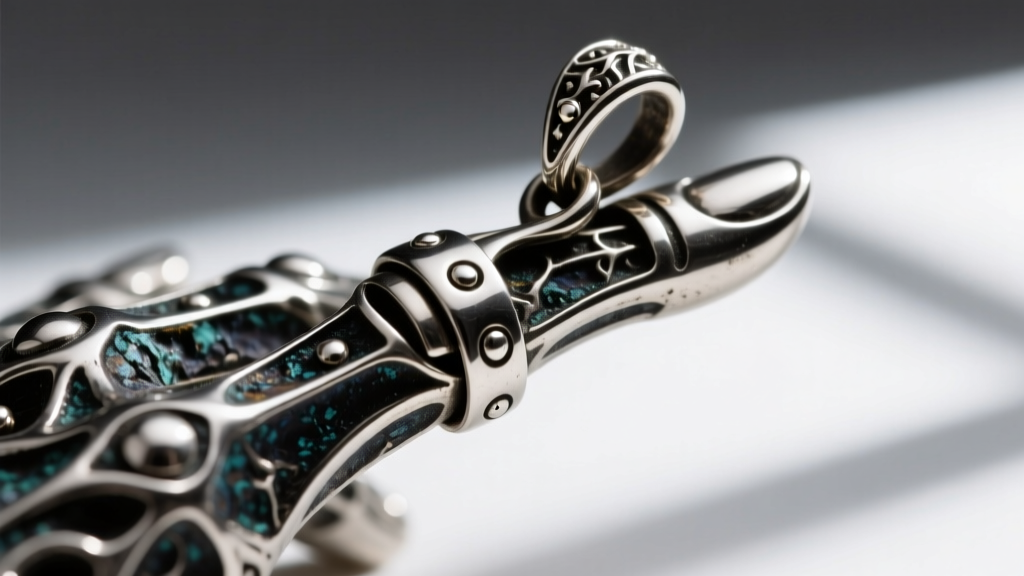
Articulation vs. Solid Cast: Engineering the Pendant
The most striking feature of a premium hand necklace is articulation—the ability of the fingers to move and drape naturally against the collarbone. Engineering an articulated hand pendant is a masterclass in micro-mechanics. Jewelers must cast the hand in up to 15 separate pieces (the palm, individual proximal, intermediate, and distal phalanges). These components are then assembled using 0.8mm to 1.2mm stainless steel or silver micro-rivets.
The tolerance gap between each joint must be precisely 0.15mm to 0.20mm. If the gap is too tight, oxidation buildup and friction will lock the joint; if it is too wide, the fingers will feel loose and rattle. The rivet ends are carefully peened and polished to ensure they are flush with the silver surface.
| Feature | Solid Cast Hand Pendant | Articulated Hand Pendant |
|---|---|---|
| Weight | Heavy (25g - 45g) | Lighter (12g - 22g) due to gaps |
| Drape | Rigid, sits flat or angles awkwardly | Fluid, conforms to the sternum |
| Durability | Extremely high, no moving parts | Moderate, rivets can bend if snagged |
| Price Range (Artisan) | $120 - $250 | $350 - $800+ |
Chain Pairing and Clasp Mechanics for Heavy Pendants
A common failure point in dark romance jewelry is the chain snapping under the weight of a solid-cast skeletal hand. A 30-gram pendant generates significant kinetic force when the wearer moves, requiring a chain with a high tensile breaking point. Standard cable or snake chains are insufficient and will eventually kink or snap at the jump ring.
Expert jewelers pair these pendants with Wheat (Spiga) chains or heavy Rolo chains. A wheat chain, characterized by its tightly woven, braided links, distributes tension evenly across multiple contact points. For a pendant weighing over 20 grams, a wheat chain with a minimum wire gauge of 2.5mm is mandatory. Furthermore, the jump ring connecting the pendant to the chain must be soldered shut rather than merely butted together, preventing the ring from pulling apart under stress. A reinforced lobster clasp with a secondary safety figure-8 chain is the industry standard for securing these investment pieces.
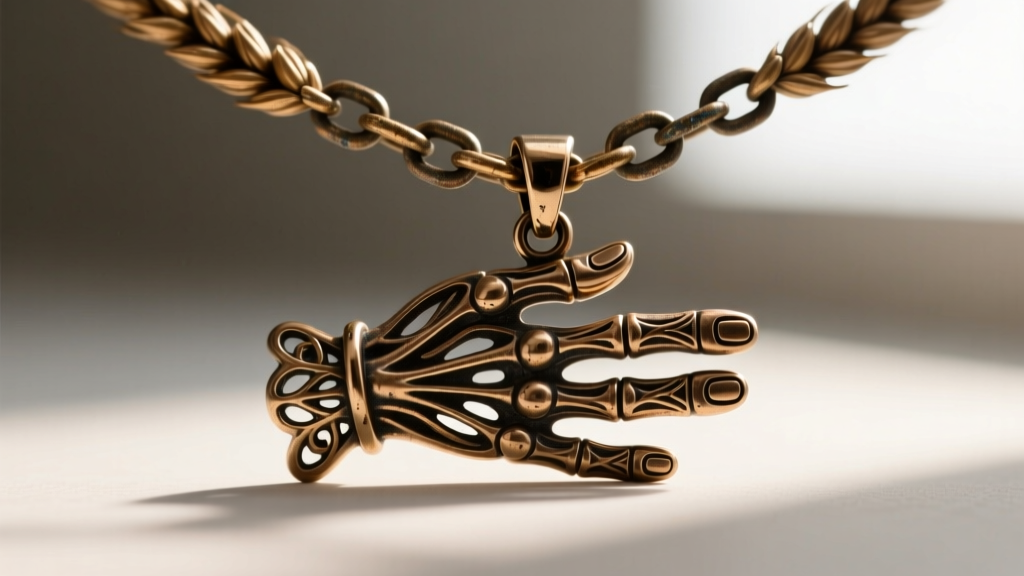
Gemstone Inlays: Onyx, Garnet, and Obsidian
To elevate the dark romance aesthetic, artisans frequently incorporate gemstones that complement the oxidized silver. Black Onyx and deep red Garnet are the undisputed kings of this genre. According to the Gemological Institute of America (GIA), black onyx (a variety of chalcedony) ranks at a 7 on the Mohs hardness scale, making it durable enough for daily wear, though it is susceptible to hard knocks due to its cleavage properties.
In dark romance hand necklaces, the gemstone is often held in the "palm" of the skeletal or anatomical hand. Because the fingers of the pendant act as a natural prong setting, jewelers often use a hybrid bezel-prong technique. A hidden silver bezel cup secures the girdle of the stone, while the cast silver fingers wrap over the crown, creating the illusion that the skeletal hand is organically gripping the gem. This protects the stone's edges while maintaining the macabre visual narrative.
Styling and Neckline Pairing
The visual weight of a hand necklace demands strategic styling. Because the pendant is typically elongated (ranging from 2.5 to 4 inches in length), it pairs best with sweetheart or square necklines that provide an open canvas of the décolletage. Wearing an articulated hand necklace over a high-neck turtleneck or a complex lace blouse will result in the piece snagging and losing its fluid drape.
For advanced layering, the dark romance aesthetic thrives on contrast. Pair a 24-inch articulated skeletal hand necklace with a tight, 14-inch oxidized silver choker featuring a small black spinel drop. This creates a vertical visual line that elongates the neck while firmly anchoring the piece within the gothic-romantic sartorial language. When investing in these pieces, always prioritize the articulation mechanics and soldered chain hardware—true dark romance jewelry should feel as enduring and timeless as the literary tropes that inspire it.


