Heart Jade Necklace Buyer's Guide: Grading and Chain Pairing
Discover how to evaluate a heart jade necklace. Learn jadeite A-B-C grading, carving symmetry, and the best chain metals for long-lasting wear.

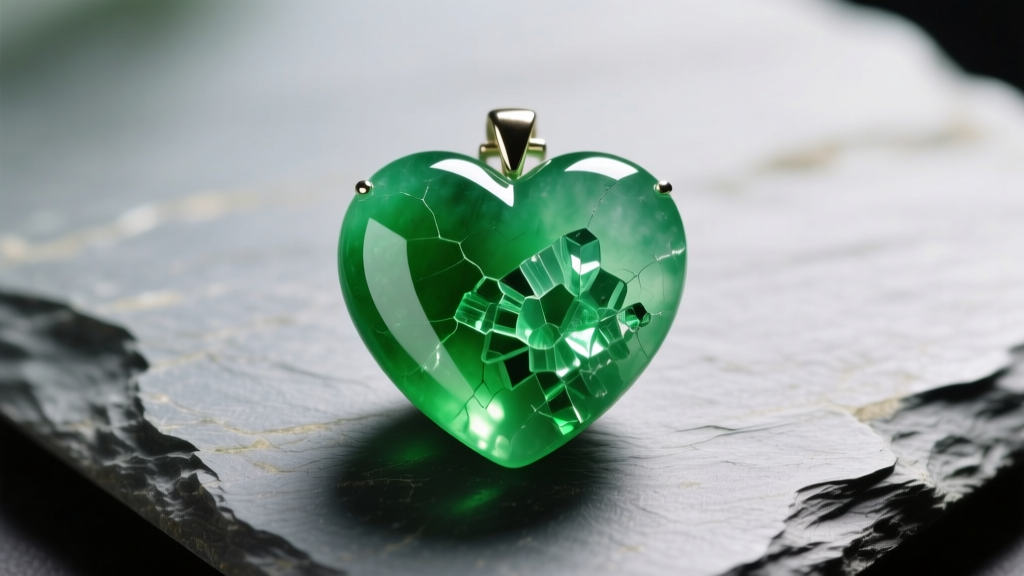
The Mineral Divide: Jadeite vs. Nephrite in Heart Pendants
When evaluating a heart jade necklace, the first technical distinction a gemologist makes is between jadeite and nephrite. Though both are colloquially called "jade," their mineralogical profiles dictate how they are carved, polished, and worn. Jadeite (a pyroxene mineral) has a granular, interlocking crystal structure that allows it to achieve a brilliant, glass-like luster. Nephrite (an amphibole mineral) possesses a fibrous matrix, resulting in a softer, more oily or waxy sheen.
For a heart-shaped pendant, which relies on sharp bilateral symmetry and defined edges at the cleft and lower point, jadeite is vastly superior. Jadeite registers a 6.5 to 7 on the Mohs hardness scale, whereas nephrite sits at 6 to 6.5. More importantly, jadeite's specific gravity (3.30–3.38) gives it a satisfying, dense heft that buyers associate with high-quality jade. According to the Gemological Institute of America (GIA), the finest jadeite—often termed "Imperial Jade"—exhibits a vivid, semi-transparent emerald-green hue that commands premium market pricing.
The A-B-C Grading System: What You Are Actually Buying
The value of a heart jade necklace is entirely dependent on its treatment status. The global jade market utilizes the A-B-C grading system to classify these treatments, which drastically alter both the stone's value and its long-term structural integrity.
- Type A (Natural): Completely untreated jadeite. It has only been cut, carved, and polished, sometimes finished with a traditional, non-permanent plum wax. This is the only grade that holds investment value and maintains its structural integrity over decades.
- Type B (Bleached and Polymer-Impregnated): Lower-quality, heavily included jade is soaked in hydrochloric acid to remove brown or yellow oxidation stains. This process destroys the stone's internal crystalline bonds, leaving it porous. It is then vacuum-impregnated with polymer resin. Over 5 to 10 years, UV exposure and skin oils cause the resin to oxidize, turning the heart pendant yellow and making it highly brittle.
- Type C (Dyed): Jade that has been artificially colored. The dye concentrates in the micro-fractures of the stone, which is visible under 10x magnification. Type C jade fades rapidly when exposed to sunlight and sweat.
Gemologists use Fourier Transform Infrared (FTIR) spectroscopy to detect Type B jade. The FTIR scan identifies the C-H stretching vibrations of the polymer resin between 2800 and 3000 cm⁻¹, a definitive marker of artificial impregnation that cannot be faked.
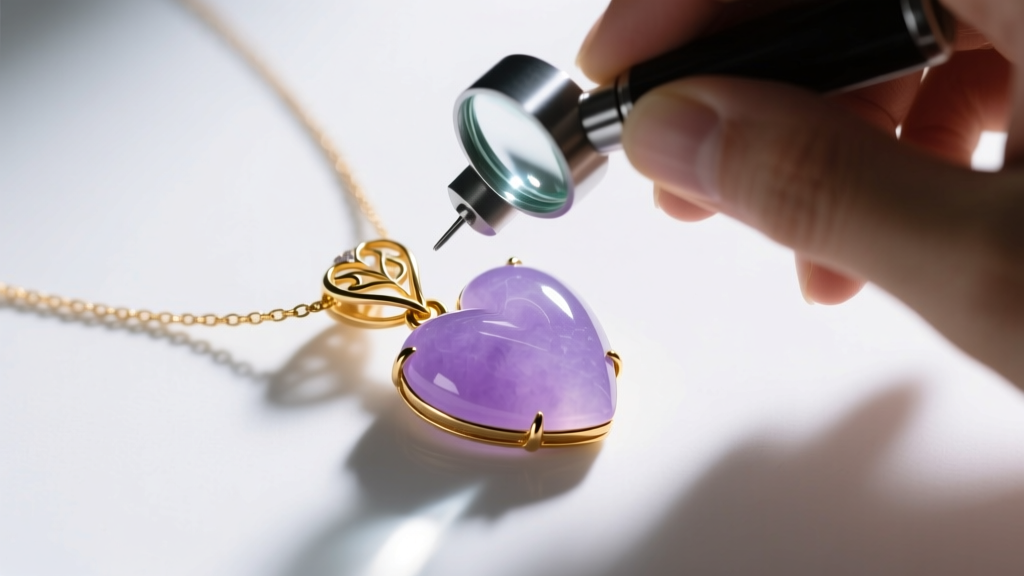
Technical Carving Metrics: Evaluating the Heart Motif
Carving a heart shape out of jadeite requires extreme lapidary precision. Unlike a smooth, domed cabochon, a heart pendant features a sharp inferior point and a superior cleft, both of which are inherent structural vulnerabilities.
Symmetry and Depth Ratios
When inspecting a heart jade necklace, measure the depth of the superior cleft. The cleft should never exceed 18% to 20% of the total vertical length of the pendant. If a lapidary artist cuts the cleft too deeply to create a dramatic shape, the pendant becomes highly susceptible to cleavage-plane snapping if dropped on a hard surface like porcelain or tile. Furthermore, the thickness-to-width ratio should ideally sit around 1:3 for a slightly puffed heart, ensuring the stone is thick enough to withstand daily wear without adding excessive weight that strains the necklace chain.
| Jadeite Grade | Visual Characteristics | Treatment | Estimated Price Range (15mm Heart) | Durability |
|---|---|---|---|---|
| Imperial (Type A) | Vivid emerald green, highly translucent | None (Wax only) | $15,000 - $80,000+ | Excellent |
| Apple Green (Type A) | Bright yellowish-green, semi-translucent | None | $2,500 - $12,000 | Excellent |
| Lavender (Type A) | Soft purple, opaque to semi-translucent | None | $800 - $4,000 | Excellent |
| Commercial (Type B+C) | Bright green, cloudy translucency | Acid, Resin, Dye | $50 - $300 | Poor (Degrades) |
Identifying Simulants: Beyond the Visual Test
The market is flooded with heart jade necklaces made from cheaper simulants. "New Jade" is actually serpentine, which has a much lower specific gravity (2.44–2.62). If a 20mm heart pendant feels unusually light in your hand, it is likely serpentine or glass. "Transvaal Jade" is a massive grossular garnet, and "Amazon Jade" is amazonite. A certified gemologist will use a refractometer to check the refractive index (RI); jadeite consistently shows an RI of 1.66, whereas serpentine reads around 1.56. Always request a certificate from a reputable lab, such as Mason-Kay or GIA, before purchasing high-ticket jadeite.
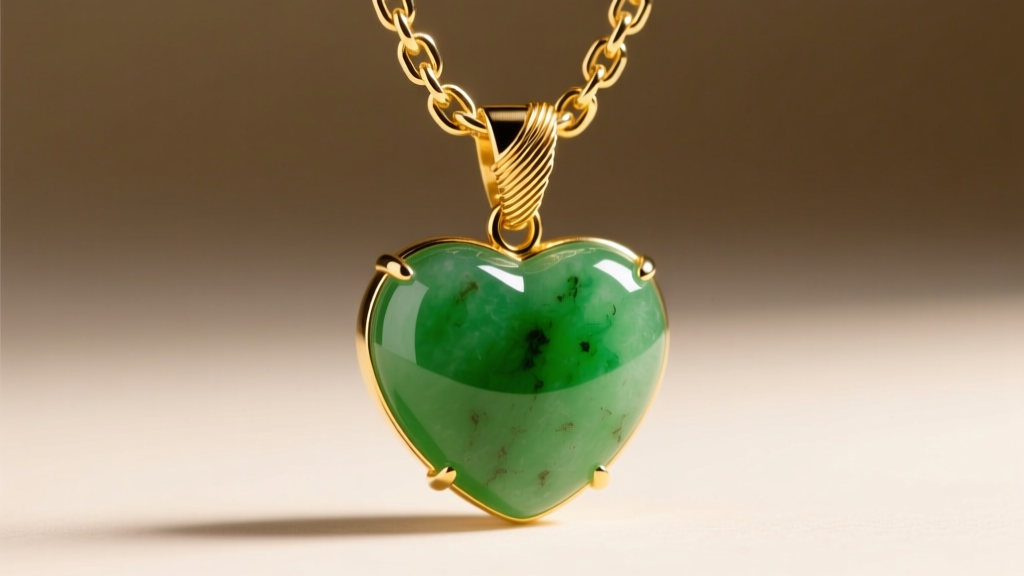
Chain Metallurgy: Pairing the Right Metal with Jade
Jadeite is exceptionally dense. A solid, 18mm heart-shaped jadeite pendant typically weighs between 4 and 7 grams. This concentrated, swinging weight demands a chain with high tensile strength and a secure clasp mechanism.
Alloy Selection and Chain Weaves
Avoid 24-karat gold chains. Pure gold is too malleable and will permanently stretch or snap under the dynamic load of a heavy jade pendant. Instead, opt for 18-karat gold (75% gold, alloyed with copper and silver for rigidity) or 14-karat gold. The chain weave is equally critical. Hollow rope chains and delicate cable chains will kink and break. A solid box chain, wheat chain, or foxtail chain in a minimum width of 1.2mm to 1.5mm provides the necessary structural support. Ensure the clasp is a solid lobster claw with a minimum spring tension of 2.5 lbs; standard spring-ring clasps frequently fail under the pendulum motion of a heavy jade heart.
Bail Construction and Failure Points
The bail—the finding that connects the pendant to the chain—is the most common failure point in jade necklaces. Many commercial pendants use a "glue-in" bail, where a metal post is epoxied into a drilled hole at the top of the heart. Over time, exposure to sweat, perfumes, and ultrasonic cleaners degrades the epoxy, causing the pendant to detach and shatter on the floor. For a secure, lifelong setting, insist on a wire-wrapped bail or a custom-fitted, friction-locked gold cap bail that wraps over the superior lobes of the heart, entirely eliminating the need for structural adhesives.
Conclusion: Investment vs. Ornamental Wear
Selecting the perfect heart jade necklace requires looking past the romantic silhouette and evaluating the stone's gemological and structural realities. By prioritizing Type A jadeite, verifying the cleft depth ratios, and pairing the dense stone with a high-tensile 18k solid box chain, you ensure the piece remains both a beautiful ornament and a durable heirloom. Whether you are seeking a translucent imperial green investment piece or a durable lavender pendant for daily wear, technical diligence is the key to acquiring jade that will outlast its wearer.


