Hebrew Name Necklace Guide: Typography, Metals & Durability
Discover the technical details of buying a custom Hebrew name necklace. Learn about metal gauges, laser cutting, typography, and chain durability.

The Engineering Behind the Sentiment
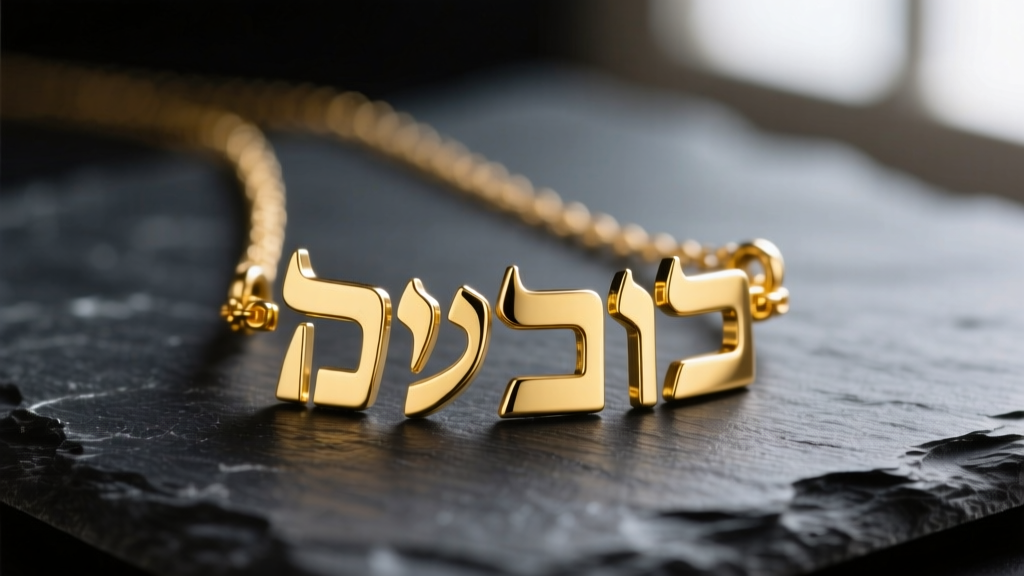
A custom Hebrew name necklace is more than a sentimental keepsake; it is a feat of micro-engineering and metallurgical precision. Unlike mass-produced pendants, a personalized nameplate must balance the intricate, flowing geometry of Hebrew calligraphy with the structural integrity required for daily wear. When the structural physics of the metal clash with the delicate loops of a cursive script, the result is a fragile piece prone to snapping at the stress points. In this technical deep dive, we examine the exact specifications—from alloy compositions and gauge thicknesses to CAD bridging techniques—that separate a durable heirloom from a disposable trinket.
Typography and Calligraphy: The CAD Constraints
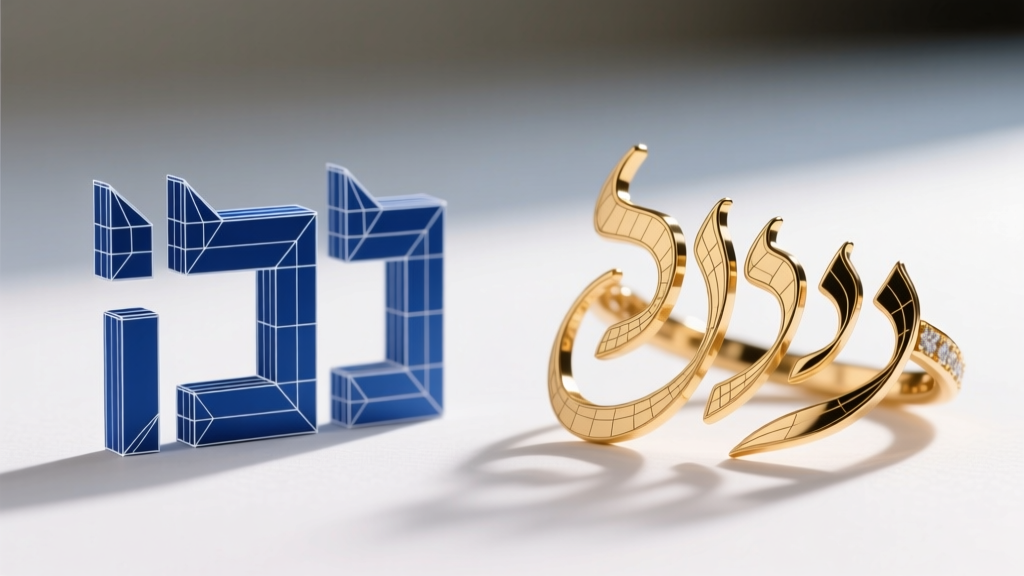
Designing a Hebrew name necklace requires navigating the unique architectural rules of the Hebrew alphabet. Letters are generally categorized into two stylistic families for jewelry: Block (Stam/Frank Ruehl) and Cursive (Ktav Yad/Miriam). While cursive is overwhelmingly popular for its elegant, interconnected flow, it presents significant challenges during the Computer-Aided Design (CAD) and laser-cutting phases.
The 'Floating Island' Problem
In laser cutting, any fully enclosed negative space within a letter will drop out unless a physical 'bridge' is designed into the CAD file. For example, the Hebrew letter 'ה' (Hei) or 'ח' (Chet) features internal negative spaces. In traditional block fonts, the top right corner of the 'ה' is intentionally left slightly disconnected for religious scribal reasons. However, in jewelry manufacturing, leaving this gap means the inner vertical stroke will simply fall away during cutting. Master jewelers solve this by adding a microscopic 0.2mm structural bridge in the CAD model, ensuring the letter remains a single, cohesive piece of metal without compromising the visual authenticity of the script.
Kerf Compensation and Stroke Width
When a 1000W fiber laser cuts through metal, it vaporizes a microscopic channel known as the 'kerf,' typically measuring between 0.10mm and 0.15mm. If a cursive Hebrew script features tapering strokes that narrow down to 0.5mm, the kerf will consume nearly 30% of the material width, leaving a brittle edge prone to micro-fractures. According to manufacturing standards outlined by Rio Grande, custom nameplate strokes should never dip below 0.9mm in width to maintain adequate tensile strength post-cutting.
Metallurgy and Gauge Thickness: What Holds Up Over Time?
The longevity of a Hebrew name necklace is dictated by the interplay between the chosen metal alloy and its thickness (gauge). A common failure point in cheap personalized jewelry is the use of 0.6mm thin-sheet sterling silver, which bends upon impact and warps the delicate Hebrew letters. Below is a technical breakdown of the optimal material specifications for custom nameplates.
| Metal Alloy | Composition / Purity | Minimum Thickness | Structural Characteristics |
|---|---|---|---|
| 925 Sterling Silver | 92.5% Ag, 7.5% Cu | 1.20mm | Highly malleable; requires rhodium plating to prevent silver sulfide tarnish. Prone to bending if cut below 1.2mm. |
| 14k Yellow Gold | 58.5% Au, Cu/Ag/Zn mix | 0.90mm | Excellent tensile strength due to copper/zinc alloys. Holds intricate cursive Hebrew edges sharply without warping. |
| 18k Rose Gold | 75% Au, 22.25% Cu, 2.75% Ag | 1.00mm | High copper content increases hardness but makes the metal slightly more brittle during the laser piercing phase. |
| 316L Surgical Steel | Fe, Cr, Ni, Mo | 1.50mm | Extremely rigid and tarnish-proof. Requires high-power fiber lasers; difficult to polish internal cursive cutouts. |
The Rhodium Plating Factor
If you opt for 925 Sterling Silver, understand that the copper alloyed within it reacts with hydrogen sulfide in the atmosphere to form silver sulfide (tarnish). To combat this, premium manufacturers apply a rhodium flash plating. However, this plating is only 0.1 to 0.5 microns thick. Over 12 to 18 months of friction against the skin and clothing, this plating will wear off, requiring professional re-dipping. For a maintenance-free alternative, 14k solid gold remains the metallurgical gold standard for heirloom nameplates.
Manufacturing Techniques: Laser Cutting vs. Investment Casting
How the physical necklace is brought to life drastically affects its edge sharpness and durability. There are two primary methods used in the industry today.
Fiber Laser Cutting
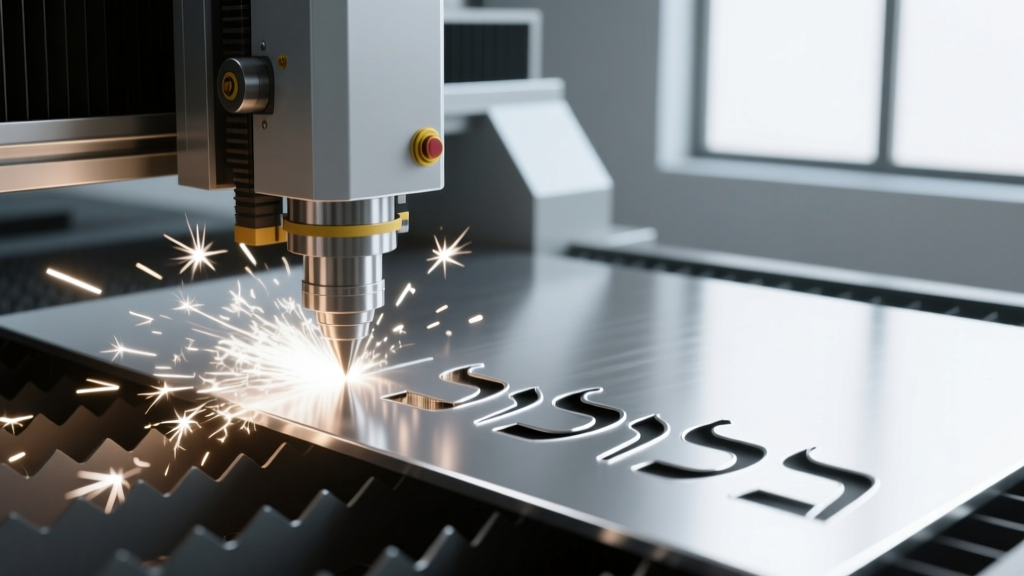
Over 90% of custom Hebrew name necklaces are produced via CNC fiber laser cutting. A high-powered beam melts through a flat sheet of pre-alloyed metal. The advantage here is absolute precision; the sharp corners of a block 'ש' (Shin) are rendered flawlessly. The drawback is the Heat-Affected Zone (HAZ). The intense heat can slightly alter the crystalline structure of the metal at the cut edges, requiring a multi-stage tumbling and polishing process to remove microscopic slag and restore the metal's corrosion resistance.
Investment Casting (Lost-Wax)
For thicker, 3D-beveled nameplates or designs incorporating diamond accents, jewelers use investment casting. A 3D wax model of the Hebrew name is printed, encased in plaster, burned out, and filled with molten gold. While casting allows for complex topographies (like raised bevels on the letters), it cannot achieve the razor-sharp, paper-thin edges of laser cutting. Cast pieces are generally heavier, more expensive, and have a softer, more organic edge profile.
Chain Selection and Bail Engineering
A beautifully engineered Hebrew nameplate will quickly become a lost item if paired with an inadequate chain. The bail (the loop connecting the plate to the chain) and the chain links must be rated for the pendant's specific mass.
'The most common point of failure in personalized jewelry is not the nameplate itself, but the unsoldered jump ring connecting the plate to the chain. Always insist on a laser-welded or soldered bail ring.' — Master Bench Jeweler
When selecting a chain, consider the tensile strength of the link architecture:
- Box Chains: Featuring interlocking, squared links that distribute weight evenly. Ideal for heavy 14k gold Hebrew nameplates exceeding 4 grams. They resist kinking and offer superior tensile strength.
- Cable Chains: The classic oval link. Suitable only for lightweight, delicate silver nameplates (under 3 grams). Prone to stretching and snapping if subjected to sudden tension.
- Rope Chains: Twisted links that mimic a woven rope. Excellent for light refraction, but the twisted geometry can trap skin oils and lotions, requiring frequent ultrasonic cleaning.
According to gemological and jewelry manufacturing guidelines referenced by the Gemological Institute of America (GIA), ensuring the clasp mechanism (such as a lobster claw or spring ring) is proportionate to the chain's gauge is critical for preventing accidental loss.
Care, Tarnish Prevention, and Maintenance
Maintaining the legibility and shine of a Hebrew name necklace requires specific care protocols, particularly for the intricate negative spaces between the letters where skin oils, dead cells, and cosmetic residues accumulate.
What to Avoid
Never use a stiff-bristled toothbrush on high-polish 14k gold or rhodium-plated silver nameplates. The abrasive action will create micro-scratches that dull the reflective surface. Furthermore, avoid exposing sterling silver to chlorinated pool water; the chlorine reacts with the copper in the 925 alloy, causing irreversible dark pitting.
Proper Cleaning Protocol
For routine maintenance, use a few drops of phosphate-free dish soap in lukewarm water. Soak the necklace for five minutes to loosen sebum from the cursive letter joints. Gently agitate the water, rinse thoroughly, and dry with a lint-free microfiber cloth. For deep cleaning, a professional jeweler can use an ultrasonic cleaner, provided the necklace does not contain any fracture-filled gemstones or delicate enamel inlays. Store the piece in an airtight polyethylene bag with an activated charcoal anti-tarnish strip to neutralize atmospheric sulfur compounds.


