Gold Necklace Hello Kitty: Authenticity, Karats & Enamel Guide
Expert deep dive into gold necklace Hello Kitty pendants. Learn to authenticate Sanrio hallmarks, compare 10k vs 14k alloys, and preserve enamel.

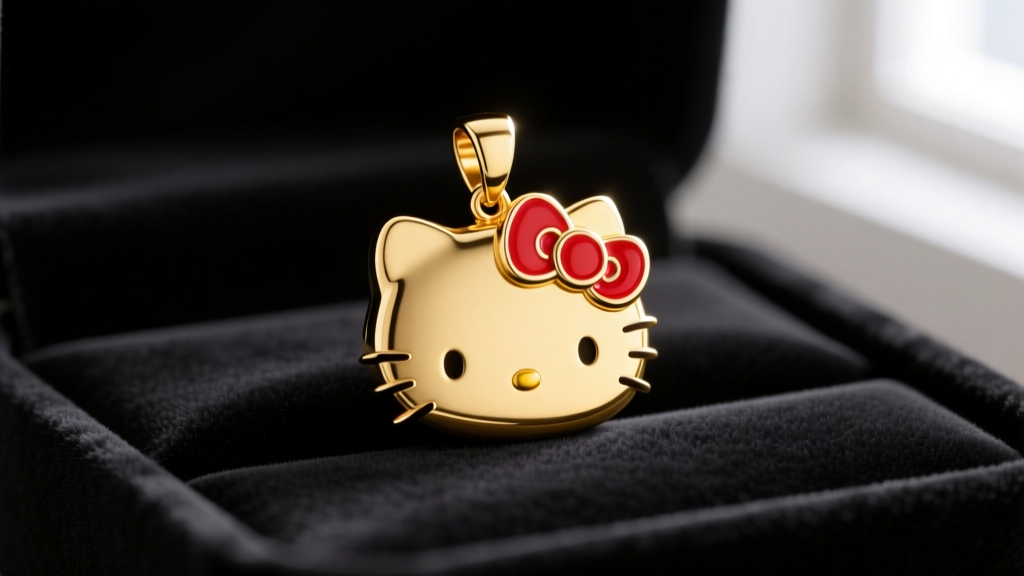
When collectors and fine jewelry enthusiasts search for a gold necklace Hello Kitty pendant, they are often navigating a complex intersection of pop-culture licensing and precious metal metallurgy. While Sanrio’s iconic character is frequently mass-produced in base metals and plastics, the fine jewelry iterations demand a rigorous technical understanding of gold alloys, hallmark authentication, and enamel preservation. This expert guide bypasses generic buying advice to deliver a metallurgical and structural deep dive into authentic Hello Kitty gold pendants, equipping you with the knowledge to evaluate karat weights, verify licensing stamps, and select the appropriate chain architecture.
The Metallurgy of Sanrio Fine Jewelry
Licensed character jewelry produced in precious metals must balance aesthetic fidelity with structural durability. According to the Gemological Institute of America (GIA), pure 24k gold is far too malleable for daily-wear pendants, especially those featuring intricate facial engravings or delicate bows. Consequently, authentic gold Hello Kitty necklaces are predominantly struck in 10k, 14k, or occasionally 18k gold.
Alloy Composition and Vickers Hardness
The performance of your pendant is dictated by its alloying metals—typically copper, silver, and zinc. A 14k gold Hello Kitty charm (58.5% pure gold) offers a Vickers hardness (HV) of approximately 120-150, making it highly resistant to the micro-scratches and dents that plague higher-karat pieces. Conversely, an 18k variant (75% pure gold, HV ~130-140 but more prone to sheer deformation due to lower copper content) will exhibit a richer yellow hue but requires meticulous care to prevent the bow or ears from warping under pressure. For collectors seeking a piece that will survive decades of daily wear without losing the crispness of Kitty’s stamped whiskers, 14k remains the optimal metallurgical choice.
Authentication: Hallmarks, Stamps, and Maker's Marks
The secondary market for licensed character jewelry is heavily saturated with counterfeit goods. Authenticating a genuine gold necklace Hello Kitty pendant requires more than a simple visual inspection; it demands a jeweler's loupe and an understanding of Federal Trade Commission (FTC) precious metal marking guidelines.
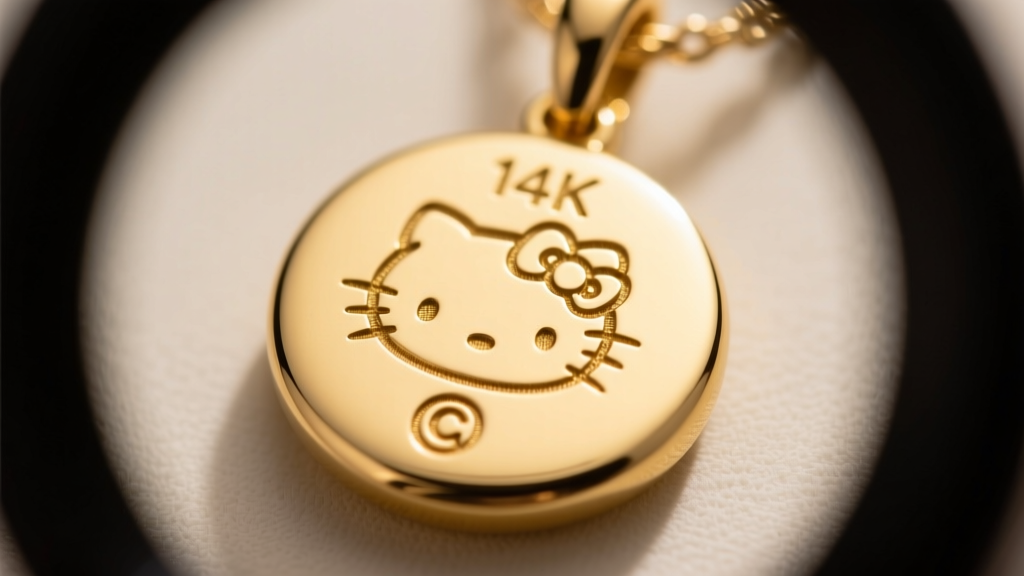
Decoding the Reverse Stamp
A legitimate Sanrio-licensed gold pendant will feature specific micro-stamps, usually located on the flat reverse plane or integrated into the bail. You must look for a triad of identifiers:
- Karat Stamp: "10K", "14K", "18K", or their metric equivalents ("417", "585", "750").
- Copyright Mark: The exact phrase "© Sanrio" or "© '76 Sanrio". Counterfeits often misspell this as "Sanrio Co" or omit the copyright symbol entirely.
- Maker’s Mark: A registered trademark of the licensed manufacturer (e.g., a tiny anchor, a specific letter matrix, or a company logo). The FTC mandates that any item stamped with a karat weight must also bear the registered hallmark of the manufacturer responsible for the quality assurance.
"In licensed fine jewelry, the crispness of the copyright stamp is a primary indicator of authenticity. Counterfeit castings often suffer from 'mushy' or shallow hallmarks due to the degradation of the rubber molds used in unauthorized mass production." — Master Bench Jeweler Assessment
Enamel Techniques: Vitreous vs. Cold Epoxy
The signature red bow on a Hello Kitty pendant is rarely solid gold; it is almost universally rendered in enamel. Understanding the type of enamel used is critical for long-term preservation and cleaning protocols.
Cold Enamel (Epoxy Resin)
The vast majority of modern, commercially available 10k and 14k Hello Kitty pendants utilize cold enamel—a two-part epoxy resin poured into the recessed gold cloisons and allowed to cure. While cost-effective and capable of producing vibrant, opaque reds, cold enamel is highly susceptible to chemical degradation. Exposure to chlorine, harsh perfumes, or acetone will cause the resin to yellow, crack, or lift from the gold backing.
Vitreous (Fired) Enamel
High-end, limited-edition, or vintage Japanese-market Sanrio gold pieces may feature vitreous enamel. This involves fusing powdered glass to the gold substrate at temperatures exceeding 1,400°F (760°C). Vitreous enamel is virtually impervious to chemicals and will not yellow. However, because 14k gold has a lower melting point than pure gold, firing vitreous enamel requires precise temperature control to prevent the gold alloy from warping. Never place a cold-enamel Hello Kitty pendant in an ultrasonic cleaner; the high-frequency cavitation will shatter the epoxy bond. Vitreous enamel can withstand ultrasonic cleaning, but the gold setting should still be evaluated for structural integrity first.
Structural Integrity: Chain and Bail Pairing
The structural failure point of any charm necklace is the bail (the loop connecting the pendant to the chain). Hello Kitty pendants often feature fixed, integrated bails or hidden "euro-style" bails that thread internally. Pairing the correct chain thickness and style is vital to prevent premature wear on the bail's interior gold.
| Chain Style | Recommended Thickness | Bail Compatibility & Wear Profile |
|---|---|---|
| Box Chain | 1.0mm - 1.5mm | Excellent. The flat, square links distribute weight evenly and cause minimal friction against the interior of a standard tubular bail. |
| Cable Chain | 1.2mm - 1.8mm | Good. Classic aesthetic, but the rounded links can act like a micro-file, slowly wearing down the gold bail over years of daily friction. |
| Rope Chain | 1.5mm - 2.0mm | Poor for standard bails. The twisted, textured links are highly abrasive and will accelerate bail degradation. Best reserved for heavy, oversized charms with reinforced steel-lined bails. |
| Figaro Chain | 1.5mm - 2.5mm | Moderate. The alternating link pattern can cause the pendant to catch or sit asymmetrically if the bail aperture is too narrow. |
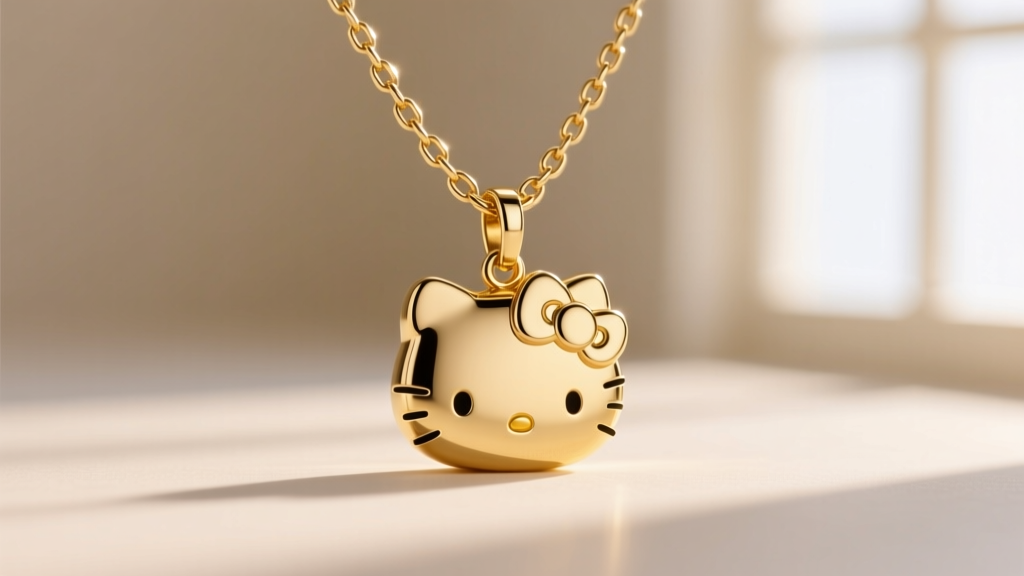
Market Valuation and Pricing Framework
Pricing a genuine gold necklace Hello Kitty pendant requires decoupling the intrinsic melt value of the gold from the "Sanrio Premium"—the collector's markup applied to officially licensed intellectual property. Below is a technical valuation framework based on current precious metal markets and standard licensing multipliers.
| Karat / Weight Class | Average Pendant Weight | Intrinsic Melt Value (Est.) | Expected Retail / Collector Price |
|---|---|---|---|
| 10K (Lightweight) | 1.0g - 1.5g | $35 - $55 | $120 - $180 |
| 14K (Standard) | 2.0g - 3.5g | $110 - $190 | $350 - $550 |
| 18K (Premium/Vintage) | 3.0g - 5.0g | $200 - $330 | $700 - $1,200+ |
When evaluating vintage pieces from the 1980s or 1990s Japanese domestic market (JDM), expect the collector price to significantly exceed the intrinsic value, particularly if the piece includes original Sanrio packaging and authentication cards. Always verify the hallmark triad and assess the enamel condition before finalizing a transaction in the secondary market.


