Wanna Help Me Pick a Necklace? A Guide to Face Shapes & Necklines
Wondering 'wanna help me pick a necklace?' Discover our expert guide on matching face shapes, necklines, and metal grades for the perfect fit.


The "Wanna Help Me Pick a Necklace?" Dilemma: Where to Start
If you have ever found yourself staring at a crowded jewelry counter or scrolling endlessly online, whispering to yourself, "Wanna help me pick a necklace?"—you are not alone. Choosing the right necklace is an exercise in applied geometry, material science, and personal styling. Unlike earrings or rings, a necklace sits at the visual anchor of the human body: the collarbone and neckline. A poorly chosen piece can visually shorten your neck, clash with your wardrobe's structural lines, or deteriorate within months due to subpar hardware.
This comprehensive buying guide strips away the vague fashion platitudes. We will break down the exact metrics you need to consider, from facial proportions and neckline synergy to the metallurgical realities of chain weaves and clasp failure rates. Whether you are investing in a solid 18k gold heirloom or a durable PVD-plated daily beater, this framework will eliminate the guesswork.
Decoding Face Shapes: The Geometry of Necklaces
The first rule of necklace selection is counter-balancing your natural facial geometry. The pendant shape and chain length should create an optical illusion that guides the eye toward an idealized oval proportion.
Round & Square Faces
For round faces (where cheekbone width and face length are roughly equal) and square faces (characterized by a sharp, angular jawline), the goal is elongation. Avoid 14-to-16-inch chokers or collar-length necklaces, as these create a horizontal line that emphasizes width. Instead, opt for 20-to-24-inch chains featuring V-shaped pendants, marquise cuts, or vertical lariat drops. These shapes draw the eye downward, visually lengthening the neck and softening a strong jawline.
Oval & Heart Faces
Oval faces possess balanced proportions, meaning nearly any length or pendant shape works. However, to highlight the collarbones, a 16-to-18-inch princess-length chain with a rounded or geometric pendant is ideal. Heart-shaped faces (wider forehead, narrow chin) benefit from 14-to-16-inch chokers or necklaces with bottom-heavy, teardrop-shaped pendants that add visual weight to the lower half of the face, balancing the narrower chin.

Neckline Synergy: Matching Metal to Fabric
A necklace must interact seamlessly with your clothing. The metal finish, chain thickness, and pendant scale must complement the fabric's weight and the garment's structural lines. Below is a definitive matrix for pairing necklines with necklace specifications.
| Garment Neckline | Ideal Chain Length | Pendant Scale & Hardware | Material Recommendation |
|---|---|---|---|
| V-Neck | 18" - 22" | Small to medium Y-drop or lariat; follows the V-line | Delicate 14k solid gold cable chain (1.2mm) |
| Crew Neck | 14" - 16" or 24"+ | Bold statement collar or long layered pendant | Chunky 316L steel curb chain or mixed-metal layers |
| Scoop Neck | 16" - 18" | Curved, rounded pendants that mirror the neckline | 18k gold vermeil with a polished bezel-set gem |
| Turtleneck | 24" - 30" | Heavy, oversized pendants; avoid delicate chains | Thick brass or bronze rope chain (3mm+ width) |
| Off-Shoulder | 12" - 14" (Choker) | Wide collars or multi-strand pearl/crystal bibs | Velvet ribbon with sterling silver hardware |
Material Grades & Hardware: What Actually Lasts
When you ask a jeweler for help, they will often focus on the gemstone. But as a buyer, your primary concern should be the chain's metallurgy and the clasp's mechanical integrity. A necklace is only as good as its weakest link—literally.
Metallurgy: Solid Gold vs. Vermeil vs. PVD
- Solid Gold (14k/18k): The benchmark for longevity. 14k gold (58.5% pure gold) offers superior tensile strength compared to 18k (75% pure gold), making it the optimal choice for chains under 1.5mm thickness that will bear the weight of a pendant. Expect to pay $250–$800+ for a quality 14k chain.
- Gold Vermeil: By industry standards, true vermeil requires a base of 925 sterling silver plated with at least 2.5 microns of 10k+ gold. Many fast-fashion brands deceptively sell 'gold-plated' silver with only 0.5 microns of gold, which wears off in months. Always verify the micron thickness.
- PVD Coating on 316L Steel: Physical Vapor Deposition (PVD) bonds gold or titanium nitride to surgical steel at a molecular level. It is highly resistant to sweat and friction, making it the ultimate choice for gym-goers or those with acidic skin pH that rapidly tarnishes traditional electroplated metals.
Clasp Mechanics & Failure Modes
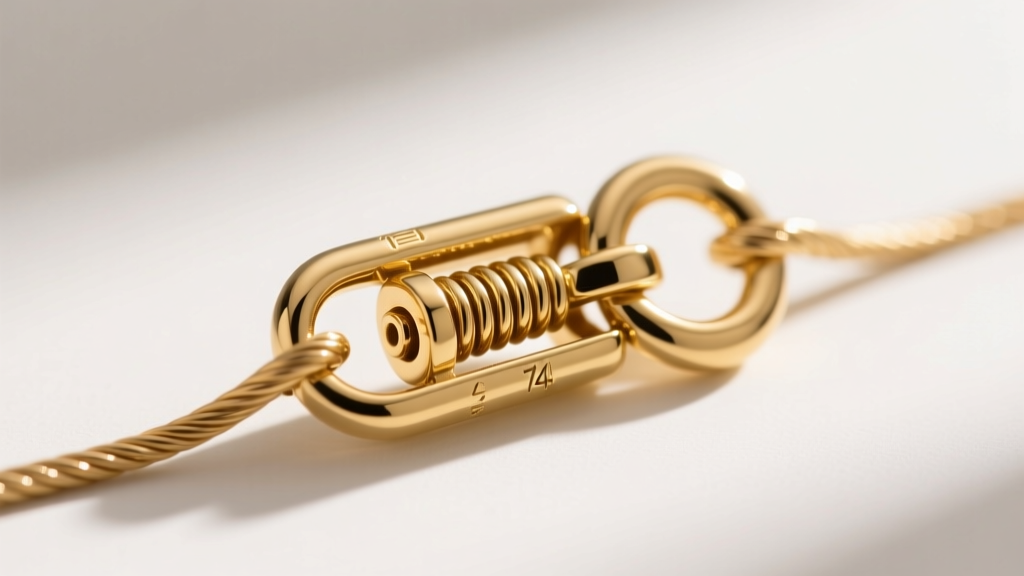
According to jewelry manufacturing experts at Rio Grande, the clasp is the most common point of structural failure. Avoid spring-ring clasps on any chain exceeding 1.5mm in width; the internal 0.3mm tension spring lacks the torque to secure heavier chains and frequently snaps under lateral stress. Instead, demand a lobster clasp (5mm for delicate chains, 7mm to 9mm for medium-to-heavy chains). For high-value pendants, ensure the jump ring connecting the pendant to the chain is soldered shut, preventing the ring from pulling apart under the pendant's pendulum-like swinging motion.
Chain Weaves: Tensile Strength and Daily Wear
Not all chain links are created equal. The weave dictates both the visual light reflection and the chain's vulnerability to daily wear and tear.
"A chain's durability is dictated by its link geometry. Flat links resist pulling but kink easily, while interlocking round links offer flexibility but can trap debris." — Master Bench Jeweler Guidelines, GIA
- Cable & Curb Chains: The most durable. Curb chains lay flat and distribute tension evenly, making them ideal for heavy pendants.
- Box Chains: Visually striking and highly reflective, but notorious for kinking. Once a box chain bends at a 90-degree angle (often from sleeping in it), the structural integrity of that link is permanently compromised.
- Rope Chains: Excellent tensile strength, but the spiraling grooves act as a trap for skin oils, lotions, and micro-dust. They require ultrasonic cleaning every few months to maintain their brilliance.
Budgeting & Sizing: Your Pre-Purchase Checklist
Before you finalize your purchase, run through this actionable checklist to ensure you are getting a piece that fits your body and your budget.
The Sizing Protocol
Do not guess your chain length. Take a piece of non-stretchable string, wrap it around your neck, and adjust it to your desired drop point. Mark the string, lay it flat, and measure it with a steel tape measure. If you are between standard sizes (e.g., 17 inches), always round up to the next standard length (18 inches) and add a 2-inch extender chain. Extenders cost less than $15 to manufacture but add massive versatility to your styling options.
Price Benchmarks (2026 Market Estimates)
- Entry-Level ($40 - $90): 316L Stainless steel with PVD gold coating, 2mm-4mm width, secure lobster clasp.
- Mid-Tier ($120 - $250): 925 Sterling silver with true 2.5-micron gold vermeil, 1.5mm-3mm width, soldered jump rings.
- Investment Grade ($400 - $1,200+): Solid 14k or 18k gold, precision laser-welded links, custom-machined lobster clasps with reinforced tension springs.
Ultimately, when you ask, "Wanna help me pick a necklace?", the answer lies in the intersection of your facial geometry, your wardrobe's architecture, and the uncompromising quality of the metalwork. Prioritize soldered hardware, verify your plating thickness, and choose a length that flatters your unique proportions. By treating your necklace purchase as an investment in precision engineering rather than just a fleeting accessory, you guarantee a piece that elevates your style for decades.


