Styling Hot Guys With Chain Necklace Looks: Fixing Bad Fits
Fix the hot guys with chain necklace aesthetic. Troubleshoot chain widths, metal grades, and layering fails with our expert men's jewelry guide.


The internet is saturated with images defining the modern masculine aesthetic, and the search trend for 'hot guys with chain necklace' styles is not just a passing meme—it is a documented shift in men's fashion. Celebrities like Jacob Elordi, A$AP Rocky, and Paul Mescal have proven that a simple chain can elevate a basic white tee into a deliberate, high-fashion statement. However, when the everyday man attempts to replicate this effortless swagger, the result often veers into tacky, uncomfortable, or disproportionate territory.
The difference between an attractive, well-proportioned chain and a distracting fashion failure comes down to millimeter-level precision in width, exact metal grades, and clasp mechanics. As a senior style analyst, I see the same four critical errors repeated constantly. This troubleshooting guide will diagnose your chain necklace fails and provide the exact 2026 specifications to fix them.
Troubleshooting Issue 1: The 'Choking' Effect (Length & Width Mismatches)
The most common reason a chain looks wrong is a mismatch between the wearer's neck circumference, the chain's length, and its physical width. A thick chain worn too high on a smaller neck creates a 'choking' visual that looks restrictive rather than relaxed. Conversely, a thin chain on a large neck disappears entirely, looking like an afterthought.
According to the style directors at GQ, the sweet spot for a standalone men's chain is the collarbone. But 'collarbone' means different things depending on your anatomy. You must measure your neck and select your chain based on structural proportions, not just guesswork.
| Neck Circumference | Ideal Chain Length | Maximum Everyday Width | Visual Placement |
|---|---|---|---|
| 14 - 15 inches | 18 inches | 4mm - 6mm | Base of the neck / upper collarbone |
| 16 - 17 inches | 20 inches | 6mm - 8mm | Directly on the collarbone (The Sweet Spot) |
| 18+ inches | 22 - 24 inches | 8mm - 12mm | Mid-chest / sternum level |
The Width Rule of Thumb
For a versatile, everyday chain that works in both casual and semi-formal settings, stay between 4mm and 8mm. Anything under 3mm reads as purely delicate or feminine in traditional menswear, while anything over 10mm crosses into loud, hip-hop statement territory that requires specific styling to pull off without looking costumey.
Troubleshooting Issue 2: The 'Green Neck' Syndrome & Skin Tone Clashing
Nothing ruins the 'hot guys with chain necklace' illusion faster than a green ring around your neck or a washed-out complexion. This happens when men buy cheap, hollow-core chains plated over brass or copper bases, or when they choose the wrong metal undertone for their skin.
Fixing the Metal Grade Problem
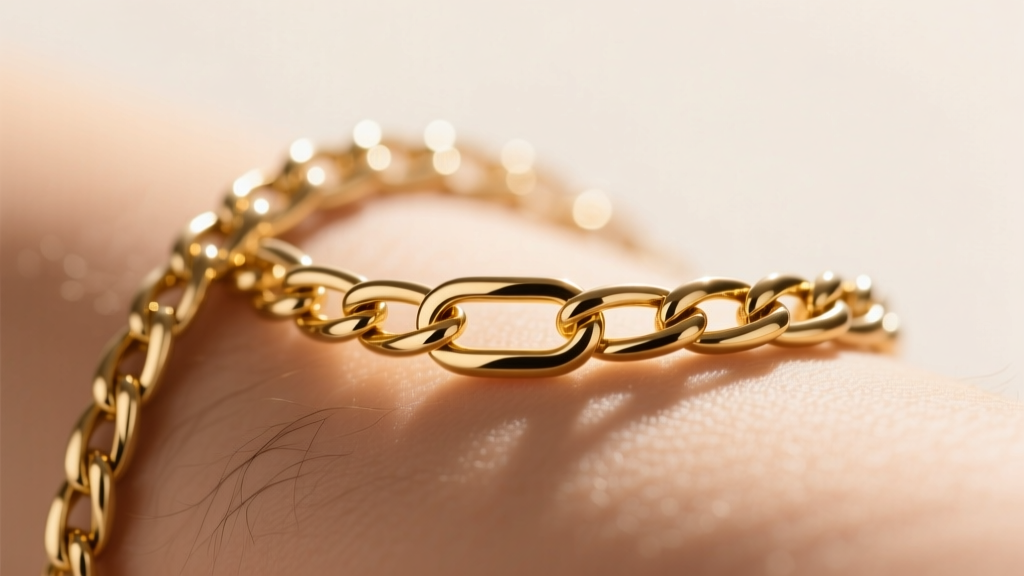
If your chain turns your skin green, it is reacting to the copper alloys in cheap base metals reacting with your sweat's acidity. To fix this, you must upgrade your material grade. The Jewelers of America recommends understanding your metal composition before purchasing everyday jewelry.
- 316L Surgical Stainless Steel: The ultimate budget fix. It is completely hypoallergenic, will never turn your skin green, and resists tarnish. However, it has a cooler, slightly grayer tone than precious metals.
- 14k Solid Gold: The gold standard for men's everyday chains. It contains 58.5% pure gold mixed with durable alloys like zinc and silver. It is hard enough to resist scratching and bending, unlike softer 18k or 24k gold.
- Gold Vermeil (The Trap): Avoid standard gold-plated brass. If you must buy plated, ensure it is 'Vermeil'—which legally requires a sterling silver base and a gold plating thickness of at least 2.5 microns. Anything less will wear off in three months of daily wear.
Matching Undertones
If you have cool, pinkish undertones, white gold, platinum, or stainless steel will complement your skin. If you have warm, olive, or golden undertones, yellow gold will make your skin look vibrant and healthy. Rose gold is notoriously difficult for men to style and often clashes with body hair and natural skin redness; avoid it unless you are intentionally layering with other rose gold accessories.
Troubleshooting Issue 3: The Chest Hair Snag & Clasp Failures
A chain should drape, not grab. Men with chest hair frequently abandon necklaces because certain link patterns act like velcro, painfully pulling hair throughout the day. Furthermore, heavy chains frequently break at the clasp because the jewelry industry defaults to cheap, small lobster clasps that cannot handle the tensile stress of a swinging 50-gram chain.
Link Geometry: What to Avoid vs. What to Buy
Avoid: Herringbone, Omega, and fine Rope chains. These feature micro-gaps and raised edges that catch and pull body hair immediately.
Buy: Cuban, Curb, and Figaro links. These chains are mechanically flattened and diamond-cut, meaning the links lay flush against one another. They slide smoothly over skin and hair without snagging. A 5mm Cuban link is widely considered the most comfortable, hair-friendly chain on the market.
Upgrading the Clasp
If your chain is wider than 6mm or weighs more than 30 grams, a standard lobster clasp is a structural liability. The lever arm on a lobster clasp will eventually bend or snap under dynamic movement. You must look for chains equipped with a Box Clasp (which locks into a square housing) or a Magnetic Safety Clasp. These distribute the weight evenly and eliminate the weak point at the nape of your neck.
Troubleshooting Issue 4: Layering Overkill (The 'Mr. T' Trap)
Layering is a staple of modern menswear, but stacking three chains of the exact same width and length creates a tangled, messy block of metal that looks chaotic rather than curated. The 2026 approach to men's layering relies on deliberate contrast.

The Rule of Two and the 2-Inch Gap
To successfully layer, stick to a maximum of two chains for everyday wear. You must create visual separation through both length and texture.
- The Length Gap: Your second chain must be at least 2 inches longer than the first. If your base chain is a 20-inch Cuban, your secondary chain must be a 22-inch or 24-inch piece. This prevents the chains from constantly tangling and knotting together.
- The Width Contrast: Never pair two thick chains. Pair a dominant statement piece (e.g., an 8mm Cuban) with a subtle, textured supporting piece (e.g., a 3mm Rope or Wheat chain). The eye needs a place to rest; the thinner chain provides negative space.
- The Pendant Anchor: If you are adding a pendant to a layered look, it should only hang from the longer chain. A 20-inch bare chain layered with a 24-inch chain holding a simple geometric pendant (like a signet or a small cross) creates a perfect V-shape that elongates the torso.
Style is about intention. A single, well-proportioned 6mm chain will always look more expensive and attractive than three tangled, poorly fitted chains of varying, clashing metal tones.
Final Maintenance Checklist
Even the perfectly sized chain will fail if it looks dull. Men's chains accumulate sebum, dead skin, and soap scum in the link crevices, which dulls the diamond-cut bevels that give the metal its shine. Once a month, soak your chain in warm water with a few drops of mild dish soap, agitate it with a soft-bristled baby toothbrush, and dry it with a microfiber cloth. Avoid wearing your chain in chlorinated pools or hot springs, as sulfur and chlorine will permanently pit and discolor sterling silver and lower-karat gold alloys. By treating your chain as a precision instrument rather than a casual accessory, you will effortlessly master the aesthetic that dominates modern menswear.


