How to Choose the Perfect Necklace for Men: A Step-by-Step Guide
Learn how to choose the perfect necklace for men with our step-by-step guide. Master chain styles, metal grades, lengths, and pendant pairings.


The Architecture of Men's Neckwear
Finding the right necklace for men is rarely as simple as picking a design off a shelf. Unlike women's jewelry, which often relies on delicate layering and varied gemstone focal points, men's neckwear is an exercise in structural integrity, proportion, and material science. A chain that looks proportional on a 15-inch neck will look like a choker on an 18-inch neck. Similarly, a metal that withstands daily wear for one person might corrode rapidly for another based on skin pH and lifestyle.
"A well-chosen chain is an anchor piece. It shouldn't just sit on the skin; it should integrate with the wearer's biomechanics and wardrobe architecture." — Master Jeweler & Stylist
This step-by-step guide strips away the guesswork, providing exact measurements, metallurgical facts, and styling frameworks to help you select a piece that lasts a lifetime.
Step 1: Determine the Ideal Chain Length and Width
The foundation of any necklace for men lies in its dimensions. Width dictates the visual weight, while length determines where that weight rests on the torso. Standard jewelry manufacturing relies on specific aspect ratios, but human anatomy varies wildly.
The Length Matrix
- 18 Inches (Choker/Base of Neck): Sits tightly at the base of the throat. Best for men with neck circumferences under 15 inches. Ideal for thin chains (1mm-2mm) or specific subcultural aesthetics.
- 20 Inches (The Standard Collarbone): The most versatile length. It rests just below the collarbone and is visible with unbuttoned crew necks or V-necks. Perfect for 3mm to 6mm widths.
- 22 Inches (Mid-Chest): Drops to the upper sternum. Excellent for wearing over t-shirts or lightweight knits. Accommodates heavier chains (6mm-10mm) without feeling restrictive.
- 24+ Inches (Statement/Over-Clothing): Rests on the lower chest. Reserved for bold, heavy pieces (10mm+) or large pendants worn over streetwear or hoodies.
Width and Proportion
Width must scale with your frame. A 2mm chain on a broad-chested man will look like a stray wire, while a 12mm chain on a slender frame can look overwhelming. For everyday, subtle wear, stick to the 2mm to 4mm range. For a noticeable but professional statement, choose 5mm to 8mm. Anything above 10mm is a dedicated streetwear or hip-hop statement piece.
Step 2: Select the Right Metal Grade for Durability

Not all metals are created equal. When investing in a necklace for men, you must consider Vickers hardness (HV), corrosion resistance, and alloy composition. According to the Gemological Institute of America (GIA), understanding alloy purity is critical for longevity.
Gold: 14k vs. 18k
While 18k gold (75% pure) offers a richer, deeper yellow hue, it is softer (approx. 125 HV). For heavy chains subject to pulling and friction, 14k gold (58.5% pure) is vastly superior. The higher concentration of alloy metals like copper and zinc increases the hardness to roughly 140 HV, making it highly resistant to link stretching and clasp deformation.
Stainless Steel: 316L vs. 304
If you are on a budget or want a worry-free daily beater, demand 316L Surgical Stainless Steel. Unlike 304 steel, 316L contains molybdenum, which drastically increases resistance to chlorides (like sweat and ocean water). It will not tarnish, rust, or turn your skin green.
Titanium: Grade 5 (Ti-6Al-4V)
For ultra-lightweight strength, aerospace-grade titanium is unmatched. It is hypoallergenic and possesses a strength-to-weight ratio that makes a massive 10mm chain feel like a 4mm silver one. However, titanium cannot be easily resized or soldered by standard jewelers if a link breaks.
Step 3: Choose a Chain Link Style That Fits Your Aesthetic
The link style dictates how the chain catches light, how it drapes, and its structural weak points. The Jewelry Wise educational portal notes that link geometry heavily influences a chain's durability and maintenance needs.
The Heavyweights: Cuban and Figaro Links
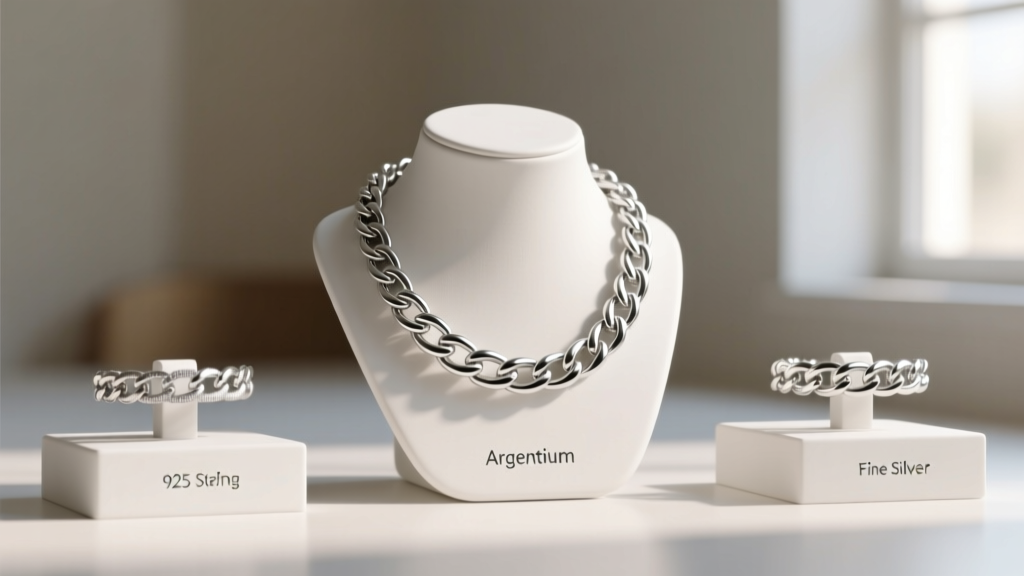
Cuban Links feature tightly interlocking, flat-surfaced oval links. They lay perfectly flat against the chest, preventing twisting and hair-pulling. Because the links are soldered and filed flat, they are incredibly robust. Figaro chains use a pattern of three short links followed by one long link, offering a vintage, rhythmic aesthetic that pairs beautifully with medallions.
The Minimalists: Box, Rope, and Curb Chains
- Box Chains: Composed of square, geometric links. They offer brilliant light reflection but are notorious for kinking if bent sharply. Avoid box chains under 2.5mm, as the thin links will easily crush under pressure.
- Rope Chains: Twisted links that mimic a nautical rope. They offer the highest light refraction of any style but are prone to catching body hair and are notoriously difficult to repair if snapped.
- Curb Chains: The classic, slightly rounded interlocking link. More flexible than the Cuban, but less uniform in its lay.
Step 4: Match the Necklace to Your Neckline and Build
A necklace for men must harmonize with the garments it accompanies. Use the matrix below to align your chain dimensions with your typical wardrobe and physical build.
| Body Build | Recommended Width | Best Length | Ideal Neckline Pairing |
|---|---|---|---|
| Slim / Lean | 2mm - 4mm | 18" - 20" | V-Necks, Unbuttoned Camp Collars |
| Athletic / Medium | 4mm - 6mm | 20" - 22" | Crew Necks, Henleys, Open Polos |
| Broad / Heavy | 6mm - 10mm+ | 22" - 26" | Heavyweight Tees, Hoodies, Outerwear |
Step 5: Pendant Pairing and Clasp Mechanics

The clasp is the most common point of catastrophic failure in men's jewelry. A heavy gold chain secured by a cheap clasp is a lost investment waiting to happen.
Clasp Engineering
Never use a spring ring clasp on any chain weighing over 30 grams. The internal spring mechanism is susceptible to shear force and sweat corrosion. For chains between 30g and 80g, a heavy-duty lobster clasp with a reinforced jump ring is mandatory. For chains exceeding 100g, you must insist on a box clasp with a double figure-eight safety catch. The box mechanism distributes the tensile load across a wide steel tongue, while the safety wires prevent total loss if the primary latch is snagged.
Pendant Bail Sizing
If you plan to add a pendant, measure the chain's end-cap and the pendant's bail (the loop it hangs from). A 6mm Cuban link will not fit through a standard 4mm pendant bail. Always opt for chains with removable end-caps or purchase pendants with hinged, screw-top bails designed for thick chains.
Common Mistakes and How to Avoid Them
Even seasoned buyers fall victim to manufacturing shortcuts. Avoid these critical errors:
- Buying Gold-Plated Brass: Brass contains high levels of copper. When exposed to the acidic pH of human sweat, the copper oxidizes rapidly, turning your skin green and degrading the metal. Always verify the base metal is silver, steel, or solid gold.
- Ignoring the Hallmark: A stamp that says '18K HGE' means Heavy Gold Electroplate, not solid gold. Look for '14K', '18K', '750', or '585' for solid precious metals.
- Sleeping in Chains: Tossing and turning applies unpredictable torque to chain links. Over time, this causes 'link stretch,' particularly in rope and box chains, permanently elongating the metal and weakening the solder joints.
By treating your necklace for men as a piece of engineered wearables rather than just an accessory, you ensure it remains a staple of your wardrobe for decades to come.