How to Make Necklace Shorter: A Material-Specific Guide
Learn how to make necklace shorter based on chain material. Compare gold, platinum, titanium, and pearls for safe, precise resizing.

Why Chain Material Dictates Your Shortening Method
When searching for how to make necklace shorter, most generic guides offer a one-size-fits-all approach: grab a pair of scissors or wire cutters and snip. However, as any professional jeweler will tell you, this is a fast track to ruining a valuable piece. The metallurgical properties of your necklace—specifically its tensile strength, Vickers hardness, and link geometry—dictate the exact tools and techniques required for safe alteration.
Whether you are working with a buttery 22k gold rope chain, a brittle tungsten carbide link, or a delicate strand of knotted Akoya pearls, the material's physical response to stress, cutting, and reattachment varies wildly. Understanding these material properties is the difference between a seamless, professional-looking resize and a permanently damaged chain. In this comprehensive guide, we break down the material science behind necklace shortening, providing actionable frameworks for precious metals, industrial alloys, and organic strung materials.
Precious Metals: Gold, Silver, and Platinum Properties
Precious metals are the most common materials for fine jewelry chains, but their alloy compositions drastically change how they must be cut and reattached. Pure gold (24k) is exceptionally soft and malleable, meaning it can be easily cut with standard flush cutters but is prone to stretching and warping during the reattachment process.
Most chains are crafted from 14k or 18k gold. 14k gold contains higher amounts of copper, zinc, or silver, giving it a Vickers hardness (HV) of roughly 120-150. This makes it durable enough to hold complex link shapes like the Figaro or Cuban link, but it requires sharp, high-leverage cutters to avoid crushing the link. 18k gold (HV 90-110) is softer and requires less physical force to cut, but the heat applied during soldering must be carefully controlled to prevent melting the surrounding links.
Platinum, conversely, is incredibly dense with a high melting point of 1,768°C. According to the Gemological Institute of America (GIA), platinum's durability comes from its density rather than its surface hardness. When shortening a platinum chain, standard steel jewelry cutters can chip or dull. You must use tungsten carbide-tipped cutters, and reattachment requires specialized laser welding or high-temperature oxy-hydrogen torches.
| Metal Type | Vickers Hardness (HV) | Recommended Cutting Tool | Reattachment Method |
|---|---|---|---|
| 14k Yellow/White Gold | 120 - 150 | Steel Flush Cutters | Torch or Laser Soldering |
| 18k Yellow/Rose Gold | 90 - 110 | Steel Flush Cutters | Torch Soldering (Easy/Medium) |
| Sterling Silver (925) | 60 - 80 | Standard Flush Cutters | Torch Soldering |
| Platinum (950) | 80 - 110 (High Density) | Tungsten Carbide Cutters | Laser Welding |
Alternative & Industrial Metals: Titanium, Tungsten, and Stainless Steel
Alternative metals have surged in popularity due to their hypoallergenic properties and modern aesthetic, but they present severe challenges when you need to make a necklace shorter. Titanium (specifically Grade 5 Ti-6Al-4V) boasts a high strength-to-weight ratio and extreme corrosion resistance. However, titanium cannot be traditionally soldered with a jeweler's torch; it requires an inert argon gas environment or laser welding. If you cut a titanium chain, you must use diamond-coated saw blades or heavy-duty bolt cutters for thicker gauges, and reattachment is often limited to mechanical jump rings rather than seamless soldering.
Tungsten carbide is notoriously difficult to alter. Ranking between 8.5 and 9 on the Mohs hardness scale, it is virtually scratch-proof but highly brittle. Standard wire cutters will shatter upon impact with a tungsten link. To shorten a tungsten chain, jewelers use diamond-tipped rotary tools or specialized hydraulic shears. Because tungsten cannot be soldered or welded in a standard jewelry studio, shortening it usually involves removing links and reconnecting the chain via heavy-duty steel or titanium jump rings.
316L Surgical Stainless Steel is softer than titanium but harder than sterling silver. It work-hardens quickly, meaning the more pressure you apply with dull cutters, the harder the metal becomes at the stress point. Always use sharp, high-quality end cutters to slice cleanly through the link wire, avoiding the crushing effect that leads to metal fatigue and eventual snapping.
Organic & Strung Materials: Pearls, Gemstones, and Silk Cord
Shortening a strung necklace is not a cutting-and-soldering process; it is a complete structural re-engineering. Pearl and gemstone bead necklaces are typically strung on silk or nylon thread. If you simply cut the cord and tie it to a clasp, the friction from the metal clasp will quickly fray and snap the organic fibers.
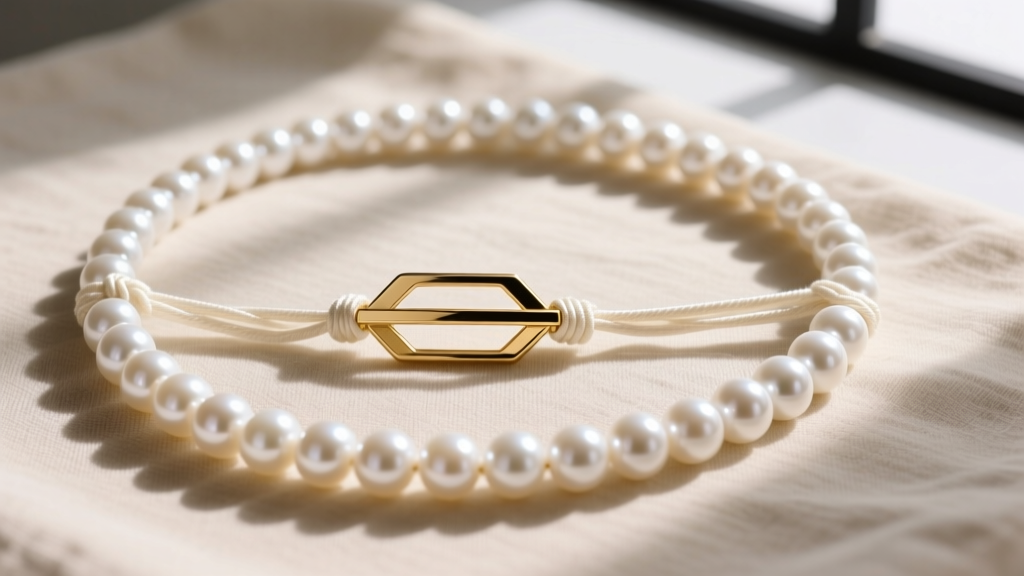
To properly shorten a pearl necklace, you must completely deconstruct the strand. According to expert tutorials from Rio Grande, the process involves cutting the original silk, removing the excess beads, and restringing the necklace using a pearl-knotting tool or a fine beading awl. You must tie individual overhand knots between each pearl to prevent them from rubbing together and to ensure that if the strand breaks, you only lose a single bead.
Furthermore, the terminal ends of the silk cord must be protected. This is achieved by threading the silk through a piece of French wire (also known as gimp or bullion)—a microscopic coiled spring of fine silver or gold-plated wire. The French wire acts as a sacrificial buffer between the soft silk and the hard metal clasp, drastically extending the lifespan of the shortened necklace.
Step-by-Step Framework: Matching Tool to Material
When executing the physical shortening of a metal chain, selecting the correct gauge of replacement hardware is just as critical as the cutting tool. Using a jump ring that is too thin will result in a structural failure, while one that is too thick will distort the chain's drape.
- Delicate Chains (Cable, Rolo, Box - under 2mm width): Use 22-gauge or 20-gauge flush cutters. To reattach the clasp, use a 20-gauge jump ring. Ensure the jump ring is opened laterally (twisting side-to-side) rather than pulling apart, which ruins the circular geometry.
- Medium Chains (Figaro, Rope, Mariner - 3mm to 5mm width): Use 18-gauge heavy-duty flush cutters. Reattach using an 18-gauge or 16-gauge jump ring. For rope chains, consider taking the piece to a professional for laser soldering, as mechanical jump rings can catch on the twisted links.
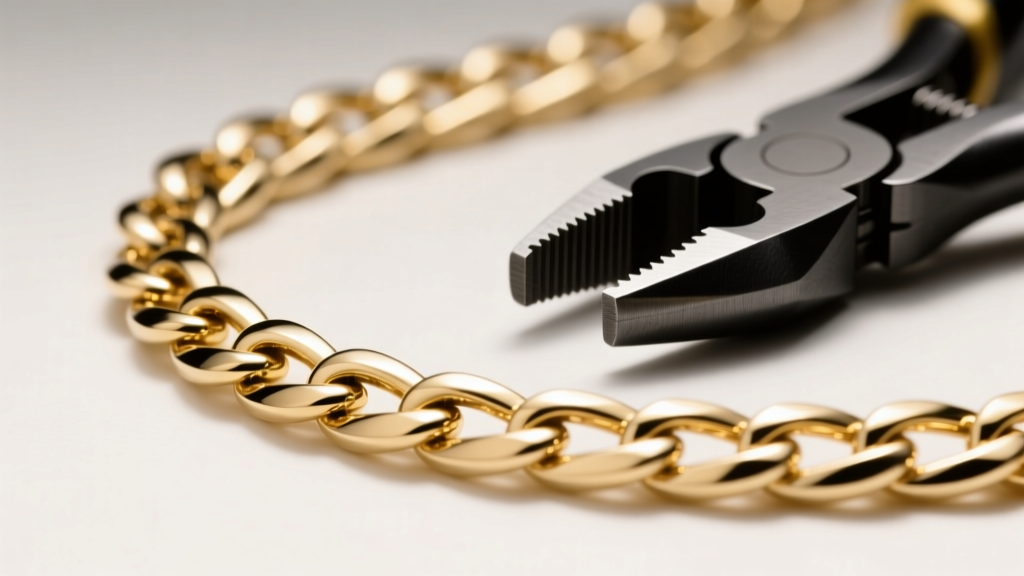
- Heavy Chains (Cuban, Curb - over 6mm width): Standard jewelry cutters will fail. Use end-cutting nippers or a jeweler's saw with a 2/0 blade. Reattachment requires 14-gauge or 12-gauge soldered jump rings, often necessitating a professional jeweler's torch to ensure the thick wire is fully fused.
Pro Tip: Never cut a seamless chain (like a herringbone, snake, or omega chain) with the intention of reattaching it via a jump ring. These chains rely on continuous tension and interlocking micro-links. Once cut, they lose their structural integrity and will kink or unravel. They must be shortened and seamlessly laser-welded by a professional.
When to Seek a Professional Jeweler
While DIY shortening is viable for simple silver cable chains or basic beaded strands, certain material properties demand professional intervention. If your necklace is crafted from platinum, features a seamless weave (Omega/Box), or incorporates hollow-core links (which crush easily under the pressure of manual cutters), the risk of irreversible damage is exceptionally high.
A professional jeweler will utilize a laser welder to shorten and reattach the chain. Laser welding uses highly focused light pulses to melt metal at a microscopic level without transferring heat to the surrounding links. This is the only safe method for shortening chains with heat-sensitive gemstone pendants attached, or for maintaining the seamless look of high-karat gold and platinum chains. Expect to pay between $35 and $85 for professional chain shortening, a worthwhile investment to preserve the structural and aesthetic integrity of your jewelry.


