How to Measure a Necklace: Fit, Length & Value Guide
Learn how to measure a necklace accurately to ensure the perfect fit and assess true value. Avoid costly resizing and buyer's remorse with our expert guide.

The Hidden Cost of Incorrect Necklace Measurements
When shopping for fine jewelry online, guessing your size is a costly gamble. Understanding how to measure a necklace accurately is not just about achieving the perfect aesthetic drape; it is a critical component of budget and value assessment. In 2026, with gold prices hovering at historic highs, the financial stakes of buying the wrong length or misjudging chain proportions are higher than ever.
Consider the hidden costs of a measurement error. If a custom-length chain is too short, you cannot simply exchange it. You will face a return, often incurring a 15% to 25% restocking fee from online retailers. Alternatively, taking a standard chain to a local bench jeweler to add links or solder on an extender costs between $45 and $120, depending on the chain type. Delicate chains like herringbone or snake chains are notoriously difficult to solder without leaving visible weak points, sometimes rendering them un-resizable. By mastering precise measurement techniques before you buy, you protect your investment and ensure the price you pay aligns with the physical value of the piece.
How to Measure a Necklace: The 3-Point Value Framework
To truly assess a necklace's value, you must look beyond the tag's stated length. A comprehensive evaluation requires a 3-point measurement framework that accounts for total drop, cross-sectional mass, and hardware proportions.
1. Total Chain Length (The Base Metric)
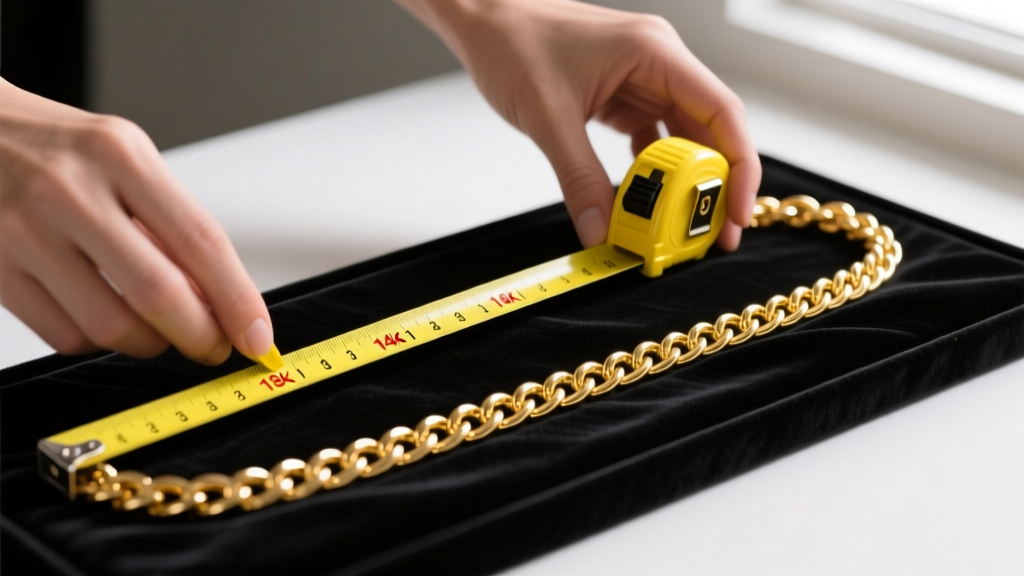
The industry standard for measuring chain length is from the very end of the clasp to the very end of the jump ring on the opposite side. Do not measure from the inside of the clasp loop, as this will short-change your measurement by up to half an inch. When evaluating value, remember that every additional inch of a solid gold chain adds a proportional amount of precious metal weight. A 20-inch chain should theoretically contain 25% more gold than a 16-inch chain of the exact same gauge, which should be reflected in the price-per-gram calculation.
2. Chain Width and Gauge (The Weight Factor)
Length is only half the equation. The width (measured in millimeters) dictates the chain's structural integrity and intrinsic metal value. A 2mm cable chain and a 4mm cable chain do not just differ in visual weight; the 4mm chain has roughly four times the cross-sectional area, meaning it requires approximately four times the amount of gold or silver to produce. When assessing budget, always compare the millimeter width against the total gram weight to verify if you are paying for solid metal or inflated brand markups.
3. Pendant Drop and Bail Size (The Visual Proportion)
If your necklace includes a pendant, measuring the 'drop' (the distance from the bail hole to the bottom tip) is crucial for assessing visual value. A 10mm pendant on a 24-inch chain will look lost and diminish the perceived value of the piece, while a 30mm pendant on a 14-inch choker can feel cumbersome. Furthermore, measure the inner diameter of the bail. A standard 2mm to 3mm chain requires a bail with at least a 4mm inner clearance to slide freely without catching and wearing down the metal over time.
Standard Necklace Lengths vs. Price-per-Inch Analysis
To help you benchmark prices, we have mapped standard necklace lengths against their typical market positioning and the expected gold weight multipliers for a standard 2mm solid 14k gold chain. Use this table to verify if a retailer's pricing scales logically with the material used.
| Length (Inches) | Standard Style Name | Best Neckline Pairing | Avg. 14k Gold Weight (2mm) | Value Multiplier (vs 16") |
|---|---|---|---|---|
| 14" - 15" | Collar / Choker | Off-shoulder, V-neck | 4.2 - 4.5 grams | 0.85x - 0.90x |
| 16" | Base / Princess | Crew neck, Scoop | 4.8 - 5.2 grams | 1.0x (Baseline) |
| 18" | Princess | Most standard tops | 5.4 - 5.8 grams | 1.12x |
| 20" - 22" | Matinee | Button-downs, Business | 6.0 - 6.6 grams | 1.25x - 1.35x |
| 24" - 30" | Opera / Rope | High necks, Evening | 7.2 - 9.0 grams | 1.50x - 1.85x |
Note: Weights are approximate and vary based on the specific link style (e.g., a 2mm rope chain weighs more than a 2mm cable chain). Data aligns with standard manufacturing benchmarks cited by industry educators like Blue Nile and James Allen.
Tools for Accurate Measurement at Home
Ditch the cloth sewing tape. Cloth tapes stretch over time, leading to inaccurate readings that can skew your value assessment. To properly evaluate jewelry at home, invest in these specific tools:
- Fiberglass Flexible Tape Measure: Fiberglass does not stretch and can contour to the curve of a necklace laid flat on a table. Ensure it has millimeter markings on one side for precise bail and pendant measurements.
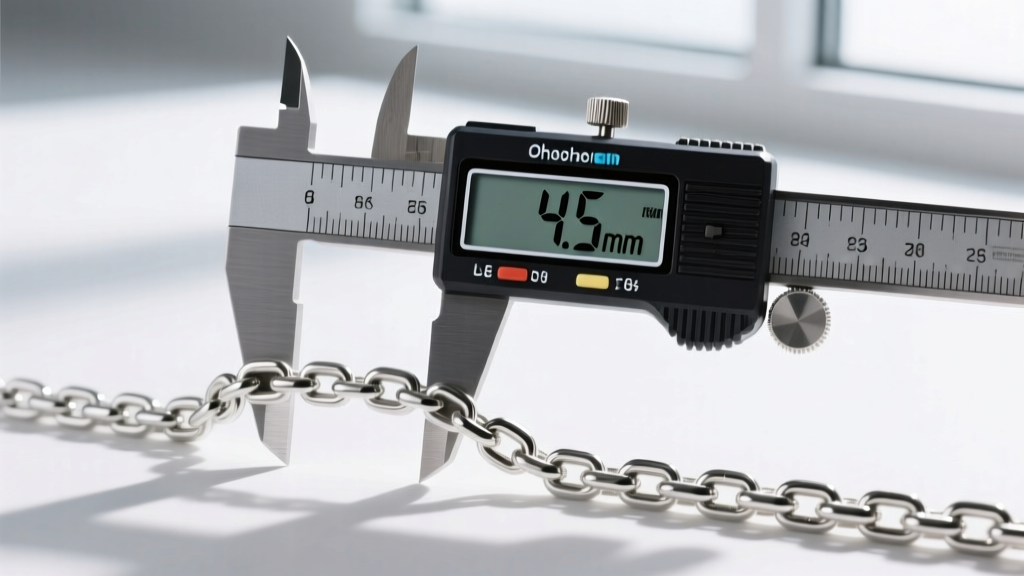
- Digital Calipers (e.g., Neiko 01407A or Mitutoyo 500-196-30): Essential for measuring chain width and clasp thickness. A difference of just 0.5mm in a Cuban link chain drastically alters the gram weight and, consequently, the fair market value.
- Jeweler's Loupe (10x or 20x magnification): While not a measuring tool for length, a loupe is mandatory for reading the microscopic hallmarks (e.g., '14K', '925', or maker's marks) stamped on the clasp or jump ring to verify the material grade before calculating value.
- Digital Pocket Scale (0.01g precision): Crucial for the final step of value assessment: weighing the piece to calculate the exact melt value versus the retail markup.
Assessing Value: When to Pay for Length vs. Width
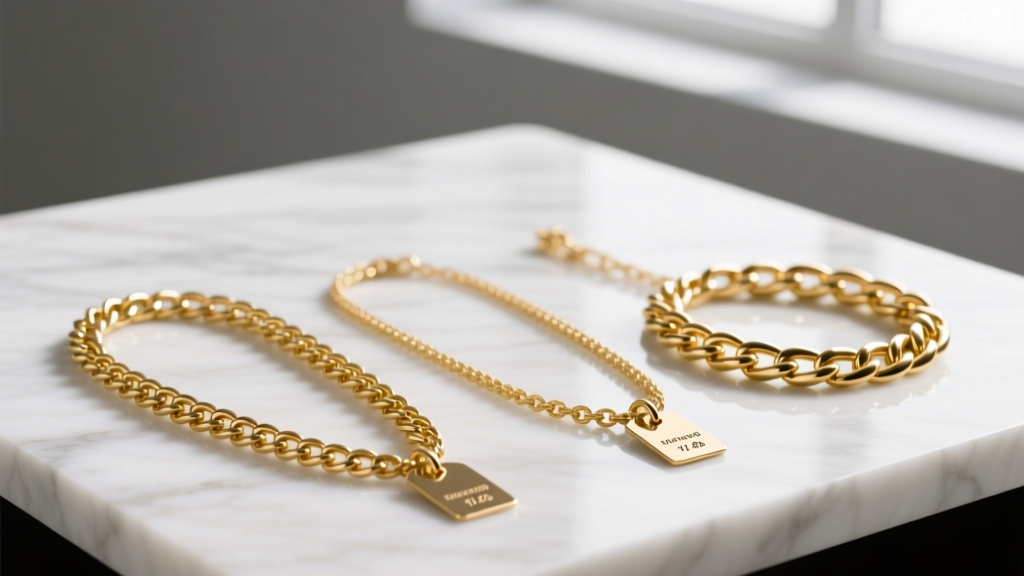
A common trap for budget-conscious buyers is prioritizing length over width, or vice versa, without understanding the structural implications. If your goal is visual impact on a budget, a longer, thinner chain (e.g., 22 inches at 1.2mm) will give you the 'layered' or 'opera' look for less money, but it is highly susceptible to snapping under the weight of even a modest pendant. The tensile strength of a 1.2mm solid gold chain is generally limited to pendants weighing under 3 grams.
Conversely, if you are evaluating a heavy-looking chain, you must use your digital scale and calipers to check for 'hollow' or 'semi-solid' manufacturing. For example, a 20-inch, 5mm wide solid 14k gold Cuban link chain should weigh approximately 38 to 45 grams. If you measure the width at 5mm, the length at 20 inches, but the scale reads just 8 grams, you are looking at a hollow electroformed chain. While hollow chains offer a massive visual footprint for a lower budget, their value retention is poor, and they are nearly impossible to repair if crushed or kinked. Always calculate the 'Price Per Gram' (Retail Price ÷ Total Gram Weight) to compare the true premium you are paying for the brand or craftsmanship versus the raw material.
Final Checklist Before You Buy
Before finalizing your purchase, run through this quick measurement and value checklist:
- Verify the exact millimeter width using calipers or confirmed spec sheets, not just descriptive words like 'chunky' or 'dainty'.
- Measure your own neck with a fiberglass tape and add 2 to 4 inches to determine your ideal base length, avoiding costly return fees.
- Check the clasp-to-jump-ring ratio. Ensure the clasp is proportional; a massive lobster clasp on a delicate 1mm chain will cause the necklace to constantly flip backward, ruining the drape and causing premature wear on the front links.
- Calculate the price-per-gram for solid metal pieces to ensure the retail markup aligns with current precious metal spot prices and reasonable fabrication costs.
Mastering how to measure a necklace transforms you from a passive consumer into an informed investor. By focusing on exact dimensions, structural weight, and proportional harmony, you ensure that every dollar of your jewelry budget is spent on lasting quality and true value.


