How to Wear a Squash Blossom Necklace: Styling & Buying Guide
Learn how to wear a squash blossom necklace effortlessly. Our guide covers turquoise grades, silver weight, and authentic Native American maker hallmarks.

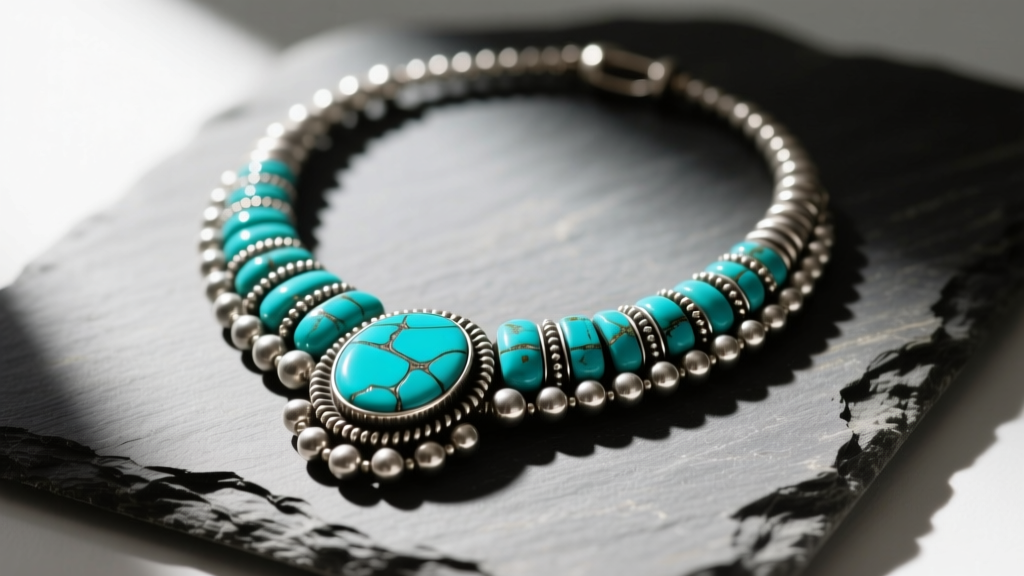
The Anatomy of a Heritage Masterpiece
Before mastering how to wear a squash blossom necklace, it is essential to understand its rich architectural anatomy. Originating in the late 19th century among Navajo (Diné) silversmiths, this iconic piece of Southwestern jewelry is a masterclass in metalwork and lapidary art. According to the Smithsonian National Museum of the American Indian, the design is a brilliant synthesis of Indigenous craftsmanship and Moorish-Spanish influences brought to the Americas by early colonizers.
A traditional squash blossom necklace consists of three primary components:
- The Naja: The central, crescent-shaped pendant. Originally derived from Moorish horse bridle ornaments meant to ward off the evil eye, the Naja is the anchor of the piece and often features the largest turquoise cabochon.
- The Blossoms: Flanking the Naja are the namesake "squash blossoms." Historically, these were inspired by the pomegranate motifs found on Spanish silver buttons and saddle trappings. They are typically crafted from two pieces of domed silver soldered together, flaring at the base.
- The Silver Beads: Interspersed between the blossoms are perfectly round, hand-hammered sterling silver or coin silver beads that provide the necklace's flexible drape and substantial weight.
What to Look For: Materials and Authenticity
When investing in a piece that can easily weigh between 150 and 350 grams, verifying material integrity and legal authenticity is non-negotiable. The Indian Arts and Crafts Board (IACB) strictly enforces the Indian Arts and Crafts Act of 1990, making it illegal to sell mass-produced overseas knockoffs as "Native American." Always look for a documented artist hallmark, not just a generic "925" stamp, which is frequently used on imported fakes.
Turquoise Grades and Origins
The value and longevity of your necklace depend heavily on the turquoise used. As detailed in the Gemological Institute of America's (GIA) turquoise guide, the stone's porosity and matrix dictate its grade:
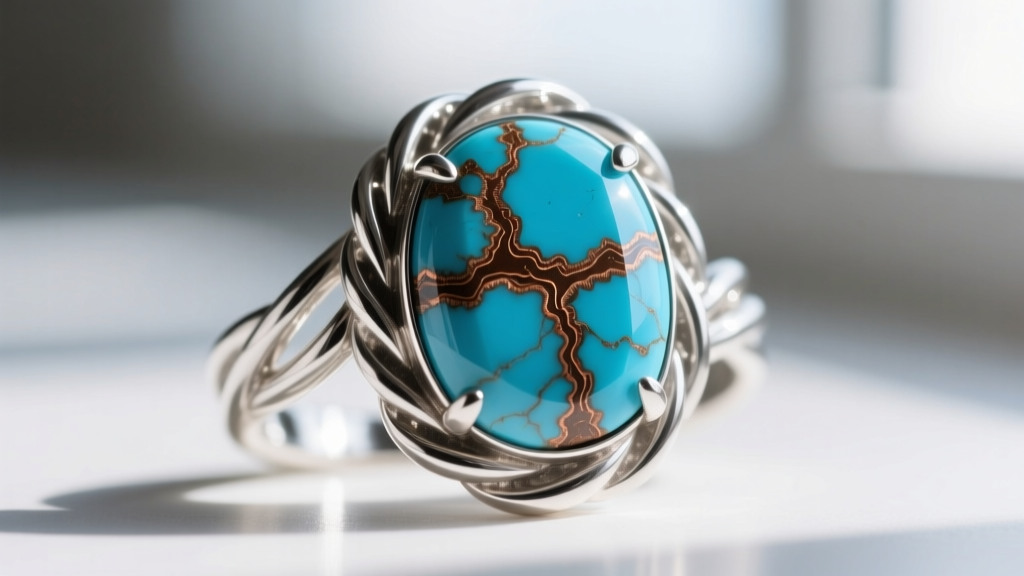
- Natural, Untreated (High Grade): Sourced from mines like Kingman or Royston. These stones feature deep blues or greens with striking brown or black copper/iron matrices. They are rare, expensive, and require careful wear to prevent "sugaring" (a chalky degradation caused by absorbing skin oils).
- Stabilized Turquoise: A completely legitimate and common practice where softer, lower-grade stones are treated with a clear epoxy resin. This prevents color shifting from skin oils and increases durability. Many mid-century Zuni and Navajo pieces utilize stabilized stones like Sleeping Beauty turquoise to achieve a uniform, vibrant sky-blue aesthetic.
- Block/Reconstituted (Avoid): Made from turquoise dust mixed with dyes and plastics. This is prevalent in cheap tourist-trap jewelry and holds zero investment value.
Silver Purity and Construction Methods
Authentic pieces are crafted in either .925 Sterling Silver or vintage Coin Silver (.900 purity, melted down from pre-1960s US coins). Coin silver has a slightly softer, warmer gray patina that collectors highly prize. Examine the beads and blossoms: hand-stamped repoussé work will show slight, beautiful asymmetries, whereas perfectly uniform, laser-cut blossoms indicate modern, non-traditional manufacturing.
How to Wear a Squash Blossom Necklace: Styling Frameworks
Learning how to wear a squash blossom necklace without letting it overwhelm your outfit requires an understanding of visual weight and neckline geometry. In 2026, the fashion landscape has shifted toward "heritage maximalism"—anchoring ultra-clean, minimalist silhouettes with one massive, historically significant piece of jewelry.
Neckline Pairings and Visual Balance
Because a traditional Naja pendant drops significantly lower than standard necklaces, and the collar beads sit thick against the neck, your neckline must provide a "canvas" for the silverwork.
| Neckline Type | Suitability | Styling Notes |
|---|---|---|
| Deep V-Neck | Excellent | Mimics the downward point of the Naja pendant, elongating the torso and framing the silverwork perfectly. |
| Scoop Neck | Very Good | Provides a wide, open canvas that accommodates the thick collar of silver beads without bunching. |
| Crew Neck / T-Shirt | Fair | Can cause the Naja to flip awkwardly. Best reserved for casual, vintage band-tee juxtapositions. |
| Turtleneck / High Collar | Poor | The thick silver beads will sit awkwardly over the fabric fold, causing discomfort and hiding the necklace's drape. |
| Denim Jacket (Open) | Excellent | The ultimate classic pairing. The indigo denim provides high contrast against oxidized or polished sterling silver. |

Occasion and Proportion Rules
For formal or evening events, opt for a "petit point" or "needlepoint" Zuni squash blossom. These feature smaller, intricately clustered turquoise stones that read as refined and delicate from a distance. For daytime, festivals, or bold fashion statements, a heavy Navajo sandcast piece with large, unpolished turquoise cabochons commands the room. Remember the rule of subtraction: if you are wearing a 250-gram squash blossom, skip the heavy statement earrings. Let the Naja be the undisputed focal point.
Pricing Tiers and Investment Value
Understanding the market prevents costly mistakes. Pricing is dictated by age, artist provenance, material quality, and weight.
- The "Tourist" Tier ($50 - $250): Lightweight, hollow silver beads, block turquoise, and no artist hallmark. Often imported. Avoid these if you are seeking authentic heritage jewelry.
- Contemporary Native American Artists ($800 - $3,500): Handcrafted by verified Navajo, Zuni, or Santo Domingo artisans. Features genuine .925 sterling silver and natural or high-grade stabilized turquoise. These are wearable investments that hold their value exceptionally well.
- Vintage and Museum Quality ($4,000 - $15,000+): Pieces dating from the 1890s to the 1960s (often called the "Fred Harvey era"). Characterized by coin silver, hand-filed bezels, and old-mine turquoise. Provenance and a recognized maker's mark (like those of early Navajo master silversmiths) drive these into the realm of serious collector assets.
Care and Maintenance for Heavy Silver
A squash blossom necklace is an heirloom that requires specific care to survive generations. The sheer weight of the piece means stress is concentrated on the stringing wire and the Naja's bail.
- Inspect the Stringing: Authentic vintage pieces are often strung on braided leather or cotton twine. If you wear the piece frequently, have a jeweler restring it on modern, clear, heavy-duty beading wire (like Soft Flex) to prevent catastrophic snapping.
- Never Use Ultrasonic Cleaners: Ultrasonic vibrations will easily fracture natural turquoise and loosen the glue in stabilized stones. Furthermore, harsh chemical silver dips will strip the natural patina and leave the turquoise porous and discolored.
- Tarnish Management: Sterling silver naturally oxidizes. To maintain the contrast in stamped designs, use a treated polishing cloth (like a Sunshine cloth) only on the raised silver areas, avoiding the turquoise entirely. Store the necklace flat in an anti-tarnish bag to prevent the heavy beads from kinking the stringing material over time.
By respecting the history, verifying the materials, and styling the piece with intentional minimalism, your squash blossom necklace will transition from a mere accessory to a wearable piece of American art history.


