How Many Inches of Necklace You Need for 2026 Layering
Master the art of layering with our precise guide on how many inches of necklace you need. Discover the 2026 formulas for lengths, gauges, and pendants.


The evolution of necklace layering has shifted dramatically as we move through 2026. Gone are the days of haphazardly throwing on three random chains and hoping they don't knot into a metallic bird's nest. Today's styling demands architectural precision, an understanding of visual weight, and a strict adherence to the mathematics of jewelry design. When stylists and collectors discuss the perfect stack, the most critical variable they evaluate is exactly how many inches of necklace are required to achieve a harmonious, tangle-free cascade. Whether you are working with delicate 14k gold cable chains or substantial oxidized silver rope chains, understanding the geometry of your neck and the physics of chain weaves is non-negotiable.
In this comprehensive style and trend analysis, we break down the exact formulas for calculating necklace lengths, the impact of pendant drops on visual spacing, and the metallurgical realities of chain friction. According to recent trend forecasts highlighted by Vogue, the modern layering aesthetic relies heavily on intentionality—mixing disparate chain widths while maintaining rigid, mathematically spaced length intervals.
The Anatomy of Necklace Lengths: A 2026 Measurement Matrix
Before calculating your layers, you must understand the baseline terminology of necklace lengths. The jewelry industry categorizes chains based on where they fall on the average female torso (approximately 5'4" to 5'6"). However, the true secret to layering isn't just the base length; it is the chain gauge (thickness) that dictates how the inches behave when draped.
| Base Length (Inches) | Style Name | Ideal Chain Gauge | Primary Neckline Pairing | 2026 Trend Status |
|---|---|---|---|---|
| 14" - 15" | Choker / Collar | 1.5mm - 3.0mm | Off-shoulder, Scoop | High (Y2K Revival) |
| 16" - 17" | Princess | 1.0mm - 2.5mm | V-Neck, Button-down | Staple (Core Layer) |
| 18" - 20" | Matinee | 2.0mm - 4.5mm | Crew, Turtleneck | Rising (Oversized Pendants) |
| 22" - 24" | Opera | 3.0mm - 6.0mm | Deep-V, Plunging | Niche (Statement Stacks) |
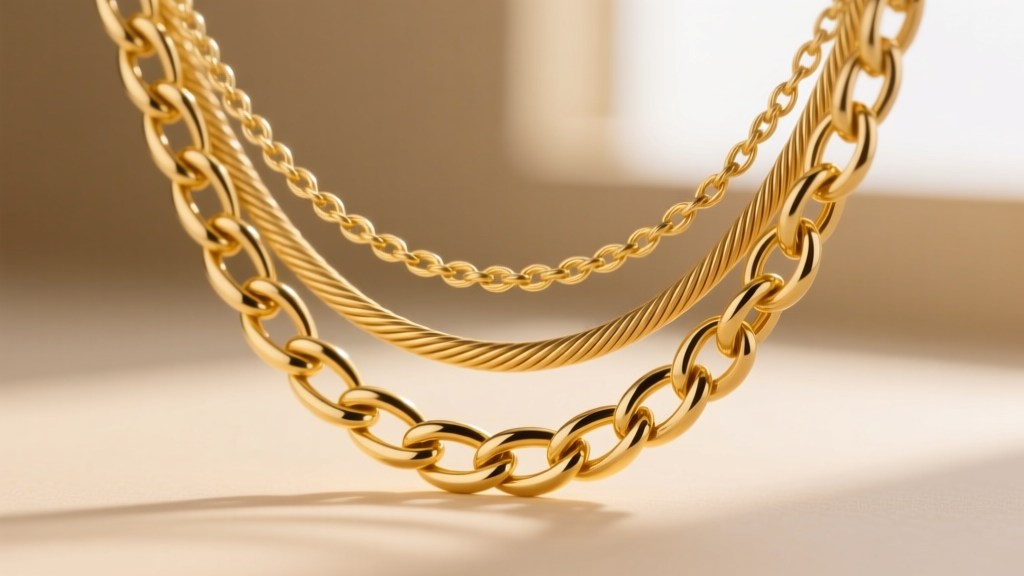
When building a standard three-piece stack, the golden rule is to maintain a minimum two-inch gap between each layer. For example, a 14-inch choker, a 16-inch princess chain, and an 18-inch matinee chain provide the perfect visual separation, ensuring that the clasps and links do not compete for the same physical space on the décolletage.
The Geometry of the Drop: Calculating Pendant Interference
The most common mistake consumers make when determining how many inches of necklace to buy is ignoring the "pendant variable." A chain's listed length only measures the metal links from clasp to clasp. It does not account for the vertical drop of a pendant, which fundamentally alters the visual termination point of the necklace.
The Visual Length Formula
To calculate the true visual length of a necklace with a pendant, use this formula: Base Chain Length + (Pendant Height / 2). Because a pendant hangs from the center point of the chain, only half of its total vertical height contributes to the downward drop.
- Scenario A: You have a 16-inch chain with a 10mm (approx. 0.4 inch) round diamond solitaire pendant. The visual drop is 16.2 inches.
- Scenario B: You have a 16-inch chain with a 25mm (approx. 1 inch) elongated teardrop locket. The visual drop is 16.5 inches.
If you attempt to layer a second chain at 17 inches beneath Scenario B, the chains will physically overlap, leading to immediate tangling and visual clutter. For 2026 layering, experts recommend a minimum visual gap of 1.5 inches between the bottom of the top pendant and the resting point of the chain below it. Therefore, if your first layer drops to 16.5 inches, your second layer must be at least 18 inches.
Metallurgy and Weave: Why Your Chains Tangle
Length is only half the battle; the physical weave of the metal dictates how those inches interact in motion. Tangling is caused by micro-friction between chain links. Understanding the friction coefficients of different weaves will save you hours of frustration.
According to metallurgical insights from the Gemological Institute of America (GIA), the hardness and finish of gold alloys affect how smoothly chains glide against one another. High-polish 14k yellow gold creates less friction than brushed or oxidized sterling silver. However, the weave geometry is the primary culprit in knotting.
Chain Weave Compatibility Guide
- Cable & Figaro Chains: These feature flat or slightly rounded, uniform links. They lay relatively flat against the skin and have a low friction profile. They are ideal base layers.
- Snake & Herringbone Chains: These are fluid, continuous-surface chains. While beautiful, they act like magnets for hair, lint, and other chains. Never layer a snake chain with a rope chain, as the rope's twisted grooves will catch the snake chain's smooth scales, creating permanent kinks.
- Rope & Curb Chains: These have high-relief, twisted, or interlocking geometric patterns. They should be used as the outermost, longest layer in a stack to prevent them from acting as a "grater" against more delicate inner layers.
The Hardware Revolution: Multi-Port Clasps and Spacers
If you struggle with maintaining the exact inches of necklace separation throughout a busy day, 2026 has seen a massive surge in the popularity of multi-port clasps and necklace spacers. These hardware solutions solve the geometry problem at the nape of the neck.
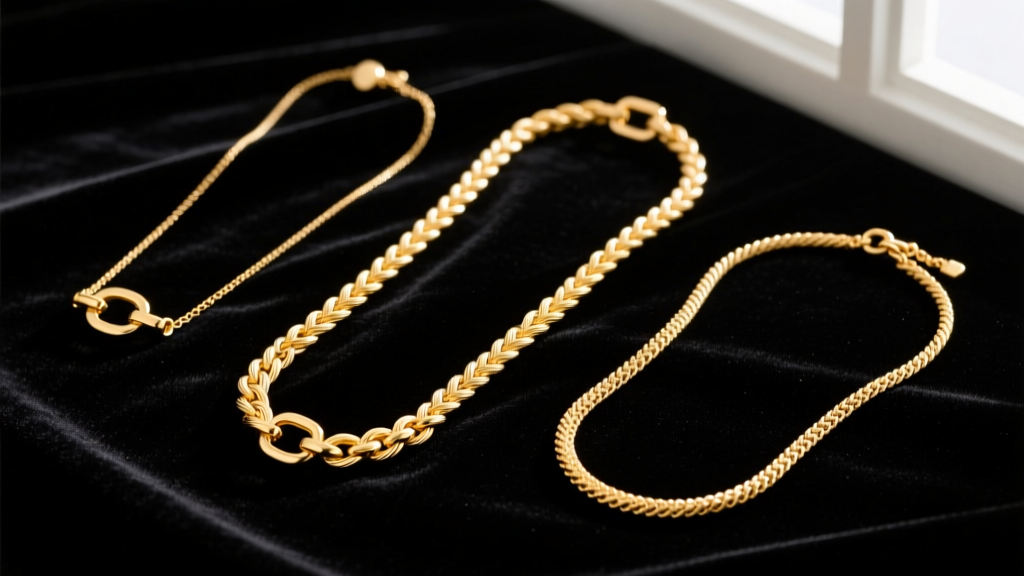
A multi-port clasp is a single, secure locking mechanism (often a reinforced lobster or a new magnetic neodymium clasp) that features two to three integrated O-rings. By threading your 14", 16", and 18" chains through a single multi-port clasp, you lock their spatial relationship at the back of the neck. This prevents the chains from sliding past one another, ensuring that the precise inches of separation you calculated in the front remain perfectly intact, even during high-movement activities.
When purchasing spacers, always verify the internal diameter of the O-rings. A standard 1.2mm cable chain requires an O-ring with an internal diameter of at least 2.5mm to glide smoothly without pinching the links. If you are using a 4.0mm Cuban link, you must source a heavy-duty spacer with 5.5mm rings, otherwise, the stress will warp the spacer's solder joints over time.
Neckline Pairing Matrix: Matching Inches to Fabric
The final step in mastering your stack is aligning your calculated inches with your wardrobe. The neckline of your garment serves as the frame for your jewelry. Here is the definitive 2026 pairing matrix:
1. The Crew Neck (T-Shirts & Sweaters)
Crew necks create a high, curved boundary. To avoid a cramped look, bypass the 14-inch choker entirely. Start your stack at 16 inches (resting just below the fabric hem), followed by an 18-inch chain with a medium-weight pendant, and finish with a 20-inch rope chain. This creates a cascading effect that elongates the torso.
2. The V-Neck & Button-Down
V-necks naturally draw the eye downward, mimicking the shape of a pendant. This is the ideal canvas for a tight, three-layer stack. Utilize a 14-inch delicate choker, a 15.5-inch princess chain with a small solitaire, and a 17-inch chain with a heavier, geometric drop that sits precisely in the center of the V, mirroring the garment's angles.
3. The Turtleneck & High Mock Neck
High necklines require dramatic length to prevent the jewelry from looking suffocating. The shortest chain in your stack should be no less than 20 inches. Layer a 20-inch heavy curb chain with a 24-inch opera-length chain featuring a substantial medallion. The visual weight of the metal is necessary to stand out against the expanse of opaque fabric.
Final Thoughts on Precision Styling
Ultimately, determining how many inches of necklace you need is an exercise in spatial awareness and material science. By respecting the two-inch gap rule, calculating for pendant drop, and intelligently mixing chain weaves to minimize friction, you elevate your jewelry from a mere accessory to a masterclass in personal styling. As gold prices continue to influence the market in 2026, investing in solid 14k or 18k pieces with precise, intentional lengths ensures your collection remains both a financial asset and a sartorial triumph.


