Best Metals for Initial Necklaces: A Material Durability Guide
Discover which metals last longest for initial necklaces. We compare gold, silver, platinum, and titanium for engraving, tarnish, and daily wear.

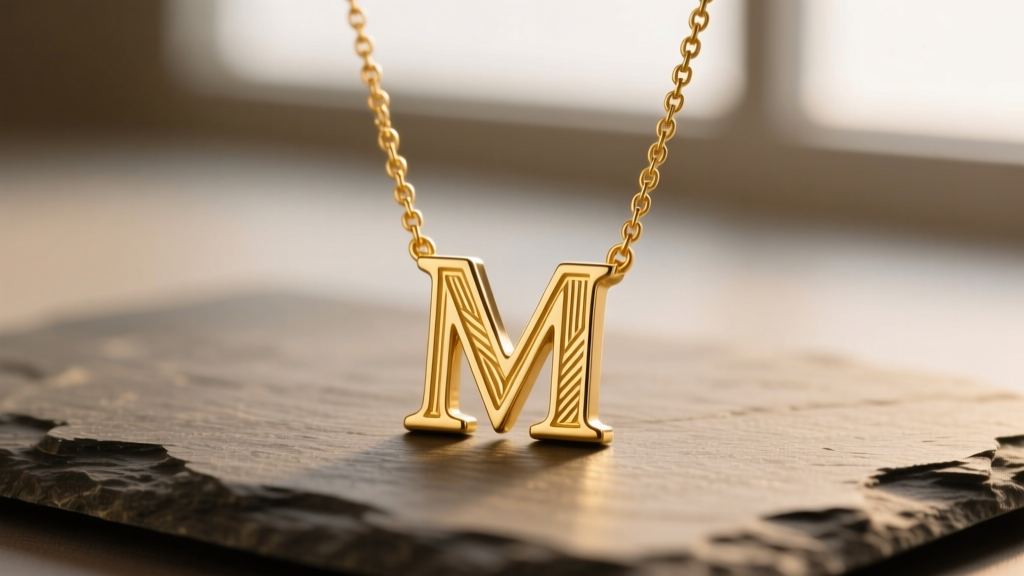
Why Metal Choice Dictates the Lifespan of Initial Necklaces
Initial necklaces are deeply personal artifacts, often worn daily as a tribute to a loved one, a child, or one's own identity. However, because these pendants rely on flat or slightly domed surfaces to showcase their lettering, the metallurgical properties of the chosen metal dictate not only the piece's longevity but also the legibility of the engraving over time. A poorly chosen alloy will scratch, tarnish, or warp, eventually obscuring the very letter it was meant to display.
According to the Gemological Institute of America (GIA), the alloy composition of precious metals drastically alters their Vickers hardness (HV) and malleability. When selecting initial necklaces, you must balance the prestige of the metal with its practical resistance to friction, environmental oxidation, and the specific engraving technique required to carve the lettering. This guide breaks down the material science behind the most popular metals used for initial pendants and chains.
The Big Four: Material Properties Compared
14k and 18k Solid Gold (The Engraver's Favorite)
Gold remains the undisputed king of personalized jewelry, but not all karats are created equal. Pure 24k gold is far too soft (approx. 25 HV) for daily wear; a simple fingernail scratch could mar the surface of an initial pendant. Therefore, jewelers alloy gold with copper, silver, and zinc.
- 14k Gold (58.5% pure gold): With a Vickers hardness of roughly 130-150 HV, 14k gold is the optimal choice for everyday initial necklaces. It is hard enough to resist micro-scratches that can blur shallow engravings, yet malleable enough for master jewelers to perform deep hand-engraving.
- 18k Gold (75% pure gold): Softer (approx. 110-125 HV) and richer in color, 18k gold offers a warmer, more luxurious backdrop for enamel-filled initial pendants. However, it will develop a soft patina of micro-scratches faster than 14k gold.
Expert Note on White Gold: White gold is alloyed with nickel or palladium and plated with rhodium. As the rhodium wears off the high-friction areas of the pendant, the underlying yellowish-gray alloy is exposed, which can ruin the visual contrast of dark-enamel filled engravings.
Sterling Silver (The High-Maintenance Classic)
Sterling silver (92.5% silver, 7.5% copper) is highly affordable and offers a brilliant, reflective canvas for laser engraving. However, the copper content makes it highly susceptible to oxidation. When exposed to hydrogen sulfide in the air and the natural acids in human sweat, sterling silver forms silver sulfide—a dark tarnish.
Interestingly, for initial necklaces, this tarnish can be a double-edged sword. If the initial is deeply engraved, tarnish will naturally accumulate in the grooves of the letter, creating a high-contrast, antique effect that actually makes the initial more legible. However, the flat surfaces of the pendant will require regular polishing with a jeweler's cloth to maintain their shine.
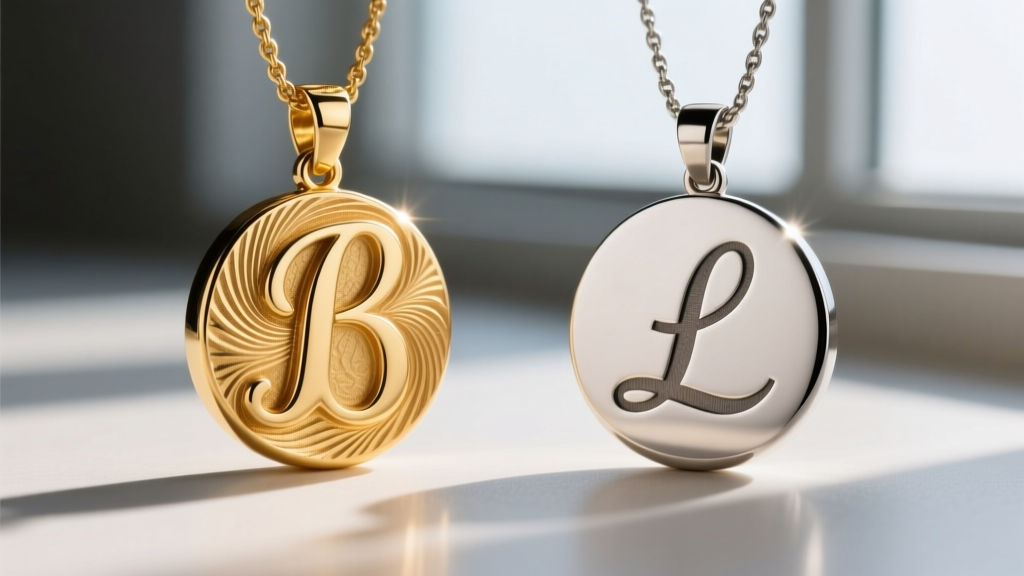
Platinum (The Indestructible Heirloom)
Platinum (typically 95% pure, alloyed with 5% ruthenium or iridium) is incredibly dense and heavy. Unlike gold, which loses microscopic particles of metal when scratched, platinum merely displaces. Over decades of wear, an initial necklace crafted from platinum will develop a soft, frosted patina rather than thinning out. Platinum is exceptionally prized for hand-engraving; its density allows the graver tool to carve deep, crisp, light-catching grooves without tearing the metal.
Titanium and Stainless Steel (The Budget Workhorses)
Grade 5 Titanium and 316L Stainless Steel are modern marvels of durability. They are entirely impervious to tarnish, sweat, and water. However, their extreme hardness (Steel is approx. 200-250 HV; Titanium is approx. 350 HV) means they cannot be hand-engraved. Initials on these metals must be etched using high-powered fiber lasers. While the initial will never fade, the engraving is often shallow (0.001 to 0.005 inches deep) and lacks the three-dimensional depth and light-reflection of hand-carved precious metals.
Material Comparison Chart: Hardness, Tarnish, and Engraving Depth
| Metal Type | Vickers Hardness (HV) | Tarnish Risk | Ideal Engraving Method | Avg. Price Range (Pendant) |
|---|---|---|---|---|
| 14k Solid Gold | 130 - 150 | None | Hand or Laser | $150 - $400 |
| 18k Solid Gold | 110 - 125 | None | Hand or Laser | $250 - $600 |
| Sterling Silver | 60 - 75 | High | Laser or CNC | $30 - $90 |
| 950 Platinum | 110 - 130 | None | Hand Engraving | $400 - $1,200 |
| 316L Steel | 200 - 250 | None | Fiber Laser Only | $15 - $45 |
Chain Pairings: Matching the Pendant Metal to the Chain
A critical mistake many buyers make when purchasing initial necklaces is mixing incompatible metals between the pendant and the chain. This introduces the risk of galvanic corrosion.
The Science of Galvanic Corrosion
When two dissimilar metals (like a sterling silver initial pendant and a white gold chain) come into contact in the presence of an electrolyte (human sweat), a microscopic electrochemical reaction occurs. The less 'noble' metal—in this case, the sterling silver—will act as an anode and corrode at an accelerated rate. The bail (the loop connecting the pendant to the chain) is where this friction and moisture accumulate, eventually leading to structural failure and the loss of your pendant.
The Golden Rule of Pairing: Always match your initial pendant to a chain of the exact same metal and karat. If you must mix metals for a layered aesthetic, ensure there is a physical barrier (like a silicone or rubber o-ring spacer) at the bail, or restrict the mixed metals to separate chains that do not share a friction point at the clasp.
Skin Sensitivities and Nickel Allergies in Initial Pendants
Because initial pendants rest directly against the sensitive skin of the décolletage, metal biocompatibility is paramount. According to the Mayo Clinic, nickel allergy is one of the most common causes of allergic contact dermatitis.
- White Gold: Often alloyed with nickel to achieve its silver color. If you have sensitive skin, avoid 14k and 18k white gold initial pendants unless they are explicitly labeled 'nickel-free' (alloyed with palladium instead).
- Surgical Steel (316L): While it contains nickel, the nickel is tightly bound within the crystalline structure of the steel and rarely leaches out, making it generally safe for most people with mild sensitivities.
- Titanium and Platinum: Both are entirely hypoallergenic and biocompatible. They are the safest choices for individuals with severe contact dermatitis.
Engraving Techniques: How Metal Dictates the Font
The metal you choose will directly limit the typography available for your initial necklace. Jewelers of America notes that traditional hand-engraving relies on a hardened steel graver tool slicing through the metal. This technique creates deep, V-shaped grooves that catch the light beautifully, but it requires a softer, malleable metal like 14k/18k gold or platinum.
Conversely, fiber laser engraving vaporizes the metal surface. Lasers can achieve incredibly intricate, micro-scoped serif fonts and even photographic halftones on hard metals like titanium and steel. However, laser etching leaves a flat-bottomed, matte-finished groove that lacks the sparkling depth of a hand-carved initial. If you want a classic, light-catching script font, choose gold or platinum. If you want a modern, minimalist, micro-font, choose laser-etched steel or titanium.
Final Verdict: Which Metal Should You Choose?
There is no single 'best' metal for initial necklaces; the right choice depends entirely on your lifestyle and aesthetic goals. For a generational heirloom that will feature deep, hand-carved lettering, 14k or 18k solid yellow gold remains the superior choice, offering the perfect balance of hardness and engraving malleability. For those seeking a modern, waterproof, and budget-friendly option that will never tarnish in the shower or gym, a 316L stainless steel pendant with a fiber-laser etched initial is virtually indestructible. By understanding the metallurgical properties of your jewelry, you ensure that the initial you wear remains as crisp and meaningful decades from now as the day it was carved.


