Interlocking Heart Necklace Anatomy: A Technical Deep Dive
Discover the metallurgy, structural engineering, and chain mechanics behind a high-quality interlocking heart necklace in this expert technical guide.


The Structural Engineering of Interlocking Hearts
The interlocking heart necklace is a staple of romantic jewelry, but beneath its sentimental surface lies a complex exercise in micro-engineering. When two separate metal loops are permanently intertwined, the margins for error are measured in fractions of a millimeter. Unlike standard pendants that hang freely from a bail, interlocking designs feature a fixed kinetic joint that must endure constant multidirectional friction.
The vast majority of these pieces are created using the lost-wax casting method. In modern 2026 jewelry manufacturing, wax models are typically milled or 3D-printed with a precise clearance gap between the two hearts. This gap is critical. If the tolerance is less than 0.15mm, the natural shrinkage of the metal during the cooling phase (14k gold, for instance, shrinks by approximately 1.25% to 1.5% from liquid to solid state) will cause the hearts to fuse or bind tightly. If the gap exceeds 0.30mm, the pendant will exhibit excessive play, leading to an audible clink and accelerated kinetic wear at the contact points.
"A master jeweler knows that the interlock point is not just a design feature; it is a mechanical hinge. The surface finish inside that hidden gap must be mirror-polished before the final assembly, or the microscopic casting porosity will act like sandpaper against the adjoining heart."
For high-end iterations, some fabricators bypass casting entirely, opting instead to laser-sinter precious metal powders or hand-fabricate the hearts from stamped sheet metal. Sheet metal fabrication yields a denser, more uniform grain structure, significantly increasing the tensile strength of the interlocking loops.
Metallurgy and Material Grades
The choice of metal dictates the longevity of the interlocking joint. Because the two hearts rub against each other with every movement of the wearer, the Vickers Hardness (HV) and wear resistance of the alloy are paramount. Soft metals will quickly develop flat spots at the friction points, eventually compromising the structural integrity of the loop.
| Material | Vickers Hardness (HV) | Density (g/cm³) | Wear Resistance at Joint | Tarnish / Maintenance |
|---|---|---|---|---|
| 925 Sterling Silver | 65 - 75 HV | 10.36 | Poor (Prone to flattening) | High (Requires frequent polishing) |
| 14k Yellow Gold | 130 - 150 HV | 12.9 - 14.6 | Excellent | Low |
| 18k Yellow Gold | 110 - 125 HV | 15.2 - 15.9 | Good | Low |
| Platinum (950/50 Ru) | 120 - 135 HV | 21.45 | Superior (Work-hardens) | Low (Develops a patina) |
While 18k gold offers a richer color, 14k gold is often the superior technical choice for interlocking pendants due to its higher alloy content (usually copper and silver), which increases the Vickers Hardness. Platinum is exceptionally durable; rather than losing metal mass when scratched, platinum displaces, meaning the interlocking loops will work-harden over time rather than wearing thin.
Bail Design and Chain Integration
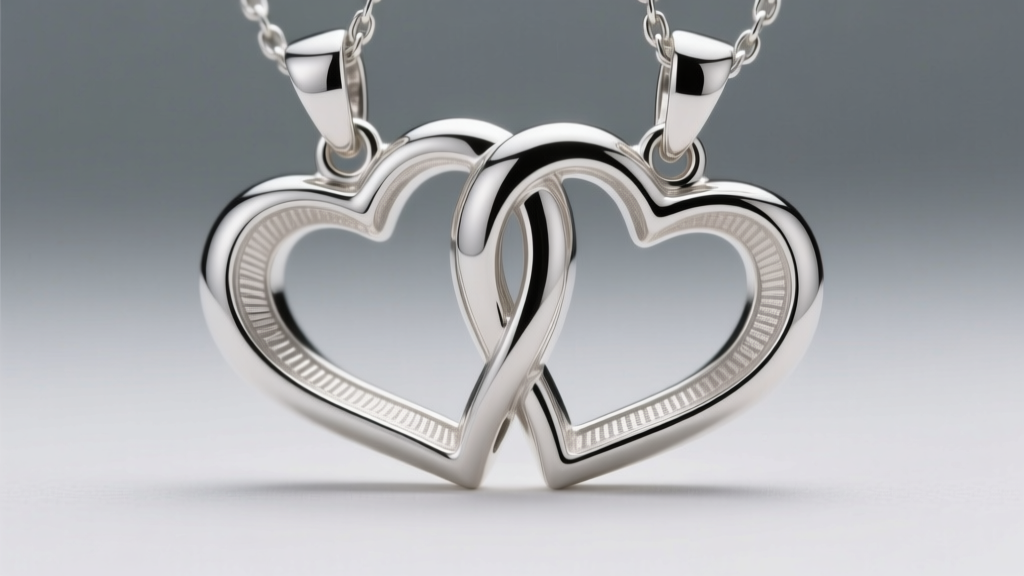
The bail—the component that connects the pendant to the chain—is the most common point of failure in poorly engineered necklaces. In a standard interlocking heart design, the top heart must feature a robust attachment point. Mass-market versions often use a simple soldered jump ring attached to the upper lobe of the top heart. Over time, the friction from the chain saws through the soft solder and the thin metal of the jump ring.
Expert-level designs utilize a hidden integrated bail. This is cast or fabricated as a seamless extension of the top heart's upper curve, creating a hollow, reinforced tunnel for the chain to pass through. This eliminates the jump ring entirely, distributing the kinetic load across a much wider surface area of the precious metal.
When pairing a chain, the rule of thumb is that the chain's width should not exceed 60% of the bail's internal diameter. For a standard integrated bail with a 2.5mm internal clearance, a 1.2mm to 1.5mm box or cable chain is ideal. Box chains are preferred for their flat, interlocking links, which glide smoothly through the bail without the snagging issues common in rope or snake chains.
Clasp Mechanics and Security
An interlocking heart pendant, particularly in 14k gold or platinum, carries significant weight. A standard spring-ring clasp is entirely inadequate for this application; the internal tension spring is weak, and the tiny lever is prone to snapping under the pendulum-like motion of a heavy pendant.
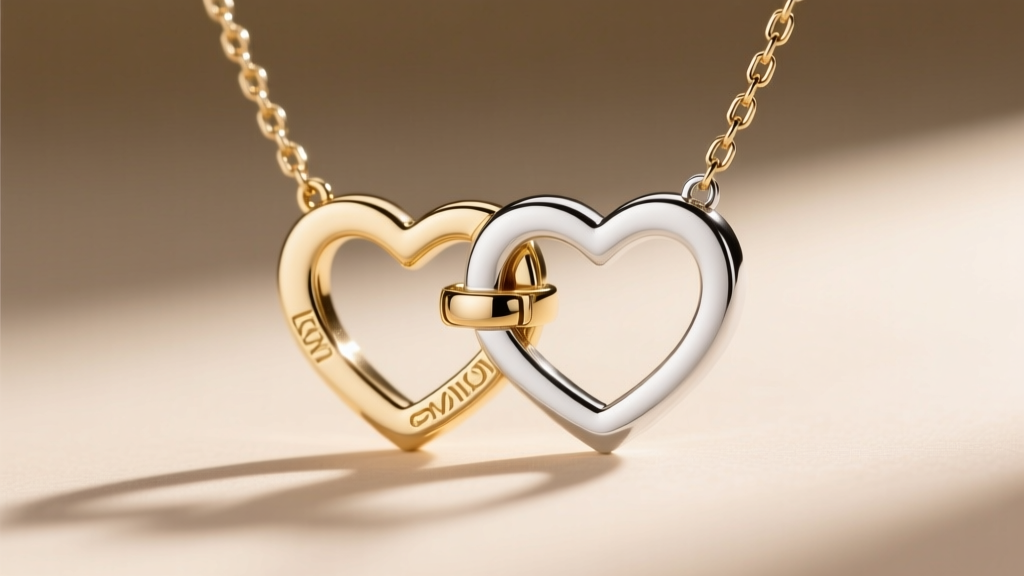
A high-quality interlocking heart necklace must be fitted with a solid-body lobster clasp. Look for clasps that specify an internal spring tension of at least 4.5 Newtons. Furthermore, the end rings (the small circular rings that the clasp hooks onto) must be flash-soldered. An unsoldered split ring will inevitably be pulled open by the weight of the interlocking hearts catching on clothing.
Troubleshooting Common Failure Points
Even with meticulous engineering, interlocking necklaces require specific maintenance protocols. Here is a diagnostic framework for the most common technical failures:
- Friction Wear at the Interlock: If the inner curve of the hearts develops a flat, shiny spot, the metal is thinning. Solution: A jeweler must apply a microscopic layer of hard plating (like rhodium or platinum) to the contact point to act as a sacrificial wear layer.
- Binding or Stiffness: The hearts no longer swing freely. This is usually caused by the accumulation of skin oils, lotions, and microscopic dust in the 0.2mm gap. Solution: Ultrasonic cleaning in a mild alkaline solution, followed by a high-pressure steam blast to clear the tolerance gap.
- Cracked Loop: If one heart cracks near the interlock, never use a traditional butane or oxy-acetylene torch for repair. The ambient heat will melt the adjacent, intertwined heart. Solution: The repair must be performed using a precision laser welder, which localizes the heat to a 0.5mm focal point, leaving the adjoining heart completely unaffected.
Sourcing and Pricing Tiers in the Current Market
Understanding the technical realities of the interlocking heart necklace allows you to navigate the market with a critical eye. According to industry fabrication standards outlined by suppliers like Rio Grande, the cost of precision casting and hand-finishing dictates the final retail price.
Mass-Market Cast ($50 - $150): Typically made of 925 sterling silver or 10k gold. The interlocking gaps are often poorly finished, and the bails are simple soldered jump rings. Expect a lifespan of 2 to 4 years with daily wear before structural thinning occurs.
Boutique Fabricated ($300 - $800): Crafted in 14k or 18k gold with integrated hidden bails, flash-soldered end rings, and mirror-polished internal tolerances. These pieces are engineered for generational wear.
High-Jewelry & Custom ($2,000+): Features platinum or high-karat gold, often incorporating micro-pavé diamonds along the outer edges. The interlocking joints are hand-fitted under magnification to achieve zero-play tolerances, representing the pinnacle of kinetic jewelry engineering.
By prioritizing structural engineering, precise metallurgy, and robust chain integration over mere aesthetic appeal, you ensure that your interlocking heart necklace remains a flawless symbol of connection for decades to come.


