Italy 925 Silver Necklace: Material Properties & Comparisons
Discover the metallurgy, hallmark verification, and material properties of an Italy 925 silver necklace compared to modern alternatives.

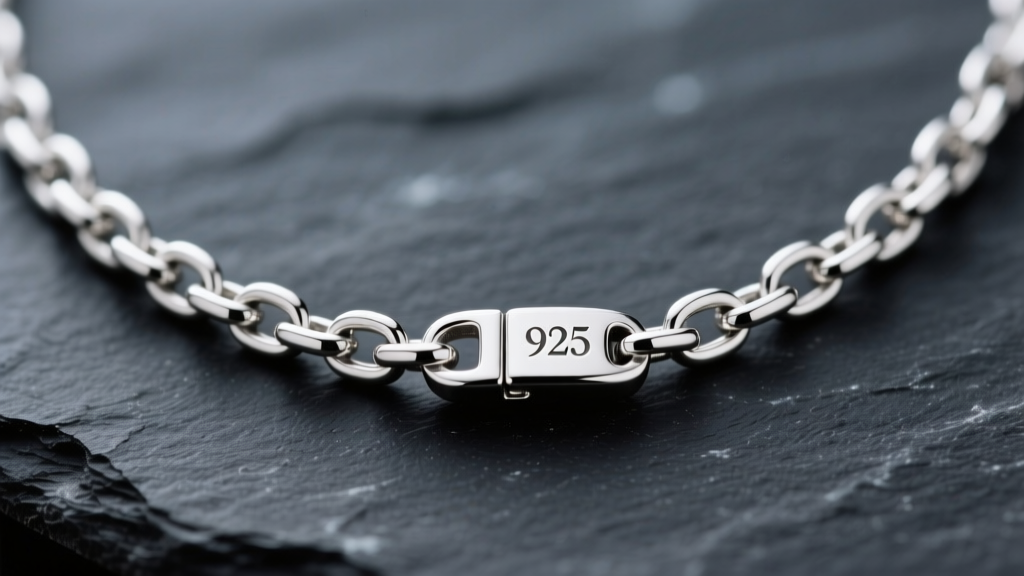
The Metallurgy of an Italy 925 Silver Necklace
When you invest in an Italy 925 silver necklace, you are purchasing a specific metallurgical alloy governed by strict European and Italian assay standards. Pure silver (999 fine silver) possesses a Mohs hardness of just 2.5 to 3, making it far too malleable for daily wear; a pure silver chain would stretch, warp, and break under minimal tensile stress. To solve this, metallurgists created sterling silver, an alloy consisting of exactly 92.5% pure silver and 7.5% secondary metals—traditionally copper.
The addition of copper dramatically increases the tensile strength and durability of the metal, allowing Italian artisans to craft intricate chain weaves like the Figaro, Mariner, and Byzantine links without compromising structural integrity. However, this copper content is also the catalyst for the material's primary vulnerability: oxidation. According to the Gemological Institute of America (GIA), it is the copper alloy, not the silver itself, that reacts with environmental sulfur to create silver sulfide (tarnish).
In recent years, premium Italian jewelers have begun utilizing Argentium silver, a modern alloy that replaces some of the copper with germanium. This adjustment significantly increases tarnish resistance and eliminates firescale during the soldering process, though traditional 925 sterling remains the industry standard for classic Italian chains.
Material Showdown: Italian Sterling vs. Common Alternatives
To understand the true value of an Italy 925 silver necklace, we must compare its physical properties and market positioning against other popular necklace materials. Below is a comprehensive breakdown of how sterling silver stacks up against stainless steel, brass, and gold vermeil.
| Material | Composition | Tarnish Resistance | Skin Reactivity | Average Price (20g Chain) |
|---|---|---|---|---|
| Italy 925 Silver | 92.5% Ag, 7.5% Cu | Moderate (Requires care) | Low (Hypoallergenic) | $85 - $160 |
| 316L Stainless Steel | Iron, Chromium, Nickel | High (Will not tarnish) | Moderate (Nickel allergies) | $25 - $50 |
| Raw Brass | Copper, Zinc | Low (Oxidizes rapidly) | High (Turns skin green) | $15 - $35 |
| Gold Vermeil | 925 Silver base + 2.5µm Gold | High (Until plating wears) | Low (Depends on karat) | $120 - $250 |
While 316L stainless steel wins on pure maintenance-free durability, it lacks the intrinsic melt value, the luxurious weight, and the light-reflective qualities of sterling silver. Brass is largely a fast-fashion material that will inevitably cause contact dermatitis or green skin discoloration due to rapid copper oxidation. Gold vermeil offers the look of gold with the durability of silver, but the plating will eventually wear away, revealing the 925 core beneath.
Tarnish Mechanics and Environmental Failure Modes
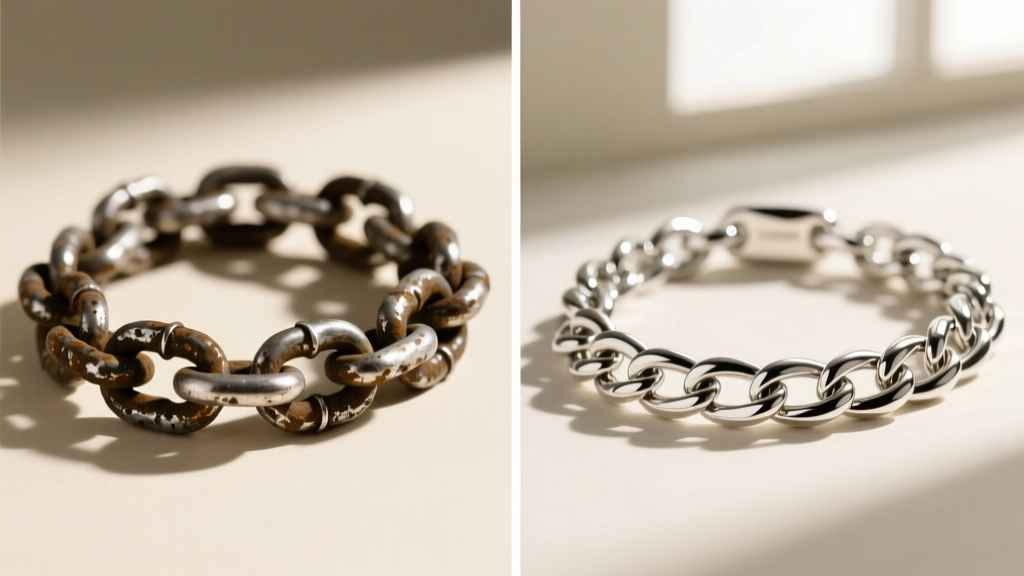
The most common complaint regarding sterling silver is tarnish. However, tarnish is not a defect; it is a predictable chemical reaction. Silver sulfide ($Ag_2S$) forms when the copper in the alloy is exposed to hydrogen sulfide ($H_2S$) in the air. This reaction is severely accelerated by specific environmental failure modes:
- High Humidity: Environments with relative humidity above 60% act as a catalyst, speeding up the oxidation process exponentially.
- Skin pH and Cosmetics: Individuals with highly acidic sweat (low pH) or those who wear sulfur-based skincare products (like acne treatments containing sulfur) will notice their Italy 925 silver necklace darkening within hours of wear.
- Chlorine and Saltwater: Swimming pools and ocean water cause rapid pitting and microscopic surface corrosion in sterling silver, leading to a dull, greyish finish that is difficult to polish out.
To combat this, many high-end Italian manufacturers apply a micro-thin layer of rhodium plating over the finished chain. Rhodium, a platinum-group metal, provides a brilliant, chrome-like finish and acts as an impermeable barrier against sulfur. However, this plating will eventually wear off at high-friction areas (like the clasp and jump rings) after 12 to 24 months of daily wear.
How to Spot Authentic Italian Hallmarks
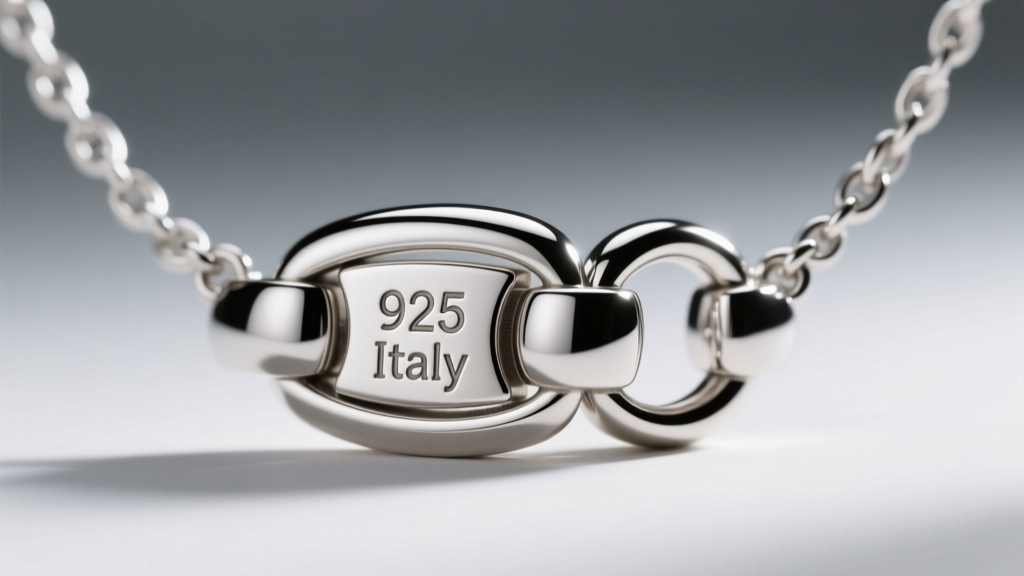
Counterfeit silver jewelry is rampant in the global market. A genuine Italy 925 silver necklace must adhere to the strict hallmarking laws outlined in Italian Legislative Decree 251/1999. When inspecting a chain, look for the following specific stamps, usually located on a flat tag near the lobster clasp:
The Standard Marks
- The Millesimal Fineness: The number 925 enclosed in an oval or stamped plainly, indicating 92.5% pure silver.
- The Origin Mark: The word ITALY or MADE IN ITALY. (Note: 'Italy' alone is sometimes used by foreign manufacturers exploiting loopholes; true authenticity requires the maker's mark).
The Italian Maker's Mark (Il Marchio del Fabbricante)
This is the ultimate proof of origin. Italian law requires registered silversmiths to stamp a unique polygonal (lozenge) mark containing a number and a two-letter provincial code. For example, a stamp reading 123 VI indicates the 123rd registered silversmith in the province of Vicenza, a city globally renowned for its gold and silver chain manufacturing. If your necklace lacks this specific geometric maker's mark, it was likely mass-produced overseas and merely stamped with 'Italy' for marketing purposes.
Pricing Tiers and What You Are Actually Paying For
Understanding the pricing structure of an Italy 925 silver necklace requires separating the melt value from the craftsmanship premium. As of early 2026, the spot price of silver hovers around $25 to $30 per troy ounce. Therefore, the raw silver value of a standard 20-gram chain is roughly $16 to $19.
However, retail prices for authentic Italian chains typically range from $85 to $250 for that same 20-gram piece. This markup is not arbitrary; it accounts for:
- Diamond-Cutting: Italian artisans use precision CNC machines to diamond-cut the facets of the silver links, creating a reflective brilliance that mimics gemstones. This process results in a 5-10% material loss due to filing and requires expensive, specialized machinery.
- Anti-Tarnish Treatments: E-coating or rhodium plating adds significant overhead to the manufacturing process.
- Labor and Overhead: Manufacturing in the Vicenza or Arezzo districts of Italy involves strict labor laws, union wages, and high environmental compliance costs for chemical runoff from the polishing stages.
If you find an 'Italy 925' chain selling for $25, it is almost certainly a hollow-core, laser-welded chain manufactured in Asia, bearing a fraudulent stamp. Genuine solid-link Italian chains possess a distinct, heavy drape and a resonant 'clink' when dropped on a glass surface.
Care Protocols for Long-Term Luster
Proper maintenance of a sterling silver necklace requires abandoning common household myths. Never use toothpaste to polish silver; modern toothpaste contains hydrated silica, which has a Mohs hardness of 6 to 7. This will inflict microscopic scratches on the silver (Mohs 2.5), permanently dulling the diamond-cut facets.
Expert Tip: For heavy, black silver sulfide tarnish, utilize an electrochemical reduction bath. Line a glass bowl with aluminum foil (shiny side up), place the silver chain on the foil, and add one tablespoon of baking soda and a cup of boiling water. The sulfur will chemically transfer from the silver to the aluminum foil in seconds, restoring the silver without removing any base metal.
For routine maintenance, simply wipe your Italy 925 silver necklace with a 100% untreated cotton flannel cloth after wearing it. This removes the microscopic layer of skin oils and environmental sulfur before it has the opportunity to bond with the copper alloy. Store the piece in an airtight polyethylene bag with a 3M anti-tarnish strip to absorb ambient sulfur gases.
Final Verdict: Is Italian 925 Worth the Investment?
An authentic Italy 925 silver necklace remains one of the most balanced investments in the jewelry market. It bridges the gap between the untarnishable but intrinsically worthless nature of stainless steel, and the prohibitively expensive realm of solid 18k gold. By understanding the metallurgical realities, verifying the lozenge-shaped Italian maker's mark, and employing proper electrochemical cleaning methods, you ensure that your sterling silver chain will retain its structural integrity and brilliant luster for decades. For those seeking heirloom-quality craftsmanship without the precious metal premium, genuine Italian sterling is unmatched.
For further reading on precious metal standards and alloy compositions, consult the metallurgical resources provided by Rio Grande, a leading supplier of jewelry-making materials and technical guides.


