Japan Necklace Guide: Mokume-Gane & Metalwork Techniques
Explore the metallurgy of the authentic Japan necklace. A technical deep dive into mokume-gane forging, alloy patinas, and Yamanashi chain precision.

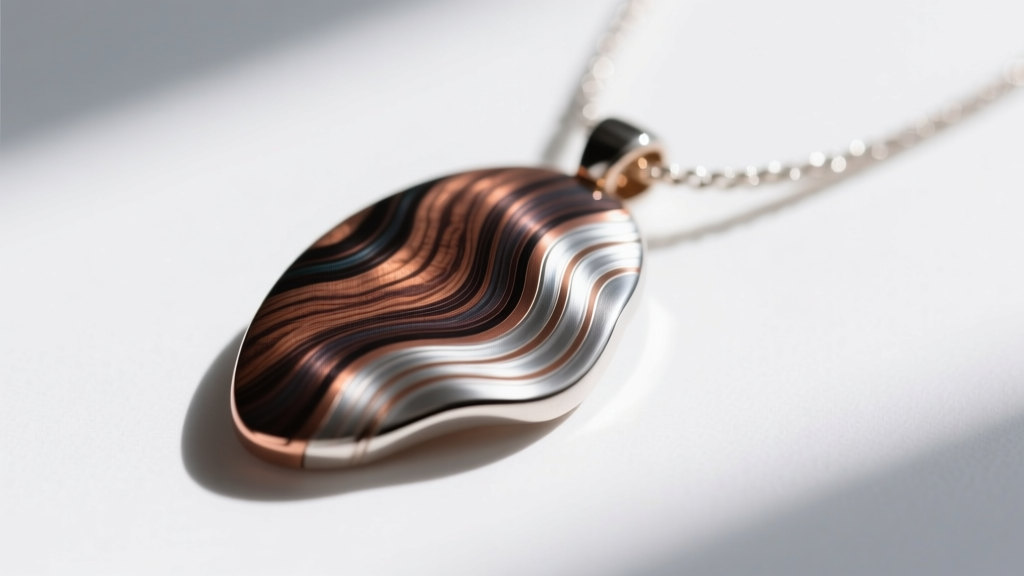
The Metallurgical Lineage of the Japan Necklace
When collectors and jewelers refer to an authentic Japan necklace, they are rarely talking about a simple geographic origin. Instead, the term denotes a specific lineage of metallurgical discipline that traces its roots directly to Edo-period sword-making techniques, later adapted for high-end jewelry. Unlike Western jewelry traditions that heavily rely on casting and soldering, traditional Japanese metalwork emphasizes solid-state diffusion bonding, precise alloy formulation, and chemical patination. Today, this heritage is most visibly expressed in mokume-gane (wood-grain metal) pendants paired with high-precision chains manufactured in the Yamanashi prefecture.
Understanding the technical specifications of these pieces is critical for buyers, appraisers, and collectors. The difference between a genuine hand-forged Japanese artifact and a mass-produced, stamped imitation lies in the atomic diffusion of the metal layers, the exact chemical composition of the alloys, and the tolerances of the chain welding.
Diffusion Bonding vs. Traditional Soldering
The foundational technique of a premium Japan necklace pendant is mokume-gane. In Western jewelry, layered metals are often joined using silver or gold solder. However, soldering introduces a foreign metal with a lower melting point, creating visible seams and structural weak points that fail during heavy forging.
Authentic Japanese mokume-gane utilizes solid-state diffusion bonding. Sheets of varying alloys—typically between 10 and 30 layers—are meticulously cleaned, stacked, and clamped under high pressure using steel plates and torque bolts. The billet is then placed in a reduction atmosphere kiln and heated to temperatures between 700°C and 900°C (depending on the specific alloys). At this critical thermal threshold, the atoms of the adjacent metal sheets migrate across the boundary, fusing into a single, continuous block of metal without melting. This creates a bond that is as strong as the parent metals, allowing the jeweler to carve, twist, and forge the billet to reveal the internal 'wood-grain' patterns without the risk of delamination.
Common Failure Modes in Improper Bonding
- Delamination: Occurs if the kiln atmosphere contains oxygen, causing microscopic oxidation layers that prevent atomic migration.
- Alloy Bleed: Heating the billet past the eutectic point of the lowest-melting alloy (often the silver or gold layers) causes the metal to liquefy and bleed out of the billet, ruining the layer distinctness.
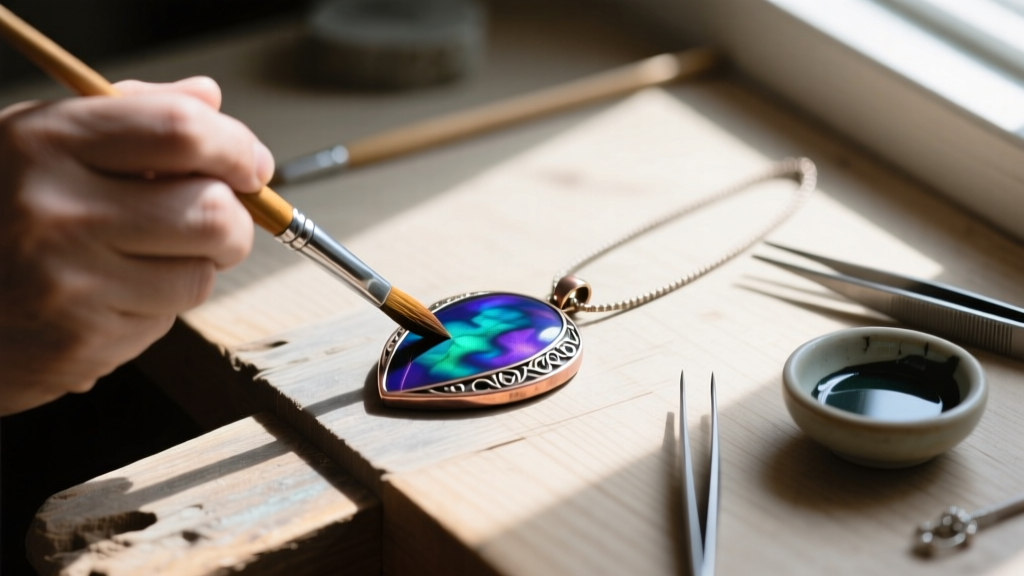
Traditional Alloys: Shakudo, Shibuichi, and Kuromido
The visual contrast in a Japan necklace is not achieved through plating or enameling, but through the use of proprietary irogane (colored metals). These are specific copper-based alloys engineered to react uniquely to chemical patination. According to the Metropolitan Museum of Art's Japanese Metalwork archives, the precise ratios of these alloys have been guarded by artisan families for centuries.
| Alloy Name | Composition (Approx.) | Pre-Patina Color | Post-Patina (Rokusho) Color |
|---|---|---|---|
| Shakudo | 96% Copper, 4% Gold | Pale Pink/Copper | Deep Blue-Black / Raven |
| Shibuichi | 75% Copper, 25% Silver | Pale Grey | Olive Green / Grey-Brown |
| Kuromido | 99% Copper, 1% Arsenic (Historical) | Copper | Dark Copper-Black |
| Yamagane | 60% Copper, 35% Zinc, 5% Lead | Brass/Yellow | Warm Brown / Gold-Bronze |
Note: Modern Kuromido formulations replace toxic arsenic with trace amounts of nickel or rely on pure copper treated with specific sulfur compounds to achieve the black finish safely.
The Patination Process: Rokusho Chemistry
Once the mokume-gane billet is carved into a pendant for the Japan necklace, it must be patinated. The traditional Japanese chemical bath is called rokusho. This is not a simple acid dip; it is a complex, boiling copper acetate solution.
The standard rokusho recipe consists of:
- Copper acetate (verdigris) - 6 parts
- Copper sulfate - 2 parts
- Alum - 1 part
- Distilled water - 100 parts
Before immersion, the pendant is boiled in a mild daikon radish broth. The natural enzymes and mild acids in the radish neutralize surface impurities and prepare the copper matrix. The pendant is then submerged in the boiling rokusho bath. The gold in the shakudo does not react to the solution, but it catalyzes the oxidation of the copper, resulting in the signature velvety blue-black finish. The process requires constant monitoring; leaving the piece in the bath for even 60 seconds too long can result in a flaky, unstable oxide layer that will eventually rub off against the wearer's skin.

Precision Chain Manufacturing in Yamanashi
A masterwork pendant requires an equally precise chain. The Yamanashi prefecture is the undisputed epicenter of Japanese precious metal chain manufacturing, producing chains with tolerances that rival Swiss watchmaking. While a standard Italian box chain might feature link wire gauges of 1.0mm with visible solder seams, high-end Japanese chains often utilize wire gauges as fine as 0.3mm to 0.8mm.
Laser Welding Tolerances
Modern Yamanashi manufacturers utilize Nd:YAG laser welding to close chain links. Unlike torch soldering, which requires flux and leaves microscopic glassy residues that can trap skin oils and cause localized corrosion, laser welding fuses the parent metal instantly. The Santa Fe Symposium on jewelry manufacturing technology has frequently highlighted Japanese laser-welding techniques for achieving weld joints under 0.2mm in diameter. This results in a chain that is entirely seamless, highly flexible, and immune to the 'kinking' failure mode common in soldered micro-chains.
Pricing Framework: Hand-Forged vs. Stamped
When shopping for a Japan necklace, consumers must be able to differentiate between authentic artisan work and commercial approximations. The market is currently flooded with 'mokume-patterned' necklaces that are actually cast from a single alloy and chemically etched, or stamped from pre-laminated industrial sheets.
- Mass-Produced / Stamped ($45 - $150): These pieces use industrial roll-bonded copper/brass sheets. The pattern is stamped via hydraulic press. They lack the depth, twist-forging, and traditional irogane alloys. Patina is often applied via electroplating rather than chemical oxidation.
- Bench-Jeweler Forged ($600 - $1,200): Hand-forged by independent artisans using traditional diffusion bonding, but potentially utilizing modern, non-traditional alloys (like titanium and zirconium) for durability.
- Master Artisan / Living National Treasure Lineage ($2,500 - $8,000+): Fully hand-forged using strict Shakudo and Shibuichi compositions, finished with traditional rokusho, and paired with Yamanashi laser-welded precious metal chains. These are investment-grade wearable artifacts.
Care and Maintenance of Patinated Copper Alloys
The greatest vulnerability of a traditional Japan necklace is its patina. The blue-black and olive-grey finishes are essentially controlled layers of copper oxidation. They are susceptible to disruption by modern environmental factors.
What to Avoid:
- Ultrasonic Cleaners: The high-frequency cavitation will physically strip the delicate oxide layer from the shakudo, leaving it patchy and raw.
- Acidic Skin pH & Cosmetics: Highly acidic sweat, perfumes, and lotions will slowly dissolve the patina. Over years of wear, the high-contact areas (like the bail and the back of the pendant) will naturally revert to their pre-patina copper/pink hues.
- Silver Dip Solutions: Commercial silver cleaners contain thiourea and strong acids that will instantly ruin the irogane patinas, causing irreversible pitting.
Proper Maintenance: Clean the necklace only with a soft, dry microfiber cloth. If the chain requires degreasing, detach the pendant and wash only the Yamanashi chain in warm water with a drop of pH-neutral dish soap. For the pendant itself, occasional, gentle wiping with a cloth lightly dampened with pure mineral oil can help seal the surface and slow down environmental oxidation without altering the optical qualities of the wood-grain metal.


