Decoding the JCM 925 Necklace: Silver Alloys & Care
Discover the material properties of a JCM 925 necklace. We compare sterling silver alloys, decode hallmarks, and share expert care tips for longevity.

What Does the JCM 925 Hallmark Actually Mean?
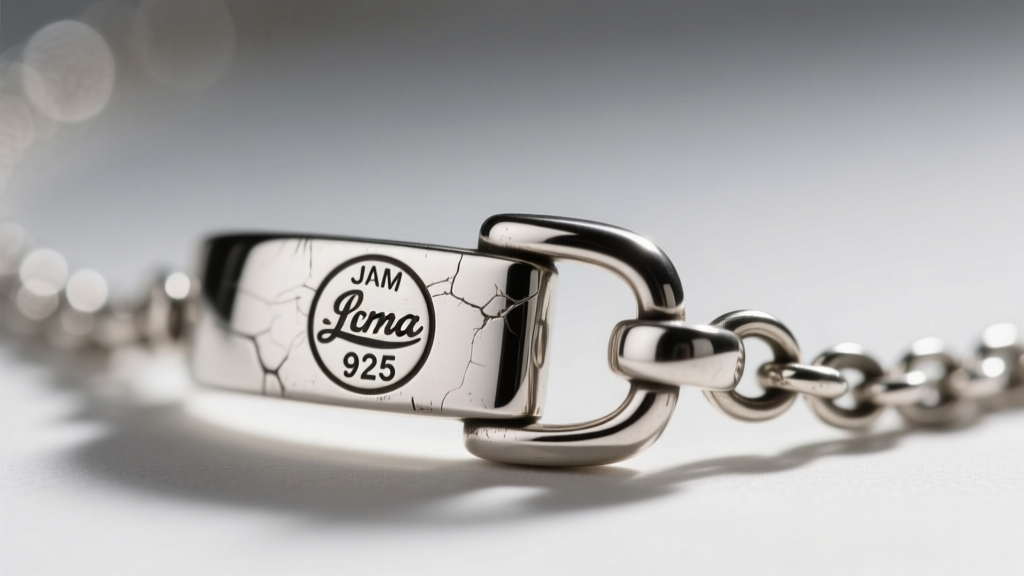
When evaluating estate, vintage, or contemporary silver jewelry, encountering a JCM 925 necklace is a common experience for serious collectors and everyday wearers alike. To understand the value and material properties of this piece, we must first deconstruct the hallmark. The '925' stamp is the universal millesimal fineness mark for sterling silver, indicating that the alloy consists of exactly 92.5% pure silver and 7.5% secondary metals—most commonly copper.
The 'JCM' prefix is a maker's mark. Historically, JCM has been associated with several mid-to-late 20th-century American jewelry manufacturers, including specific in-house lines produced for major retailers like J.C. Penney, as well as independent silversmiths operating under the Jewelry Crafters Mark registry. According to the Federal Trade Commission (FTC) guidelines on precious metals, a maker's mark must be registered and stamped alongside the quality mark to ensure accountability for the alloy's purity. Therefore, a JCM 925 stamp guarantees that the manufacturer legally stood behind the sterling silver composition of the necklace at the time of its assay and sale.
Metallurgical Breakdown: Why 92.5% is the Sweet Spot
Pure silver (999 fine silver) possesses a stunning luster but is metallurgically unsuited for functional necklaces. On the Vickers Hardness (HV) scale, pure silver scores a mere 25 HV, making it as soft as heavy gauge lead. If a necklace chain were crafted from 999 silver, the links would stretch, warp, and snap under the mere weight of a pendant.
By alloying 92.5% silver with 7.5% copper, the resulting sterling silver achieves a Vickers Hardness of approximately 70 HV in its annealed state, and up to 130 HV when work-hardened during the wire-drawing and link-forming processes. This specific ratio provides the optimal balance between the hypoallergenic, lustrous properties of silver and the tensile strength required for daily wear. As noted by The Silver Institute, this 7.5% copper addition is what makes sterling silver a viable material for complex chain weaves and secure clasp mechanisms.
Material Comparison Chart
| Material | Composition | Hardness (HV) | Tarnish Rate | Best Chain Application |
|---|---|---|---|---|
| 999 Fine Silver | 99.9% Ag | 25 HV | Very Low | Bezel wire, non-load-bearing |
| 925 Sterling (JCM) | 92.5% Ag, 7.5% Cu | 70-130 HV | Moderate | Cable, Curb, Figaro chains |
| Argentium 935 | 93.5% Ag, Cu, Ge | 85-140 HV | Very Low | Intricate weaves, welding |
| 316L Stainless | Fe, Cr, Ni, Mo | 150-190 HV | None | Heavy pendants, curb links |
Tarnish, Oxidation, and the Copper Factor
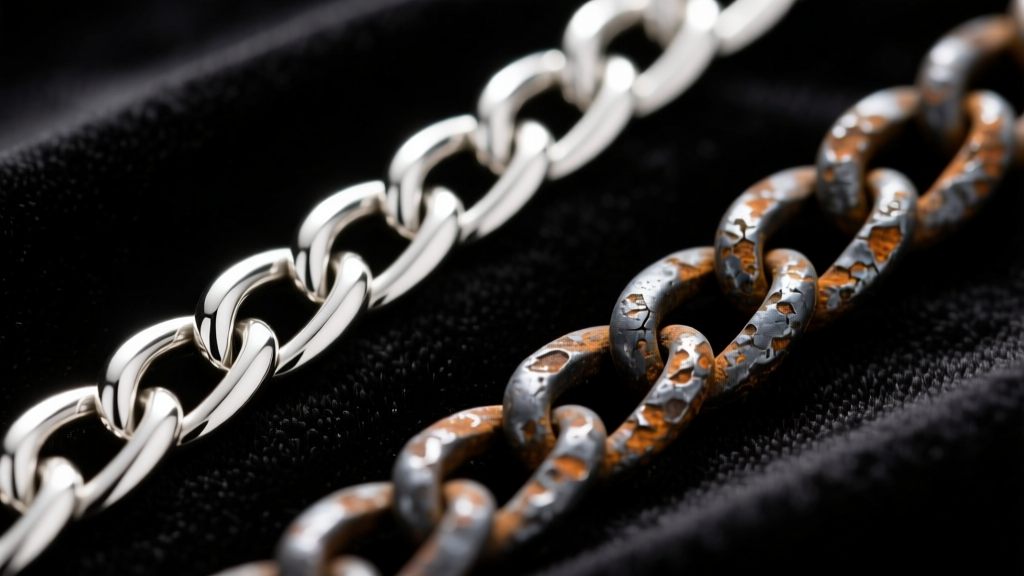
The primary vulnerability of any JCM 925 necklace is tarnish. While pure silver does not readily oxidize in normal atmospheric conditions, the 7.5% copper in the alloy is highly reactive. When exposed to hydrogen sulfide and sulfur dioxide in the air, the copper and silver react to form silver sulfide (Ag2S) and copper sulfide (CuS), which manifest as a dull yellow film that eventually deepens into a black crust.
This chemical reaction is accelerated by environmental factors. High humidity, exposure to cosmetics, perfumes, and even the natural pH and sulfur content of the wearer's sweat can drastically increase the tarnish rate. A JCM necklace worn daily against the skin may actually tarnish slower than one left sitting in a humid bathroom, as the gentle friction of clothing and skin oils can mechanically polish the surface and delay sulfide buildup.
Rhodium Plating: The Modern Shield
Many modern and late-vintage JCM 925 necklaces are treated with a flash plating of rhodium, a platinum-group metal. This layer is typically between 0.75 and 1.0 microns thick. Rhodium is completely impervious to sulfur-based tarnish and provides a brilliant, cool-white reflectivity that mimics white gold. However, on high-friction areas like the clasp and the links resting against the collarbone, this microscopic layer will eventually wear away, exposing the underlying 925 alloy to the elements once more.
Chain Link Mechanics and Alloy Stress
The 925 sterling alloy behaves differently depending on the chain style manufactured by JCM. Understanding these mechanical stress points is crucial for longevity:
- Cable and Curb Chains: These round or oval links distribute tension evenly. The work-hardening process during manufacturing makes these links highly resistant to stretching, making them the most durable choice for heavy pendants.
- Herringbone and Snake Chains: These flat, flush-linked chains are notoriously fragile in 925 silver. Because the links lack structural rigidity and rely on a tight, interlocking matrix, a single kink permanently work-hardens that specific spot, leading to a brittle fracture. Never sleep in a 925 herringbone chain.
- Box Chains: The square, folded links of a box chain offer excellent tensile strength but can suffer from 'link gapping' over time if the silver is subjected to repetitive pulling, as the folded corners slowly unfold under stress.
Authentication and Real-World Testing
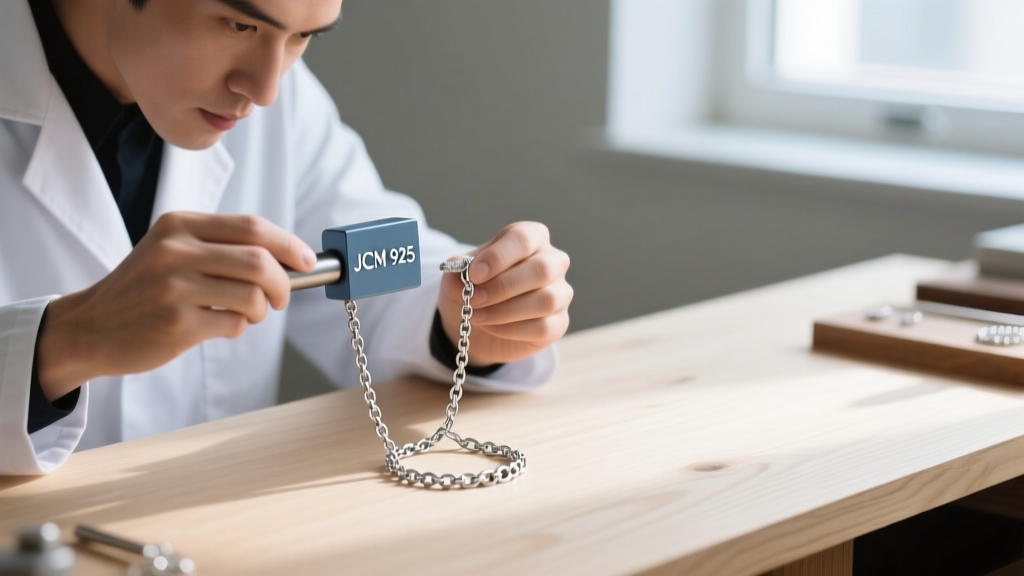
If you are evaluating a JCM 925 necklace for purchase or authentication, rely on material science rather than visual inspection alone. Counterfeiters frequently stamp base metals with fake hallmarks. Here are two non-destructive tests utilized by jewelers:
The Diamagnetic Test
Silver is diamagnetic, meaning it actually creates a very weak, opposing magnetic field when exposed to a magnet. If you slide a strong neodymium magnet down a 45-degree angled JCM silver chain, it should slide slowly, as if moving through a viscous fluid, due to the Lenz's law eddy currents generated in the metal. If the chain sticks to the magnet or drops instantly, it contains ferromagnetic metals like iron or nickel and is not solid 925 silver.
The Thermal Conductivity Test
Silver possesses the highest thermal conductivity of any common metal, measuring at an impressive 429 W/(m·K). If you place an ice cube on the pendant or a thick link of the necklace at room temperature, the silver will rapidly draw heat from the surrounding air and transfer it to the ice. The ice should begin melting almost instantaneously, and the silver itself will become painfully cold to the touch within seconds. Base metals and stainless steel lack this extreme thermal transfer rate.
Expert Care and Maintenance Protocols
To maintain the structural integrity and luster of your JCM 925 necklace, avoid ultrasonic cleaners if the piece features porous gemstones (like turquoise or opals) or intentional oxidized detailing. For general cleaning, use a liquid silver dip containing thiourea, which chemically reverses the silver sulfide reaction without removing base metal. Follow this with a mechanical polish using a treated jeweler's rouge cloth to restore the microscopic surface scratches and bring the alloy back to a mirror finish. Store the piece in an airtight anti-tarnish bag with a silica gel desiccant to halt atmospheric sulfur exposure.
Final Verdict on JCM 925 Silver Durability
A JCM 925 necklace represents a highly functional, historically significant intersection of American jewelry manufacturing and classic metallurgy. While it requires more environmental management than stainless steel or platinum, the 92.5/7.5 silver-copper alloy provides an unmatched warmth, reflectivity, and skin-compatibility that synthetic or base metals simply cannot replicate. By understanding the specific stress points of your chain style and managing the copper-driven oxidation process, a well-made JCM sterling piece will easily outlast its original owner.


