Beyond got jesus on my necklace lyrics: Faith Pendant Tech Guide
Explore the technical craftsmanship behind faith jewelry referenced in rap lyrics, from diamond pavé settings to heavy gold chain pairings.

The Intersection of Faith, Culture, and High Jewelry
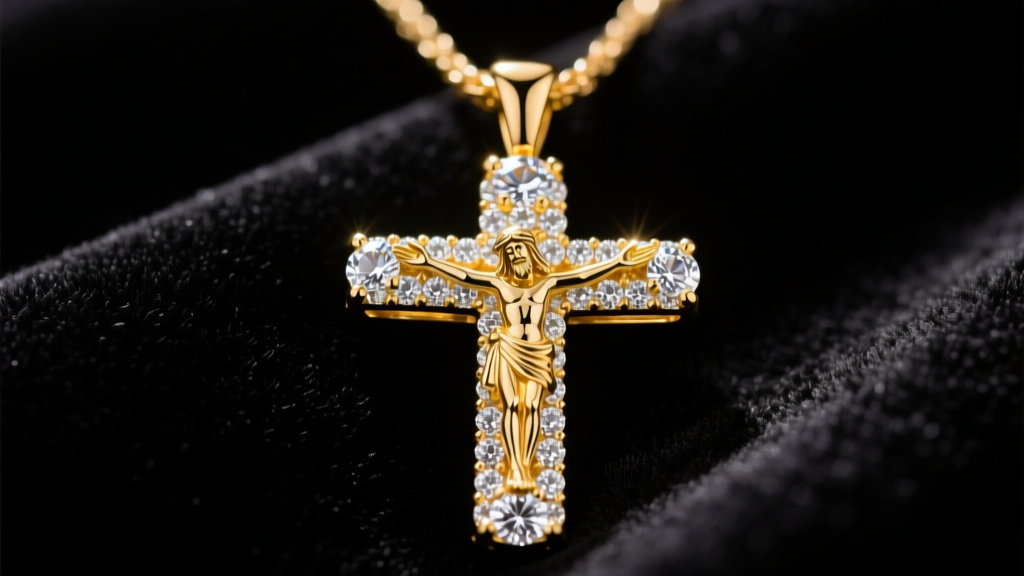
When fans and collectors search for got jesus on my necklace lyrics, they are rarely just looking for a song's verse; they are tapping into a profound cultural movement where faith, streetwear, and high-end jewelry collide. The "Jesus Piece" has evolved from a niche religious artifact into a staple of hip-hop horology and fine jewelry, popularized by icons like The Notorious B.I.G. and Kanye West. However, behind the cultural flex and the lyrical references lies a world of intense metallurgical engineering, gemological precision, and structural design. As a domain expert in necklace architecture, I am pulling back the curtain on what it actually takes to manufacture, set, and maintain a high-end faith pendant in 2026.
Technical Anatomy of a High-End Faith Pendant
Creating a luxury religious medallion or 3D Jesus piece is not a simple casting job. It requires a mastery of base metals, alloy tensile strength, and microscopic stone setting. The pendant must support its own weight while serving as a canvas for hundreds of precision-cut diamonds.
Base Metals and Karat Configurations
The foundation of any premium pendant is its gold alloy. While 24k gold is pure, it is far too malleable for jewelry that will be worn daily and subjected to the tension of diamond prongs. Jewelers typically rely on two specific configurations:
- 14k Gold (58.5% Pure Gold): The industry standard for heavy, iced-out pendants. The higher concentration of alloy metals (like zinc, copper, and silver) increases the tensile strength, ensuring that micro-prongs do not bend or snap under stress.
- 18k Gold (75% Pure Gold): Preferred for its richer, deeper yellow hue and hypoallergenic properties. However, 18k gold is softer. If an 18k Jesus piece is heavily iced, the jeweler must use thicker bezel walls and reinforced hidden bails to prevent structural warping over time.
Stone Selection and Micro-Pavé Engineering
The "ice" on a faith pendant is typically composed of melee diamonds—small stones ranging from 0.01 to 0.02 carats each. According to the Gemological Institute of America (GIA), grading melee diamonds is complex because they are often sold in parcels. For a high-tier pendant, jewelers select stones in the VS1 to VS2 clarity range with G-H color. This ensures the pendant appears flawlessly white to the naked eye without the exponential cost of D-flawless melee.
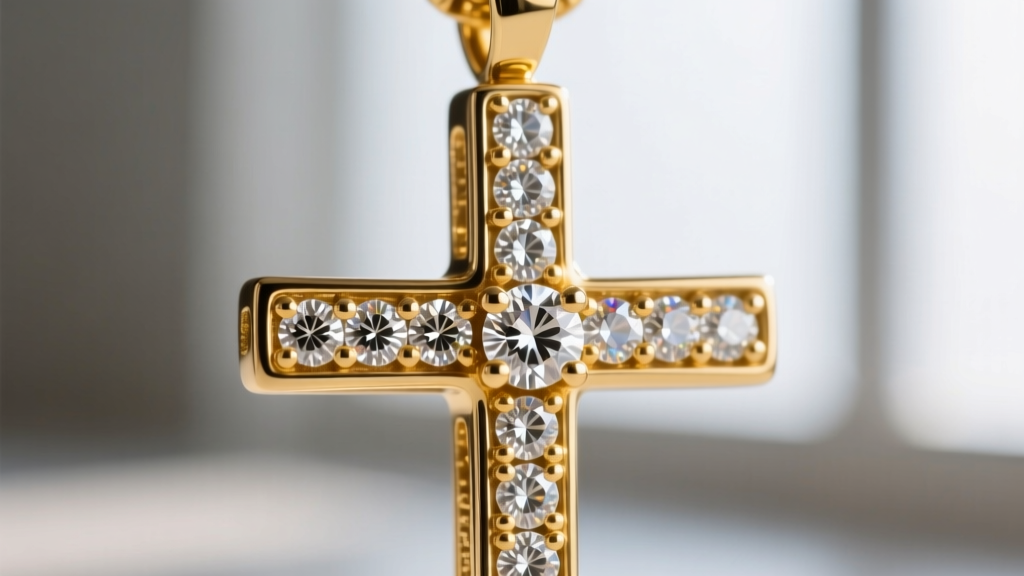
The setting technique is usually micro-pavé. Unlike traditional prong settings, micro-pavé uses tiny beads of gold raised from the base metal itself to hold the stones. This maximizes the diamond surface area and minimizes the visibility of the metal, creating the illusion of a solid surface of light. For larger accent stones (such as the crown of thorns or a halo), bezel settings are employed to protect the girdle of the diamond from chipping against the gold framework.
Chain Pairing: Gauge, Weight, and Clasp Mechanics
A heavy faith pendant requires a chain that can handle dynamic load. The most common failure point in necklace mechanics is the bail (the loop connecting the pendant to the chain) or the chain's clasp. When pairing a chain with a heavy pendant, you must calculate the pendant's weight and match it with a chain that has a high tensile yield.
Chain Specifications and Weight Capacities
| Chain Style | Ideal Width / Gauge | Tensile Capacity | Best Pendant Type |
|---|---|---|---|
| Cuban Link | 10mm - 14mm | High (150g+) | Heavy 3D Jesus Pieces, Large Crucifixes |
| Rope Chain | 8mm - 12mm | Medium (90g) | Flat Medallions, Saint Christopher Medals |
| Figaro Chain | 6mm - 8mm | Low (50g) | Lightweight Enamel Pendants, Small Crosses |
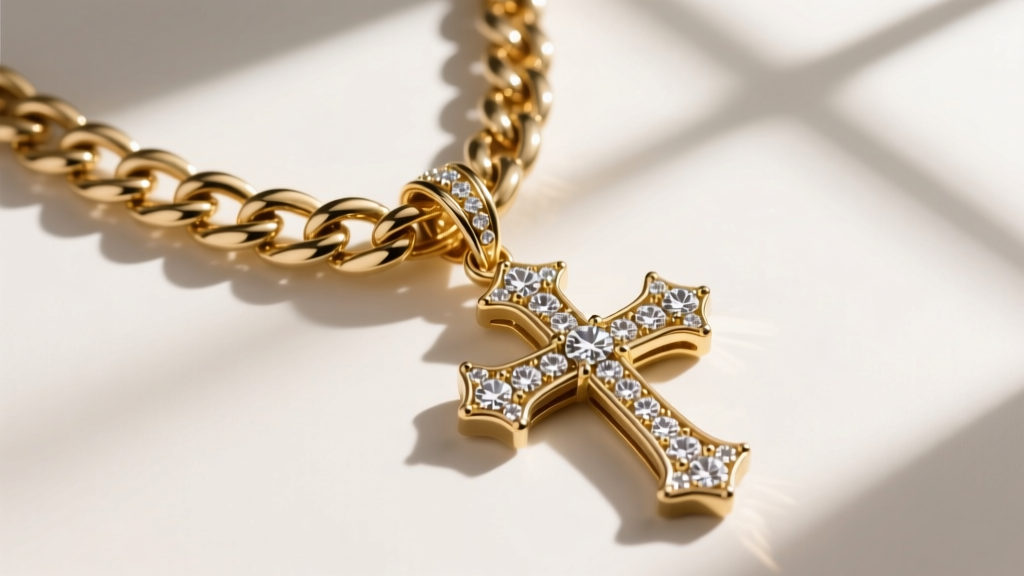
The Bail Rule: If you are threading a 12mm Cuban link chain through a pendant, the inner diameter of the pendant's bail must be at least 14mm to 16mm. A tight bail causes friction, wearing down both the chain links and the bail itself, eventually leading to catastrophic metal fatigue and a lost pendant.
Manufacturing Methods: Lost-Wax Casting vs. CNC Milling
How is a 3D Jesus piece actually brought to life? In 2026, the industry relies on a hybrid approach combining digital precision with ancient metallurgical techniques.
Step 1: CAD Modeling
Every high-end pendant begins in CAD software like MatrixGold. The designer sculpts the facial contours, the texture of the hair, and the folds of the garments in a 3D digital space. This step is critical for calculating the exact gram weight of the final piece. A solid 14k gold Jesus piece can easily exceed 80 grams; hollowing out the back (creating a "semi-solid" piece) reduces the weight to a more wearable 35 grams while maintaining the structural integrity of the face.
Step 2: Lost-Wax Casting
The CAD file is sent to a 3D wax printer. The wax model is then encased in a plaster-like investment material and placed in a kiln. As the JCK Jewelry Industry Portal frequently notes in their manufacturing deep-dives, the wax melts away (hence "lost-wax"), leaving a perfect negative cavity. Molten 14k gold, heated to approximately 1,550°F (843°C), is forced into the cavity using a centrifugal or vacuum casting machine. This method captures microscopic details, such as the individual thorns on a crown, that CNC milling simply cannot achieve on a 3D axis.
"The Jesus piece is more than an accessory; it is a modern relic. The craftsmanship required to set 400 micro-diamonds into a 3D gold cast without compromising the structural integrity of the facial features is a masterclass in modern metallurgy."
Maintenance and Prong Tightening for Iced-Out Pendants
Faith pendants, especially those worn daily and layered over streetwear, endure significant environmental and physical stress. Sweat, lotions, and the friction of clothing can degrade the metal and loosen settings over time.
Cleaning Protocols
While ultrasonic cleaners are excellent for removing trapped oils from the pavilion (bottom) of the diamonds, they can be dangerous if the pendant features fracture-filled diamonds or delicate enamel work. The high-frequency vibrations can shatter treated stones or chip enamel. The safest method for cleaning an iced-out Jesus piece is a soft-bristled toothbrush, warm distilled water, and a few drops of ammonia-free dish soap, gently agitating the surface and drying with a microfiber cloth.
Routine Prong Inspections
Because micro-pavé relies on microscopic beads of gold, a single snag on a heavy cotton hoodie can lift a prong. Owners of high-end faith pendants should have a jeweler inspect the piece under a 10x loupe every six months. The jeweler will use a burnishing tool to push the metal beads back over the girdle of the diamonds, securing them before they fall out. Neglecting this maintenance is the primary reason vintage hip-hop jewelry loses its original brilliance and value on the secondary market.
Final Thoughts on Faith Jewelry Engineering
The cultural impact of faith pendants in music and fashion is undeniable, immortalized in countless verses and lyrics. But as collectors and enthusiasts know, the true value of these pieces lies beneath the surface. From the precise alloy mixtures and CAD-weight distribution to the meticulous micro-pavé setting and heavy-duty bail engineering, a luxury Jesus piece is a triumph of modern jewelry manufacturing. Whether you are investing in a custom 18k gold crucifix or a fully iced 3D medallion, understanding the technical specifications ensures your pendant will remain a lasting legacy, both culturally and structurally.