Karat Gold Necklace Metallurgy: Chain Durability & Alloy Guide
Explore the metallurgy of a karat gold necklace. Compare 10k, 14k, 18k, and 22k alloys, Vickers hardness, chain durability, and structural repair limits.

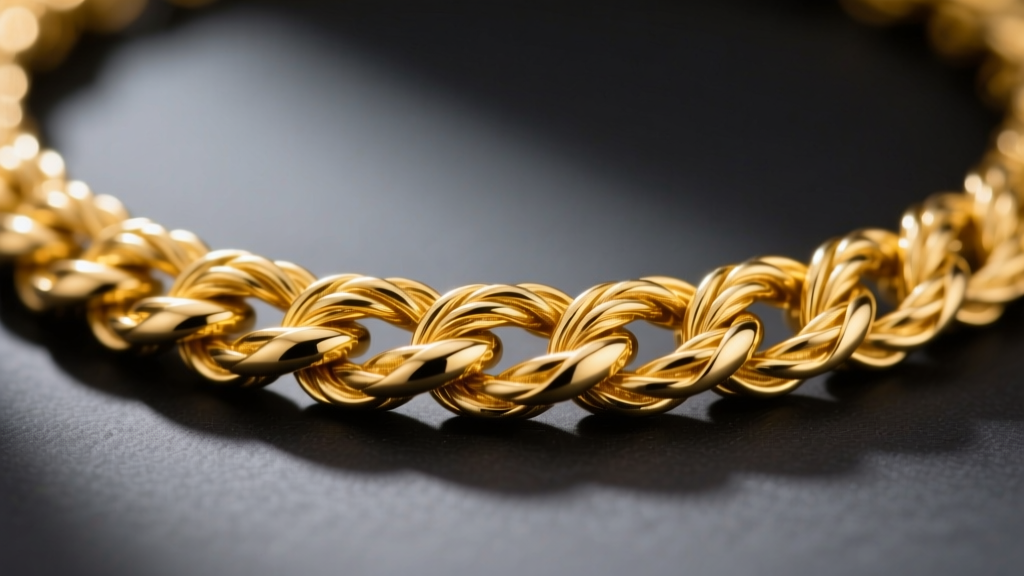
The Science of Gold Alloys: Why Pure Gold Fails as a Chain
When evaluating a karat gold necklace, most consumers focus exclusively on color and price. However, from a metallurgical perspective, the karat system is a precise measurement of structural integrity, tensile strength, and environmental resistance. Pure 24-karat gold (99.9% Au) possesses a Vickers Hardness (HV) of roughly 25, making it as soft as lead. A 24k gold chain will stretch, deform, and eventually snap under the sheer weight of its own links or a modest pendant.
To engineer a durable necklace, gold must be alloyed with secondary metals. The specific combination of copper (Cu), silver (Ag), zinc (Zn), and sometimes palladium (Pd) or nickel (Ni) dictates the chain's mechanical properties. Copper increases tensile strength and introduces a rose hue, while silver enhances ductility and maintains a yellow tone. Zinc acts as a crucial deoxidizer during the casting and drawing processes, preventing porosity in the final wire used for chain links.
Vickers Hardness and Tensile Strength
The durability of a karat gold necklace is best measured by its Vickers Hardness (HV) and Ultimate Tensile Strength (UTS) in Megapascals (MPa). As the gold content decreases, the alloy matrix becomes denser and more resistant to shear stress. According to the Gemological Institute of America (GIA), the transition from 18k to 14k gold represents a significant leap in structural durability, which is why 14k remains the industry standard for complex, high-stress chain architectures like rope or box chains.
Karat Gold Necklace Comparison Matrix
The following matrix breaks down the exact metallurgical specifications for the most common gold alloys used in fine jewelry chain manufacturing. Note how tensile strength inversely correlates with gold purity.
| Karat | Au % | Primary Alloy Metals | Vickers Hardness (HV) | Tensile Strength (MPa) | Tarnish & Corrosion Risk |
|---|---|---|---|---|---|
| 22k | 91.6% | Copper, Silver | 60 - 75 | ~250 | Very Low |
| 18k | 75.0% | Copper, Silver, Zinc | 120 - 135 | ~450 | Low |
| 14k | 58.5% | Copper, Silver, Zinc | 140 - 160 | ~600 | Moderate |
| 10k | 41.7% | Copper, Zinc, Nickel | 170 - 190 | ~750 | High |
Chain Construction: Matching Karat to Link Architecture
The physical geometry of a chain dictates which karat gold alloy is required to prevent premature failure. A chain's architecture determines how stress is distributed across the individual links.
High-Stress Links: Rope and Box Chains
Rope chains are constructed by twisting multiple smaller links together, creating inherent sheer stress points at the twist junctions. Box chains rely on interlocking square links that bear weight on flat, planar surfaces. Because these designs concentrate mechanical stress, they demand high tensile strength. A rope chain crafted in 18k or 22k gold is highly susceptible to micro-fractures at the twist points. For these architectures, a 14k karat gold necklace is the optimal choice, providing the necessary 600+ MPa tensile strength to resist snapping when subjected to sudden kinetic shocks (e.g., the chain catching on clothing).
Surface-Dependent Links: Herringbone and Snake Chains
Herringbone and snake chains are composed of tightly packed, flat, or micro-linked segments designed to create a continuous, fluid surface. Their primary failure mode is not snapping, but rather kinking and structural buckling. While 18k gold is traditionally used for herringbone chains to maximize the luxurious, heavy drape, its lower Vickers Hardness means that once a kink occurs, the metal yields and work-hardens, making it nearly impossible to perfectly flatten without laser annealing. If daily durability is the priority, a 14k flat-link chain will resist initial buckling far better than its 18k counterpart.
Clasp Engineering and Karat Limitations
The clasp is the most mechanically complex component of any karat gold necklace. The alloy used for the chain body is often fundamentally incompatible with the requirements of the clasp mechanism.
- Spring Ring Clasps: The internal spring of a spring ring clasp must be made of hardened steel or a specialized beryllium-copper alloy to maintain tension. The outer shell can be 14k or 18k, but the structural catch requires a harder base metal.
- Lobster Clasps: Stamped 14k lobster clasps offer superior fatigue resistance compared to cast 18k clasps. The repetitive opening and closing of a cast 18k lever will eventually lead to metal fatigue and hinge failure due to the higher gold content's malleability.
- Box Clasps with Figure-8 Safeties: For heavy pendants on 18k or 22k chains, a standard tongue-in-box clasp will loosen over time as the gold tongue compresses. A secondary 'figure-8' wire safety, usually crafted in a stiffer 14k alloy, is mandatory to prevent catastrophic unclasping.
Environmental Degradation: Stress Corrosion Cracking
A critical, often overlooked aspect of gold chain metallurgy is environmental degradation, specifically Stress Corrosion Cracking (SCC). Lower karat alloys (10k and 14k) contain higher percentages of copper and zinc. When exposed to chlorine (in swimming pools, hot tubs, or harsh household cleaners), these base metals undergo rapid galvanic oxidation.
This oxidation targets the highest-stress areas of the necklace—namely, the solder joints and the interior curves of the links. The chlorine literally eats away the alloy matrix at the microscopic level, leading to sudden, brittle fractures. An 18k karat gold necklace is significantly more resistant to SCC due to its 75% inert gold content, but it is not entirely immune. As noted by the Birmingham Assay Office, maintaining the integrity of gold hallmarks and alloys requires strict avoidance of halogen-based chemicals, which compromise the structural lattice of copper-bearing gold alloys.
Soldering, Repairs, and Metallurgical Fatigue
When a gold chain breaks, the repair process introduces a new metallurgical variable: the solder. Gold solders are categorized by their melting points into Hard, Medium, and Easy grades.
Expert Repair Rule: Never use 'Easy' solder (melting point ~680°C) on a high-stress link of a 14k or 18k chain. Easy solder contains a higher percentage of zinc and cadmium to lower its melting point, resulting in a joint that is chemically weaker, more prone to tarnish, and visibly distinct from the surrounding chain links under UV or X-ray fluorescence (XRF) testing.
For modern repairs on fine karat gold necklaces, laser welding is vastly superior to traditional torch soldering. A laser welder uses a concentrated pulse of light to fuse the exact same karat gold wire into the broken link without requiring flux or foreign solder alloys. This preserves the original Vickers Hardness of the link and eliminates the galvanic corrosion risks associated with mismatched solder joints.
Expert Verdict: Selecting Your Alloy
Choosing the right karat gold necklace requires balancing aesthetic purity with mechanical reality. If you are investing in a heavy, complex chain like a Cuban link or a Rope chain intended for daily wear and pendant suspension, 14k gold offers the optimal intersection of rich color and sheer structural dominance. If you are purchasing a simple, low-stress cable chain or a solid herringbone for occasional, careful wear, 18k gold provides the superior luster, hypoallergenic properties, and prestige that defines true fine jewelry. Understand the metallurgy, and your chain will outlast the trends.


